What is Apache Airflow?
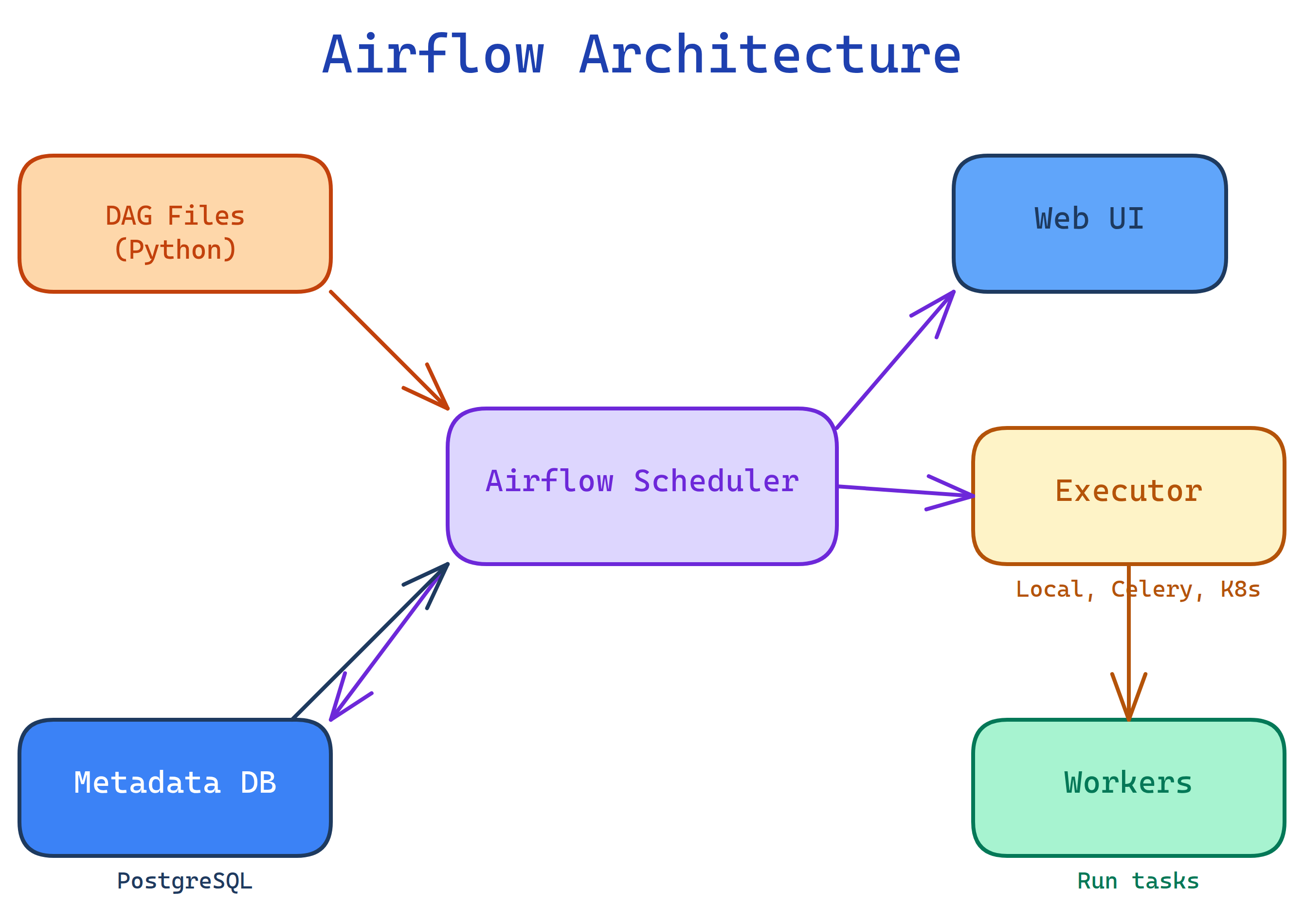
Airflow is an open-source workflow orchestrator. You define your data pipelines as Python code (DAGs), Airflow schedules and runs them, and you monitor everything through a web UI. Think of it as a smart cron job on steroids that knows about dependencies.
Airflow's XCom mechanism — used to pass data between tasks — is a common source of memory and performance issues that new users discover in production. XComs are stored in the Airflow metadata database; pushing a large DataFrame or a multi-megabyte JSON blob via xcom_push will bloat the database and slow the scheduler. The design intent is to pass small references (a file path, a table name, a row count) not actual data payloads. For larger transfers, write to intermediate storage (S3, GCS, a temp table) and push the path. The Airflow XComs documentation notes this constraint explicitly.
DAG import errors are the silent killer of Airflow stability. Any Python error during DAG file parsing — an uncaught exception at module level, a missing import — causes that DAG to be silently dropped from the scheduler. The DAG appears missing rather than failed. The Airflow DAG serialization docs explain how the scheduler processes DAG files; checking airflow dags list-import-errors should be a standard health check.
Airflow is the right tool when your pipeline has complex dependencies between tasks, conditional branching, retry logic, and scheduling requirements. If you have three sequential Python scripts that run daily, a cron job is simpler and more reliable. The operational cost of Airflow (scheduler, workers, metadata DB) only amortizes when the complexity of your workflows justifies it.
The Big Picture
Airflow orchestrates work. You tell it what to do, when to do it, and in what order.
Explain Like I'm 12
Imagine you're the manager of a factory assembly line. You have a clipboard with the order of steps: first cut the wood, then sand it, then paint it, then dry it. Some steps can happen at the same time (cutting two boards). Some must wait (can't paint before sanding).
Airflow is that clipboard — but automatic. You write the steps and their order in Python. Airflow runs them on schedule, watches for failures, retries broken steps, and shows you a dashboard of everything that's happening. You never have to stand over the assembly line again.
What is Airflow?
Apache Airflow was created at Airbnb in 2014 and became an Apache top-level project in 2019. It's the most widely used workflow orchestrator in data engineering.
Key characteristics:
- Workflows as code — DAGs are Python files, so you get version control, code review, and testing for free
- Dependency-aware — tasks run only when their upstream dependencies succeed
- Scheduled — cron-like scheduling with catchup for missed runs
- Extensible — 1000+ pre-built operators for AWS, GCP, Azure, databases, APIs, and more
- Observable — rich web UI with DAG visualizations, logs, and task history
Who is it for?
Data engineers building ETL/ELT pipelines. ML engineers orchestrating training jobs. Analytics engineers scheduling dbt runs. DevOps teams automating infrastructure tasks. Anyone who has outgrown cron jobs and needs visibility into complex, multi-step workflows.
What can Airflow do?
- ETL/ELT pipelines — extract data from APIs, transform in Spark/SQL, load to warehouse
- ML pipelines — train models, validate, deploy to production
- Data quality checks — run tests on data after each load
- Report generation — build and email reports on a schedule
- Infrastructure automation — spin up/down clusters, manage resources
- Cross-system orchestration — coordinate tasks across Spark, Kubernetes, cloud services, databases
Airflow vs Others
| Feature | Airflow | Prefect | Dagster | Cron |
|---|---|---|---|---|
| Language | Python | Python | Python | Shell |
| UI | Rich web UI | Cloud UI | Dagit UI | None |
| Dependencies | DAG-based | Flow-based | Asset-based | None |
| Retries | Built-in | Built-in | Built-in | Manual |
| Ecosystem | Largest (1000+ operators) | Growing | Growing | N/A |
| Best for | Complex pipelines at scale | Modern Python workflows | Data asset management | Simple recurring jobs |
What you'll learn
Test Yourself
What does DAG stand for?
Why is Airflow better than cron for data pipelines?
What language are Airflow DAGs written in?