What is the US Healthcare System?
The US Healthcare system is a $4.5 trillion ecosystem of payers, providers, patients, and government agencies. Unlike single-payer countries, the US uses a mix of private insurance, employer plans, and government programs (Medicare, Medicaid).
The Big Picture
The US Healthcare system is the most complex (and expensive) in the world. Here's how all the pieces connect:
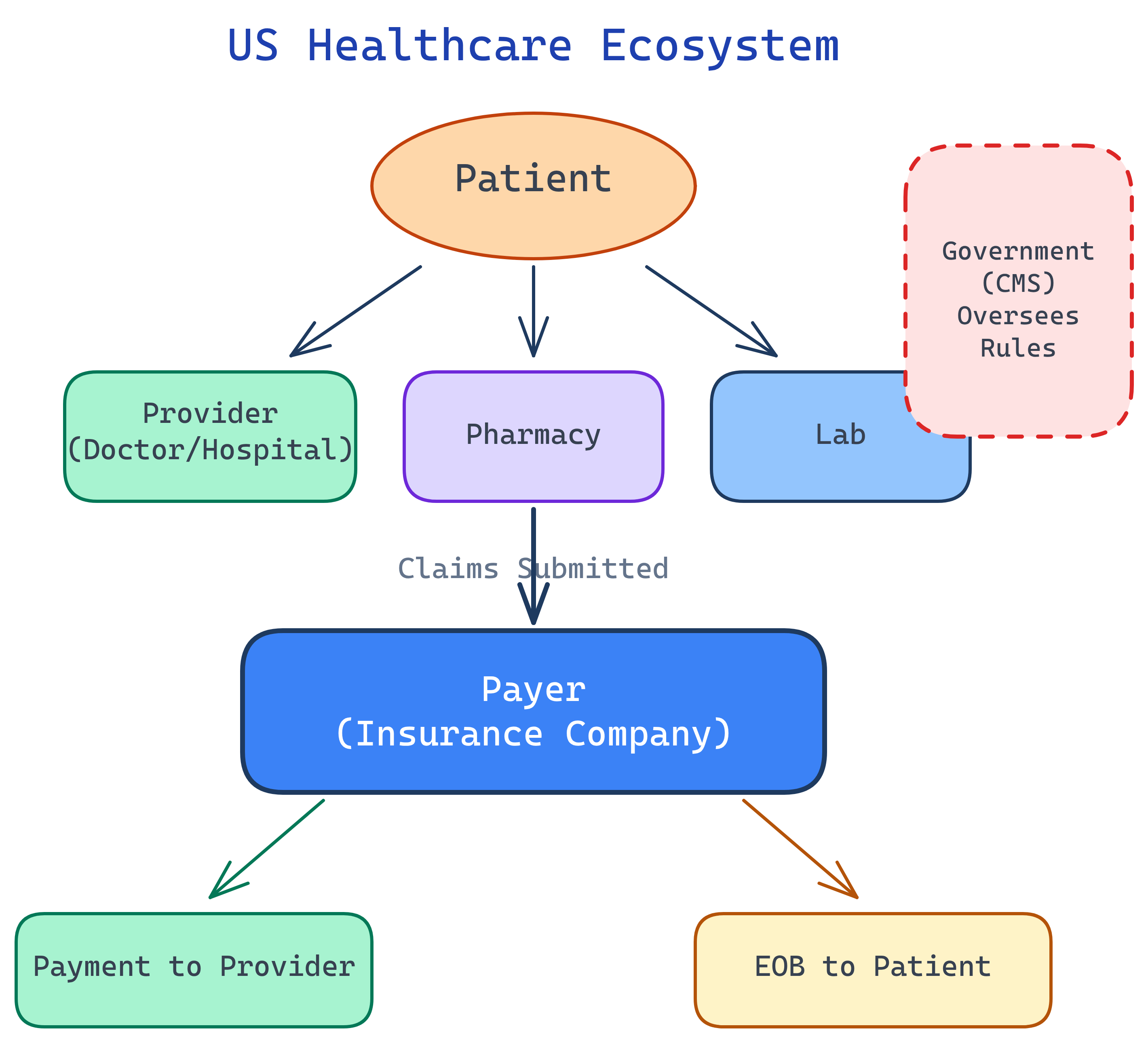
Explain Like I'm 12
Imagine your school has a nurse's office. But instead of the school paying directly, your parents pay a company (insurance) every month. When you get sick, the insurance company pays most of the doctor's bill. Now scale that to 330 million people, add government programs for grandparents (Medicare) and low-income families (Medicaid), and you have the US Healthcare system.
What is the US Healthcare System?
The US doesn't have one healthcare system — it has a patchwork of many systems running in parallel. This is called a multi-payer system. Compare that to the UK (NHS pays for everything) or Canada (single government payer) where there's one entity handling the bills.
In the US, where your health coverage comes from depends on who you are:
- Employer-sponsored insurance — About 49% of Americans get coverage through their job. The employer picks a plan (or several), and both the employer and employee pay premiums.
- Medicare — Federal program for people 65+ and certain disabled individuals. Covers about 65 million people.
- Medicaid & CHIP — Joint federal-state program for low-income families and children. Covers about 90 million people.
- ACA Marketplace — Individual plans purchased through Healthcare.gov or state exchanges. Subsidies available based on income. About 20 million enrolled.
- Uninsured — About 26 million Americans have no coverage at all.
This fragmentation is why US healthcare is so complex — and why data professionals are in high demand to make sense of it all.
Who is it for?
This topic is for anyone entering the healthcare data space. Whether you're a data analyst building dashboards for a hospital, a BI developer working with claims data, a healthcare consultant advising payers, or a software engineer building health tech products — you need to understand how the system works before you can work with its data.
Healthcare is one of the largest employers in the US, and every organization in it is drowning in data. Understanding the domain is what separates someone who can write SQL from someone who can deliver insights.
The Major Players
Six groups make the US healthcare machine run. Each one generates massive amounts of data:
How Money Flows
At its core, healthcare is a billing system. Here's the simplified claim lifecycle — the journey every dollar takes:
This cycle repeats billions of times per year. Every step generates data, and every step can go wrong. That's why healthcare analytics is such a big deal.
What You'll Learn
This topic walks you through the US Healthcare system from big picture to deep details:
Test Yourself
What are the 3 main ways Americans get health insurance?
What is the difference between Medicare and Medicaid?
What role do payers play in the healthcare system?
Why is the US system called "multi-payer"?