What is Python?
Python is a general-purpose programming language known for readable syntax, a massive ecosystem, and being the #1 language for data science, AI, web backends, and automation.
The Big Picture
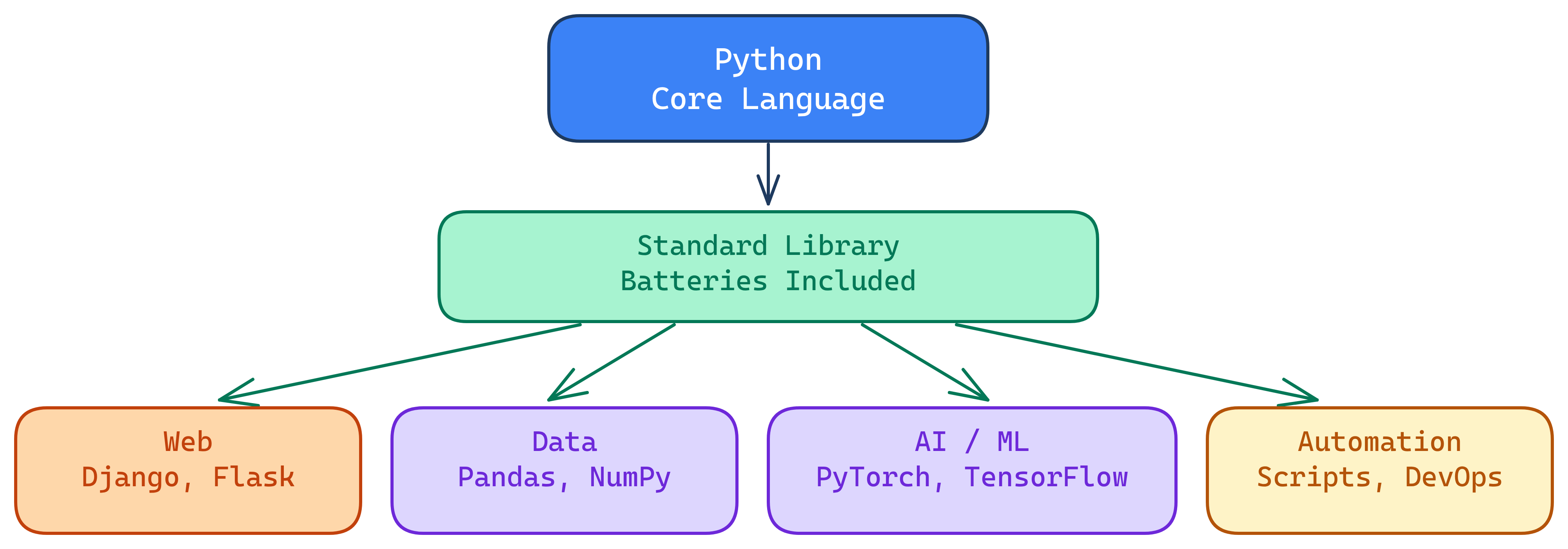
Python sits at the center of nearly every modern software domain. Here's how the ecosystem connects:
Explain Like I'm 12
Python is like English for computers. While other languages need lots of special symbols and rules (like learning Chinese), Python reads almost like a sentence. That's why it's the first language most people learn, and why everyone from Instagram's engineers to NASA's scientists uses it.
What is Python?
Python is a high-level, interpreted, general-purpose programming language created by Guido van Rossum in 1991. Its core philosophy? "There should be one obvious way to do it." Readability over cleverness, always.
Here's what makes Python different from other languages:
- Interpreted — No compilation step. Write code, run it immediately. The interpreter reads your code line by line.
- Dynamically typed — You don't have to declare variable types. Write
x = 42and Python figures out it's an integer. - Batteries included — Python ships with a massive standard library. File I/O, HTTP requests, JSON parsing, regular expressions, databases — all built in, no extra installs needed.
- Indentation is syntax — Instead of curly braces, Python uses whitespace to define code blocks. This forces clean, readable code.
- #1 on TIOBE index — The most popular programming language in the world, ahead of C, Java, and JavaScript.
Python powers everything from 10-line scripts to billion-dollar platforms. Instagram, Spotify, Netflix, Dropbox, and Reddit all run on Python backends.
Why Python?
Six reasons Python dominates:
- Readable syntax — Less code means fewer bugs. A Python program is typically 3-5x shorter than the equivalent Java program.
- Massive ecosystem — Over 300,000+ packages on PyPI (Python Package Index). Whatever you need, someone's probably built it.
- Versatile — Web development, data analysis, AI/ML, scripting, automation, DevOps — one language does it all.
- Huge community — Stack Overflow's most-asked language. Every question you have has already been answered.
- Excellent documentation — Python's official docs are among the best in the industry. Clear, thorough, and beginner-friendly.
- Gentle learning curve — You can write useful programs within hours of starting. Most other languages take days or weeks before you build anything real.
Who is it for?
Python is for everyone who touches code, whether that's your full-time job or something you do occasionally:
- Beginners learning to code — Python is the #1 first language taught in universities worldwide.
- Data analysts — Pandas, NumPy, and Jupyter notebooks are the analyst's toolkit.
- Data scientists — TensorFlow, PyTorch, scikit-learn — the entire ML ecosystem is Python-first.
- Backend web developers — Django, Flask, and FastAPI power some of the world's biggest websites.
- Automation engineers — Scripts for web scraping, file processing, API integrations, and DevOps pipelines.
- Anyone who wants to script quickly — Need to rename 1,000 files, parse a CSV, or hit an API? Python is the fastest path from problem to solution.
Where Python is Used
Python dominates five major domains. Each one has its own ecosystem of libraries and frameworks:
What You'll Learn
This topic walks you through Python from the fundamentals to real-world applications:
Test Yourself
What does "dynamically typed" mean in Python?
x = 42 (int), then x = "hello" (str) — the same variable can hold different types at different times. Compare this to statically typed languages like Java where you must declare int x = 42;.Name 3 domains where Python is commonly used.
Who created Python and what year?
What makes Python different from languages like Java or C++?