DDL, DML, DCL, and TCL
Every SQL command belongs to one of 4 categories: DDL (define structure), DML (manipulate data), DCL (control access), TCL (manage transactions). Knowing which is which is a guaranteed interview question.
Explain Like I'm 12
Think of a database like a school.
- DDL is the architect — builds classrooms (tables), adds whiteboards (columns), or tears down walls (drops tables).
- DML is the teacher — writes on the whiteboard (INSERT), erases things (DELETE), changes what's written (UPDATE), and reads it aloud (SELECT).
- DCL is the principal — decides who gets keys to which room (GRANT/REVOKE).
- TCL is the safety system — saves your work (COMMIT) or undoes a mistake (ROLLBACK).
The 4 Categories at a Glance
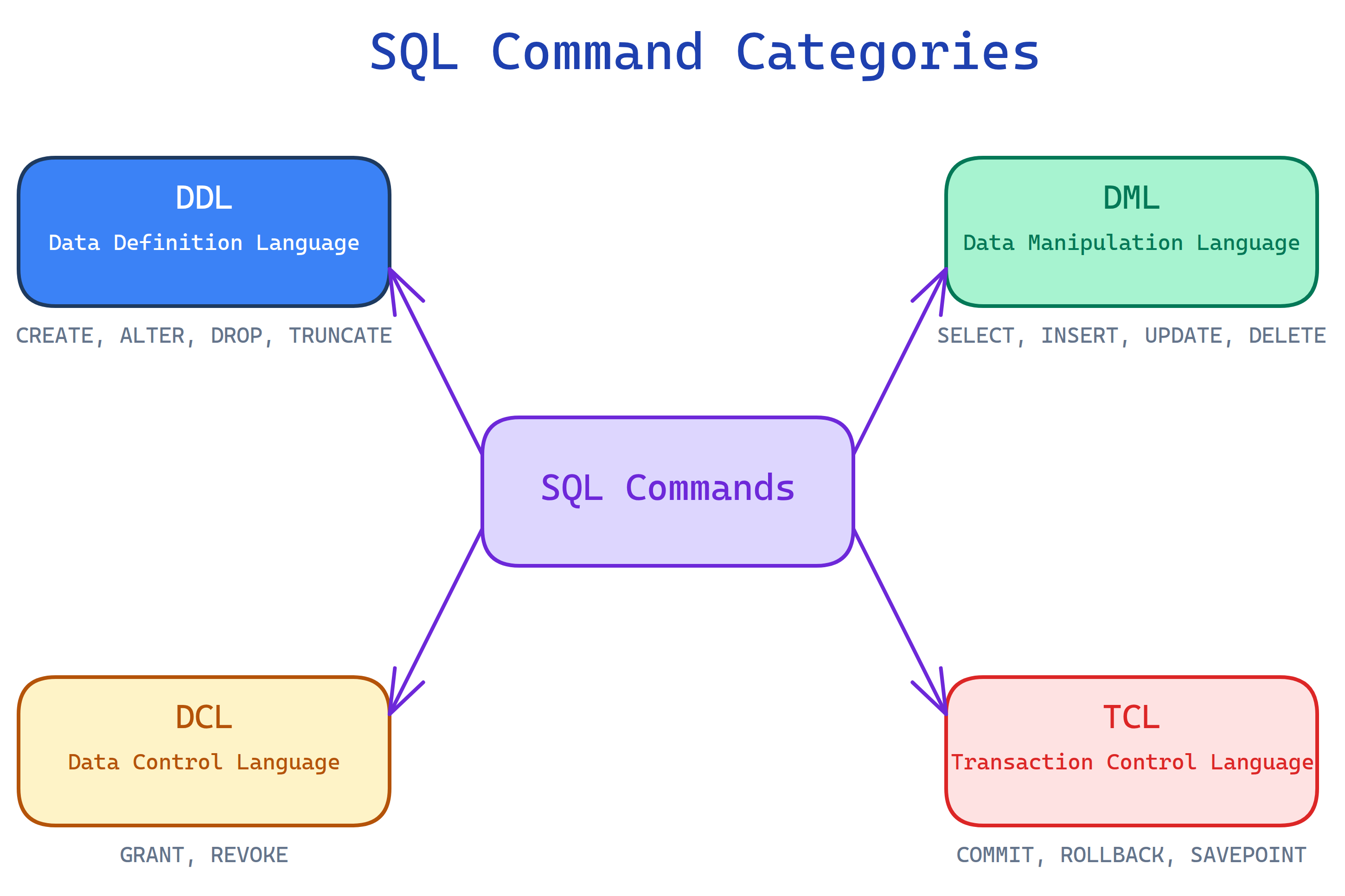
| Category | Full Name | Purpose | Commands | Auto-commit? |
|---|---|---|---|---|
| DDL | Data Definition Language | Define/change database structure | CREATE, ALTER, DROP, TRUNCATE, RENAME | Yes |
| DML | Data Manipulation Language | Read and modify data | SELECT, INSERT, UPDATE, DELETE, MERGE | No |
| DCL | Data Control Language | Control access permissions | GRANT, REVOKE | Yes |
| TCL | Transaction Control Language | Manage transactions | COMMIT, ROLLBACK, SAVEPOINT | N/A |
DDL Data Definition Language
DDL commands define the structure of your database — tables, columns, constraints, indexes. They answer: "What shape does the container have?"
CREATE — Build Something New
-- Create a table
CREATE TABLE employees (
  id       INT PRIMARY KEY,
  name     VARCHAR(100) NOT NULL,
  email    VARCHAR(255) UNIQUE,
  dept_id  INT REFERENCES departments(id),
  salary   DECIMAL(10, 2) DEFAULT 0,
  hired_at DATE NOT NULL
);

-- Create an index
CREATE INDEX idx_emp_dept ON employees(dept_id);

-- Create a view
CREATE VIEW high_earners AS
  SELECT name, salary FROM employees WHERE salary > 100000;
ALTER — Change Existing Structure
-- Add a column
ALTER TABLE employees ADD COLUMN phone VARCHAR(20);

-- Change column type
ALTER TABLE employees ALTER COLUMN salary TYPE NUMERIC(12, 2);

-- Add a constraint
ALTER TABLE employees ADD CONSTRAINT chk_salary CHECK (salary >= 0);

-- Drop a column
ALTER TABLE employees DROP COLUMN phone;
DROP — Destroy Permanently
-- Drop a table (all data gone!)
DROP TABLE employees;

-- Drop only if it exists (prevents errors)
DROP TABLE IF EXISTS temp_data;
TRUNCATE — Delete All Rows, Keep Structure
-- Remove all rows but keep the table
TRUNCATE TABLE logs;DML Data Manipulation Language
DML commands work with the data inside tables. This is what you'll use 90% of the time.
SELECT — Read Data
SELECT name, salary FROM employees WHERE dept_id = 10 ORDER BY salary DESC;INSERT — Add New Rows
-- Single row
INSERT INTO employees (id, name, email, dept_id, salary, hired_at)
VALUES (1, 'Alice', '[email protected]', 10, 95000, '2024-01-15');

-- Multiple rows
INSERT INTO employees (id, name, email, dept_id, salary, hired_at) VALUES
  (2, 'Bob', '[email protected]', 20, 90000, '2024-02-01'),
  (3, 'Charlie', '[email protected]', 10, 90000, '2024-03-10');

-- Insert from a query
INSERT INTO archive_employees
SELECT * FROM employees WHERE hired_at < '2020-01-01';
UPDATE — Modify Existing Rows
-- Update specific rows
UPDATE employees SET salary = salary * 1.10 WHERE dept_id = 10;

-- Update with a JOIN (PostgreSQL syntax)
UPDATE employees e
SET salary = salary * 1.05
FROM departments d
WHERE e.dept_id = d.id AND d.dept_name = 'Engineering';DELETE — Remove Rows
-- Delete specific rows
DELETE FROM employees WHERE id = 4;

-- Delete with a subquery
DELETE FROM employees
WHERE dept_id IN (SELECT id FROM departments WHERE archived = true);
MERGE / UPSERT
-- PostgreSQL: INSERT or UPDATE if exists
INSERT INTO employees (id, name, salary)
VALUES (1, 'Alice', 100000)
ON CONFLICT (id) DO UPDATE SET salary = EXCLUDED.salary;
DCL Data Control Language
DCL controls who can do what. It's the security layer of SQL.
GRANT — Give Permissions
-- Grant SELECT on a table
GRANT SELECT ON employees TO analyst_role;

-- Grant multiple permissions
GRANT SELECT, INSERT, UPDATE ON employees TO app_role;

-- Grant all on a schema
GRANT ALL PRIVILEGES ON ALL TABLES IN SCHEMA public TO admin_role;
REVOKE — Remove Permissions
-- Revoke write access
REVOKE INSERT, UPDATE, DELETE ON employees FROM analyst_role;

-- Revoke all
REVOKE ALL PRIVILEGES ON employees FROM temp_user;TCL Transaction Control Language
TCL manages transactions — groups of operations that must succeed or fail together.
COMMIT — Save Changes
BEGIN;
  UPDATE accounts SET balance = balance - 500 WHERE id = 1;
  UPDATE accounts SET balance = balance + 500 WHERE id = 2;
COMMIT;  -- Both updates are now permanent
ROLLBACK — Undo Changes
BEGIN;
  DELETE FROM employees WHERE dept_id = 30;
  -- Oops, wrong department!
ROLLBACK;  -- Nothing was deleted
SAVEPOINT — Partial Rollback
BEGIN;
  INSERT INTO orders VALUES (1, 'Widget', 100);
  SAVEPOINT after_order;

  INSERT INTO payments VALUES (1, 100, 'credit_card');
  -- Payment failed!
  ROLLBACK TO after_order;
  -- Order still exists, payment rolled back

  INSERT INTO payments VALUES (1, 100, 'bank_transfer');
COMMIT;When to Use What
Test Yourself
Q: Which category does CREATE TABLE belong to?
Q: What's the difference between TRUNCATE and DELETE?
Q: What does ACID stand for?
Q: Can you ROLLBACK a DROP TABLE?
Interview Questions
Q: Classify these commands: CREATE, SELECT, GRANT, COMMIT, ALTER, DELETE, REVOKE, ROLLBACK.
- DDL: CREATE, ALTER
- DML: SELECT, DELETE
- DCL: GRANT, REVOKE
- TCL: COMMIT, ROLLBACK
Q: You accidentally deleted all rows from a production table. The transaction is still open. What do you do?
ROLLBACK; — since DELETE is DML and the transaction hasn't been committed, ROLLBACK will undo the delete. If you had used TRUNCATE (DDL), it would have auto-committed and you'd need to restore from a backup.Q: What is the difference between DROP, TRUNCATE, and DELETE?
- DROP (DDL): Removes the entire table — structure, data, indexes, constraints, everything.
- TRUNCATE (DDL): Removes all rows but keeps the table structure. Auto-commits. Cannot use WHERE.
- DELETE (DML): Removes specific rows using WHERE. Can be rolled back. Fires triggers. Slower on large tables.
Q: Explain the principle of least privilege in the context of database security.
Q: What happens if the database crashes in the middle of a transaction?