SEO Core Concepts
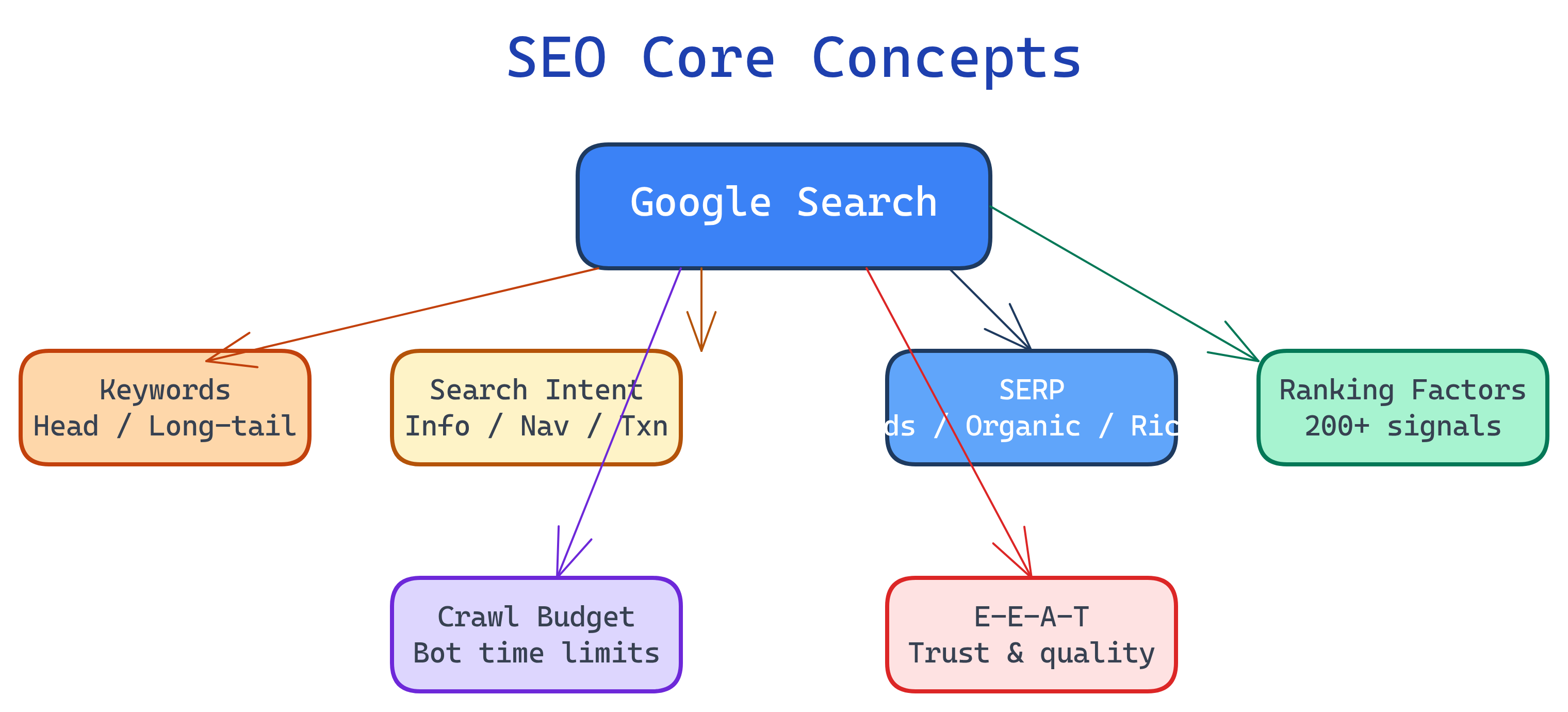
SEO revolves around keywords (what people search), search intent (why they search), ranking factors (what Google measures), crawl budget (how much Google reads), and E-E-A-T (how Google trusts you). Master these building blocks and every SEO tactic makes sense.
Concept Map
Explain Like I'm 12
Think of Google as a matchmaker. Someone types a question (that's a keyword). Google looks at what they really want (that's search intent). Then it picks the best websites based on a scorecard (those are ranking factors). But Google can only grade pages it's actually read — and it has limited reading time (crawl budget). Finally, Google checks if the author seems trustworthy (E-E-A-T). Get all five right, and Google matches YOUR page to the searcher.
Cheat Sheet
| Concept | What It Does | Key Tools |
|---|---|---|
| Keywords | Words & phrases people type into search engines | Google Keyword Planner, Ahrefs, Semrush |
| Search Intent | The reason behind a search query (informational, navigational, transactional, commercial) | Google SERP analysis, "People Also Ask" |
| SERP | Search Engine Results Page — the page Google shows after a search | SERP checkers, rank trackers |
| Ranking Factors | 200+ signals Google uses to score and order results | Google Search Console, PageSpeed Insights |
| Crawl Budget | How many pages Googlebot will crawl on your site in a given time | robots.txt, XML sitemaps, GSC crawl stats |
| E-E-A-T | Experience, Expertise, Authoritativeness, Trustworthiness — Google's content quality framework | Author bios, citations, reviews |
| Backlinks | Links from other websites pointing to yours — act as "votes of confidence" | Ahrefs, Moz, Majestic |
| Domain Authority | A score predicting how likely a domain is to rank (third-party metric) | Moz DA, Ahrefs DR |
The Building Blocks
1. Keywords
Keywords are the foundation of SEO. They're the words and phrases people type into Google. Your goal is to find the keywords your audience uses and create content that matches.
Keywords come in three flavors:
| Type | Example | Search Volume | Competition | Conversion |
|---|---|---|---|---|
| Head (1-2 words) | "SEO" | Very high | Extremely hard | Low |
| Body (2-3 words) | "SEO basics" | Medium | Moderate | Medium |
| Long-tail (4+ words) | "how to do SEO for a new website" | Low | Easy | High |
2. Search Intent
Search intent is why someone searches. Google's entire algorithm is built around matching results to intent. If your page doesn't match the intent, it won't rank — no matter how optimized it is.
| Intent Type | User Wants To… | Example Query | Best Content Format |
|---|---|---|---|
| Informational | Learn something | "what is SEO" | Blog post, guide, tutorial |
| Navigational | Find a specific site | "Google Search Console login" | Landing page, homepage |
| Transactional | Buy or sign up | "buy Ahrefs subscription" | Product page, pricing page |
| Commercial | Compare before buying | "Semrush vs Ahrefs" | Comparison, review |
3. SERP Anatomy
The Search Engine Results Page is where the battle is won or lost. A modern Google SERP includes:
- Paid ads — Marked with "Sponsored" label, appear at top and bottom
- Featured snippet — A highlighted answer box (position 0) pulled from a webpage
- People Also Ask — Expandable related questions
- Organic results — The 10 blue links (each with title, URL, description)
- Knowledge panel — Entity info box on the right side
- Local pack — Map with 3 local business listings
- Image/video carousels — Visual results for relevant queries
4. Ranking Factors
Google uses 200+ ranking signals. Nobody knows the exact algorithm, but the most impactful ones are well-established:
| Category | Top Factors | Impact |
|---|---|---|
| Content | Relevance, depth, freshness, keyword usage | 🔴 Critical |
| Backlinks | Number, quality, relevance of linking domains | 🔴 Critical |
| Technical | Page speed, mobile-friendly, HTTPS, Core Web Vitals | 🟡 Important |
| User Experience | Click-through rate, bounce rate, dwell time | 🟡 Important |
| On-Page | Title tags, headers, internal links, schema | 🟢 Foundational |
5. Crawl Budget
Googlebot has limited time and resources. Crawl budget is how many pages it will visit on your site in a given period. For small sites (under 10K pages), this rarely matters. For large sites, it's critical.
Things that waste crawl budget:
- Duplicate content (same page at multiple URLs)
- Infinite URL parameters (
?sort=price&page=2&color=red) - Soft 404 errors (page says "not found" but returns HTTP 200)
- Redirect chains (A → B → C → D)
6. E-E-A-T
E-E-A-T stands for Experience, Expertise, Authoritativeness, and Trustworthiness. It's not a direct ranking factor — it's a framework Google's human quality raters use to evaluate search results.
| Letter | Meaning | How to Demonstrate |
|---|---|---|
| E | Experience | Show first-hand experience with the topic (photos, case studies, personal insights) |
| E | Expertise | Author has knowledge/credentials in the field |
| A | Authoritativeness | Site/author is recognized as a go-to source |
| T | Trustworthiness | Accurate content, HTTPS, clear contact info, good reputation |
7. Backlinks & Domain Authority
A backlink is a link from another website to yours. Google treats each backlink as a vote of confidence. Not all votes are equal — a link from The New York Times is worth more than a link from a random blog.
Key backlink metrics:
- Quantity — More backlinks generally = better rankings
- Quality — Links from high-authority, relevant sites matter most
- Relevance — A link from a marketing blog to your SEO page is more valuable than one from a cooking site
- Anchor text — The clickable text of the link signals what your page is about
Test Yourself
What are the four types of search intent?
Informational (learn something), Navigational (find a specific site), Transactional (buy/sign up), and Commercial investigation (compare before buying).
Why are long-tail keywords often better for new websites?
Long-tail keywords have lower competition (easier to rank for), higher conversion rates (more specific intent), and help new sites build authority gradually before targeting competitive head terms.
What does E-E-A-T stand for, and why does it matter?
Experience, Expertise, Authoritativeness, Trustworthiness. It's Google's quality framework used by human raters. While not a direct ranking signal, it shapes how Google evaluates content quality — especially for YMYL topics like health and finance.
What wastes crawl budget?
Duplicate content, infinite URL parameters, soft 404 errors, and redirect chains. These make Googlebot spend its limited time on low-value pages instead of your important content.
What makes a backlink high-quality?
A high-quality backlink comes from a high-authority domain, is topically relevant to your content, uses descriptive anchor text, and is editorially earned (not paid or exchanged).
