What is Backend Development?
Backend development is everything that happens on the server — APIs, databases, authentication, and business logic. It's the invisible engine that powers every app, website, and service you use.
The Big Picture
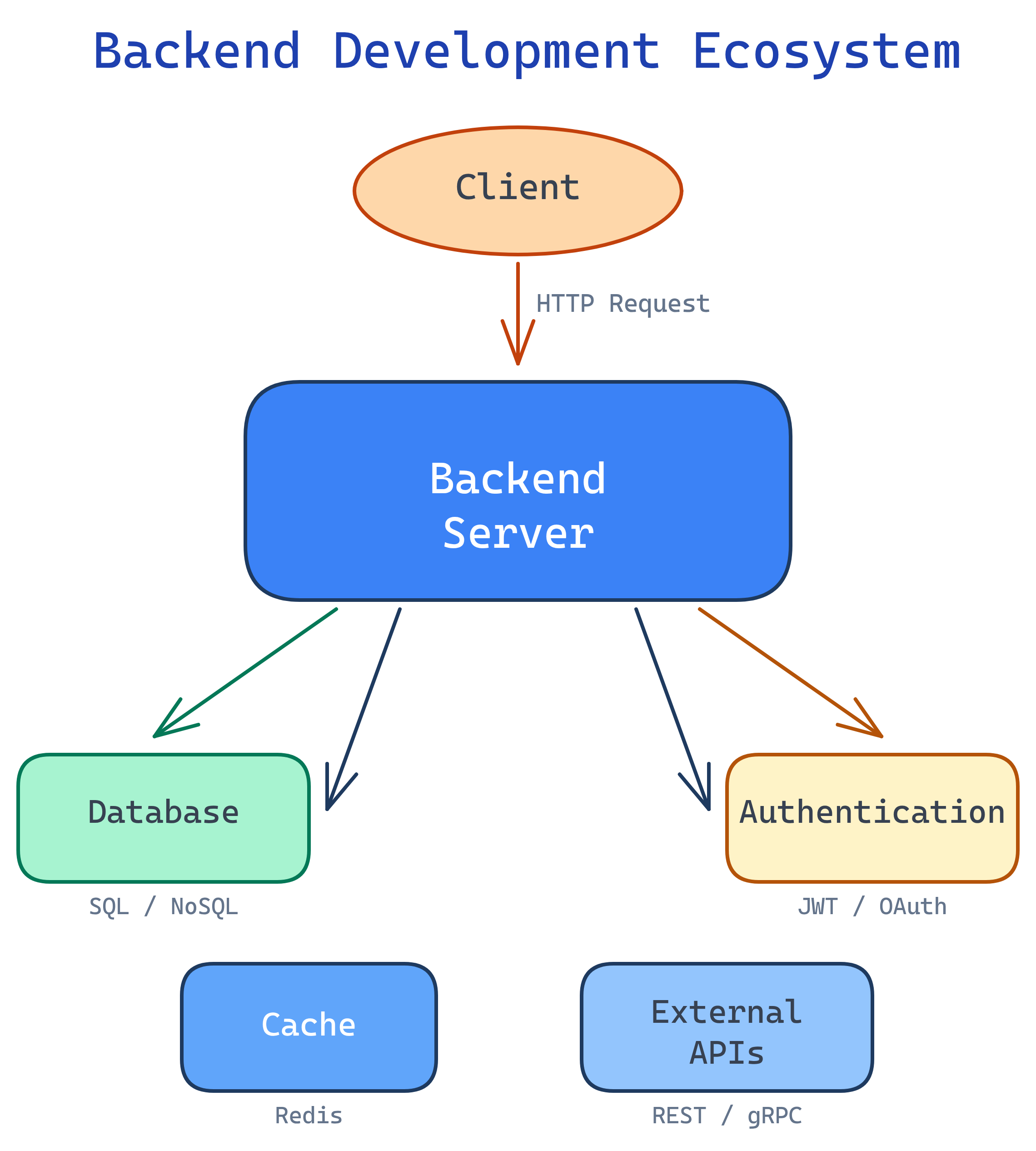
Backend development sits between users and data. Every time you tap a button, search for something, or log in, your request travels from the frontend to the backend, which does the real work:
Explain Like I'm 12
Think of a restaurant. You sit down, look at the menu (that's the frontend — the pretty stuff you see), and tell the waiter what you want. The waiter walks your order to the kitchen (that's the backend). In the kitchen, chefs check if they have the ingredients (database), follow the recipe (business logic), make sure you're allowed to order that dish (authentication), and prepare your meal. You never see the kitchen, but without it, there's no food. That's backend development — the invisible kitchen that makes everything work.
What is Backend Development?
Backend development is server-side programming — building the logic, databases, and infrastructure that power applications. When a user clicks "Sign Up" on a website, the frontend sends that request to a server. The backend receives it, validates the data, hashes the password, stores it in a database, sends a confirmation email, and responds with "Account created." All of that happens invisibly in milliseconds.
At its core, backend development revolves around the client-server model:
- Client — The browser, mobile app, or any device that makes a request. It says, "Hey server, give me this user's profile."
- Server — A program running on a remote machine that receives the request, does the work, and sends back a response. It says, "Here's the data you asked for, formatted as JSON."
- Database — Where data lives permanently. User accounts, product catalogs, transaction histories — the server reads from and writes to databases.
- API (Application Programming Interface) — The contract between the client and server. It defines what requests you can make and what responses you'll get back.
Here's what backend developers actually build day-to-day:
- REST and GraphQL APIs — Endpoints that frontends, mobile apps, and other services call to get or send data.
- Authentication and authorization — Login systems, password hashing, JWTs, OAuth, role-based access control.
- Database design — Schema design, migrations, queries, indexing, and choosing between SQL and NoSQL.
- Business logic — The rules unique to each application: pricing calculations, recommendation engines, notification triggers.
- Background jobs — Sending emails, processing images, generating reports — tasks that run asynchronously.
- Third-party integrations — Payment gateways (Stripe), email services (SendGrid), cloud storage (S3), and more.
Why Learn Backend?
Six reasons backend development is one of the most valuable skills in tech:
- High demand — Every company with a website, app, or API needs backend developers. Job boards consistently list backend roles among the most in-demand positions in software engineering.
- Full-stack capability — Knowing backend turns a frontend developer into a full-stack developer, doubling your value and understanding of the entire system.
- Powers everything — Mobile apps, web apps, IoT devices, AI services, payment systems — they all depend on backend infrastructure. No backend, no product.
- Great salaries — Backend and full-stack engineers consistently earn top-tier salaries, with senior roles often exceeding $150K+ in major markets.
- Diverse tech stacks — Python, Node.js, Java, Go, Rust, C# — you can pick the language you love. The concepts transfer across all of them.
- Scalability challenges — Backend is where the hardest engineering problems live: handling millions of requests, distributed systems, caching strategies, and database optimization.
Who is it for?
Backend development is for anyone who wants to understand how software really works under the hood:
- Web developers — You've built frontends with HTML, CSS, and JavaScript. Now learn what happens after the user clicks "Submit."
- Data engineers — Backend skills help you build data pipelines, APIs for data access, and services that feed machine learning models.
- Computer science students — Backend development is where algorithms, data structures, and system design come to life in real products.
- Frontend developers wanting full-stack — Stop depending on "the backend team." Own the entire feature, from button click to database write.
- Career changers — Backend development has clear learning paths, abundant resources, and is accessible without a CS degree if you're willing to learn.
Where Backend is Used
Backend development powers every major category of software. Here are five domains where backend skills are essential:
What You'll Learn
This topic walks you through backend development from the fundamentals to production-ready skills:
Test Yourself
What is the difference between frontend and backend?
Name 3 things a backend developer builds.
What is an API?
GET /api/users/123 returns user data as JSON. APIs let frontends, mobile apps, and other services interact with your backend without knowing how it works internally — they just know what to ask for and what they'll get back.Why do backends need authentication?