Feynman Technique & 80/20 Rule
The Feynman Technique forces deep understanding by making you explain concepts simply. The 80/20 Rule (Pareto Principle) tells you which 20% of a subject gives you 80% of the results. Combined, they are the fastest way to learn the important stuff deeply.
Explain Like I'm 12
Learning is like packing for a trip. The 80/20 Rule tells you to only pack what you'll actually wear — no need to bring 15 shirts for a 3-day trip. The Feynman Technique tells you to explain your packing list to a 5-year-old: "I'm bringing this jacket because it's cold there." If you can't explain why you packed something, you probably don't understand your trip well enough.
Together: pick the important stuff (80/20), then make sure you really understand it (Feynman). That's it. That's the whole secret.
The Big Picture
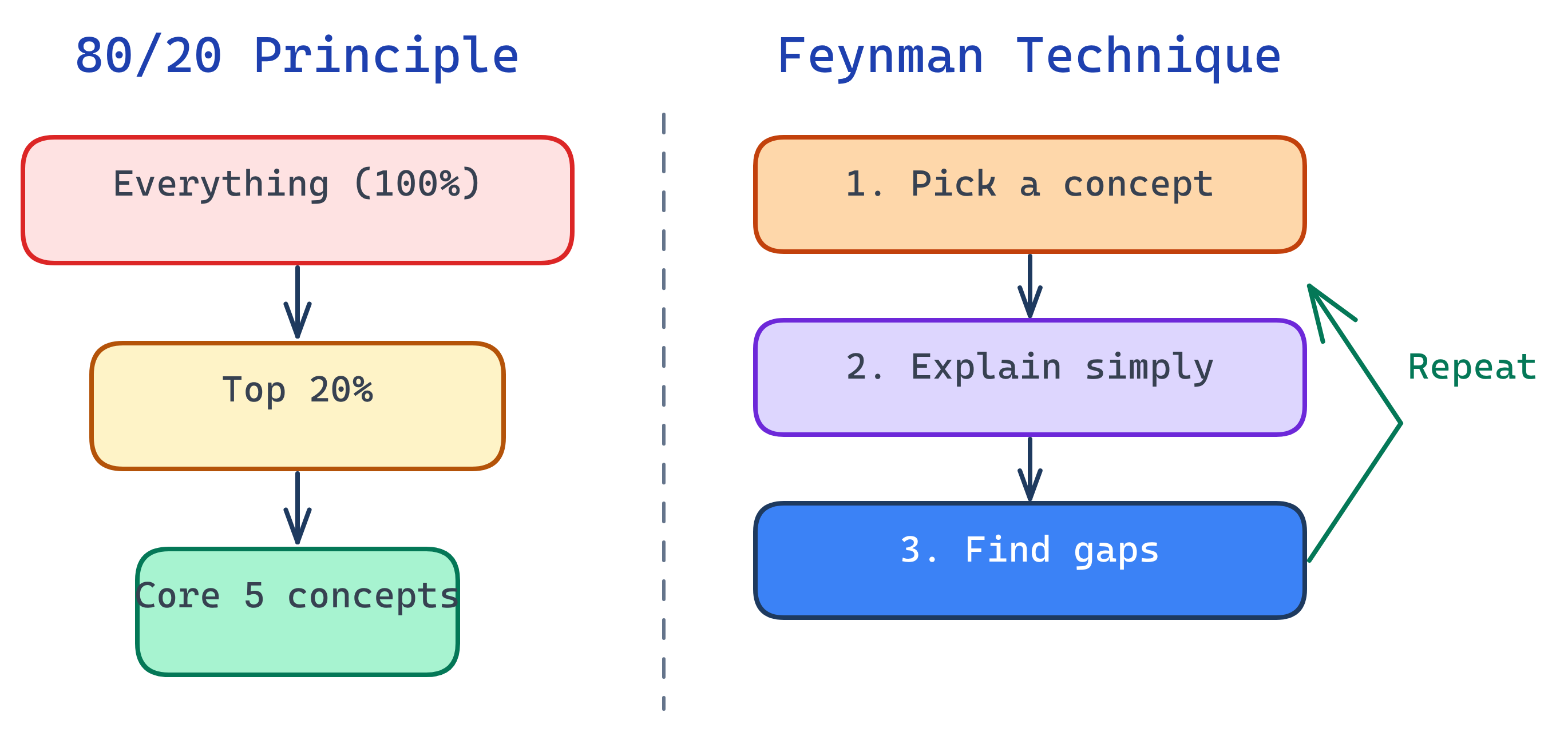
The 80/20 Rule for Learning
Where it comes from
In 1896, Italian economist Vilfredo Pareto noticed that 80% of Italy's wealth was owned by 20% of the people. The pattern keeps showing up everywhere: 80% of bugs come from 20% of the code. 80% of sales come from 20% of the customers. And in learning: 20% of concepts give you 80% of practical knowledge.
Real examples
Here's what 80/20 looks like across different subjects:
| Subject | The 20% that matters | What you can skip (for now) |
|---|---|---|
| SQL | SELECT, WHERE, JOIN, GROUP BY, subqueries | Window functions, CTEs, recursive queries, temp tables |
| Python | Variables, loops, functions, lists, dicts | Decorators, metaclasses, async/await, generators |
| Excel | Formulas, VLOOKUP, pivot tables, charts | VBA, Power Query, macros, custom functions |
| Healthcare | Claims process, coding (CPT/ICD), plan types | Risk adjustment, HEDIS measures, EDI standards |
How to find the 20%
- Read the table of contents. The first 3-5 chapters are almost always the core 20%.
- Ask an expert: "If I could only learn 5 things, what should they be?"
- Look at job descriptions. What skills are "required" vs "nice-to-have"? Required = 20%.
- Find the most-referenced concepts in beginner tutorials. If every tutorial mentions it, it's in the 20%.
The Feynman Technique — Step by Step
Named after physicist Richard Feynman, who was famous for explaining impossibly complex ideas in simple language. His secret wasn't genius — it was a method anyone can use.
The 4 Steps
- Pick ONE concept (not a whole chapter, not a whole book — one concept).
- Write an explanation in plain English, as if teaching a curious 12-year-old. No jargon. No copying from the source material. Your words, your analogies.
- Find your gaps. Where you get stuck or resort to vague hand-waving = what you don't actually understand. Go back to the source material for just that gap.
- Simplify further. Use analogies. If your explanation is longer than 3 paragraphs, it's too complex. Cut it down.
The loop: Explain → Find gaps → Study gaps → Explain again → Repeat until crystal clear.
Feynman in Action — Worked Example
Let's walk through a real Feynman cycle. Topic: "What is a database JOIN?"
Attempt 1 (bad)
"A JOIN combines rows from two or more tables based on a related column between them."
This is just a textbook definition. You could say this sentence without understanding a single thing about JOINs. It doesn't pass the Feynman test.
Gap found
What does "related column" actually mean in practice? What happens to rows that don't match? Why would I need this instead of putting everything in one table?
Attempt 2 (better)
"Imagine two spreadsheets: one has student names and their class IDs, the other has class IDs and teacher names. A JOIN is like saying 'match them up by class ID so I can see which student has which teacher.' If a student doesn't have a class, they disappear from the result (that's an INNER JOIN). If you want to keep ALL students even without a class, that's a LEFT JOIN."
Combining 80/20 + Feynman
These two techniques are even more powerful together. Here's the workflow:
- Use 80/20 to identify the 5-7 key concepts. Don't try to Feynman everything — just the stuff that matters.
- Use Feynman on EACH of those concepts. Write an ELI12 explanation for every one.
- Write your Feynman explanations into a personal cheat sheet. One page, 5-7 concepts, each with a plain-English explanation.
This cheat sheet becomes your go-to reference and review tool. When you need a refresher, you read your words, not a textbook. And because you wrote it, the act of reading it triggers deeper recall.
Common Mistakes
| Mistake | Which rule it breaks | What to do instead |
|---|---|---|
| Trying to learn everything at once | Violates 80/20 | Pick the top 5-7 concepts first. Expand later. |
| Copying definitions instead of creating your own | Violates Feynman | Close the book. Write from memory. Use your own words. |
| Skipping the "explain it" step (just reading) | Passive learning | After every section, pause and explain it aloud or in writing. |
| Never going back to fill gaps | Incomplete Feynman loop | When you get stuck, that's the signal to go deeper — not to skip. |
Test Yourself
Q: What is the 80/20 Rule in the context of learning?
Q: What are the 4 steps of the Feynman Technique?
Q: How do you identify the "20%" for a new subject?
Q: What's wrong with this Feynman explanation: "A JOIN combines rows from two tables based on a related column"?
Q: How do you combine 80/20 and Feynman into a practical workflow?
Interview Questions
Q: How would you apply the Feynman Technique to learn a new technology in one week?
Q: Give an example of the 80/20 rule applied to your last project.
Q: How do you decide what to learn first when starting a new domain?