How to Learn Anything Fast
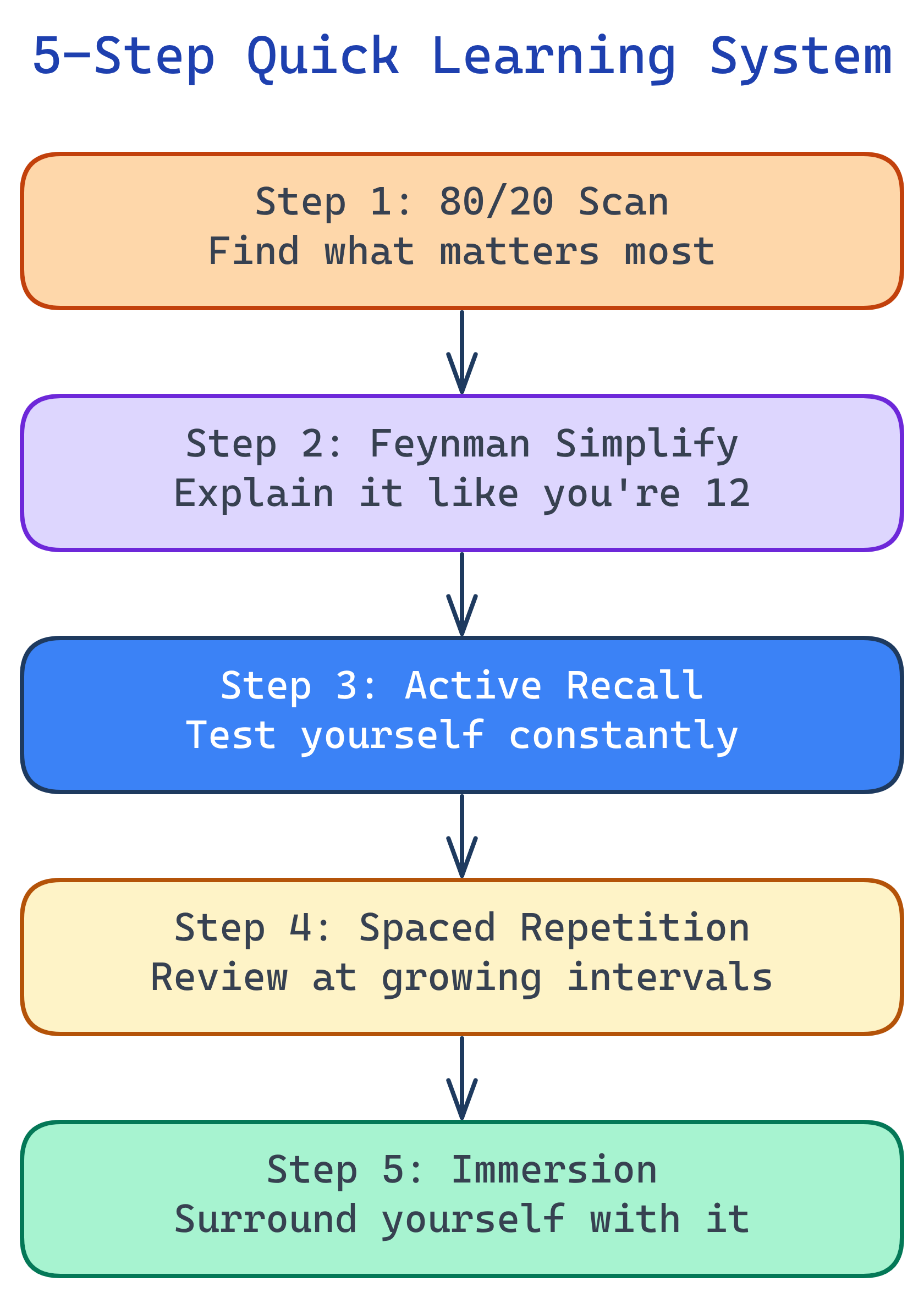
A practical 5-step system for learning anything fast: Define the 20% that matters (80/20), Explain it simply (Feynman), Quiz yourself constantly (Active Recall), Space it out (Spaced Repetition), and Surround yourself with it (Immersion).
The Feynman technique sounds deceptively simple: explain what you are learning in plain language, identify where your explanation breaks down, and go back to the source. The value is in the third step. When you try to explain a concept and find a gap, that gap is precisely where your mental model is incomplete. Passive re-reading does not expose gaps; explaining does. The technique draws on research showing that elaborative interrogation and self-explanation consistently outperform re-reading for long-term retention. The landmark paper by Dunlosky et al. (2013), "Improving Students' Learning With Effective Learning Techniques", ranks these strategies by evidence quality.
Spaced repetition works because of the spacing effect: reviewing material at increasing intervals (1 day, 3 days, 1 week, 2 weeks) is more effective per minute of study than massed practice ("cramming"). The Ebbinghaus forgetting curve — showing that we forget roughly 50% of new information within an hour without review — is the empirical basis. Tools like Anki implement spaced repetition algorithmically. The key discipline is making cards at the moment you learn something, not after; the act of formulating a question forces encoding.
Active recall — the practice of retrieving information from memory rather than passively reviewing it — is the single highest-leverage technique for durable learning. Every "Test Yourself" section on this site is designed around this principle. The uncomfortable feeling of not immediately remembering an answer is not failure; it is the retrieval attempt itself that strengthens the memory trace. Research by Roediger and Karpicke (2006) demonstrated that testing produces greater long-term retention than repeated study.
The Big Picture
Most people learn the hard way — literally. They re-read textbooks, highlight everything in yellow, and cram the night before. Then they forget 70% of it within a day. Here's the system that actually works:
Explain Like I'm 12
You know how you can play your favorite video game for hours and remember every detail, but reading a textbook for 30 minutes puts you to sleep? That's because the game uses all 5 learning tricks without you knowing: it focuses on what matters (you skip tutorials you don't need), it makes you DO things (not just watch), it tests you constantly (boss fights!), you come back to it every day (spaced out), and you're totally immersed. This guide teaches you to hack any subject the same way.
The Problem: Why Traditional Studying Fails
Let's be honest: most of what you were taught about studying is wrong. Here's why:
- Re-reading is passive. Your eyes scan the words, your brain says "yep, I've seen this before," and you feel like you're learning. You're not. You're building an illusion of knowledge — you recognize the material but can't actually use it. It's like watching someone cook on YouTube and thinking you can make the dish.
- Highlighting does almost nothing. Studies consistently show that highlighting text has near-zero impact on retention. All you're doing is picking which parts of the page look prettier in yellow.
- Cramming works for 48 hours, then vanishes. You can stuff information into short-term memory for a test. But within 2 days? It's gone. You spent 6 hours studying for knowledge that had a 48-hour shelf life.
The real kicker is the forgetting curve. Discovered by Hermann Ebbinghaus in the 1880s, it shows that without any review, you lose about 70% of new information within 24 hours. After a week, you're down to maybe 10-20%. All that effort, evaporating.
But here's the good news: the forgetting curve has a weakness. Every time you actively recall information at the right intervals, you reset the curve AND make it decay slower. That's the entire foundation of this system.
The 5-Step System
These aren't theoretical concepts from an academic paper you'll never read. They're practical steps you can start using today, on anything you're trying to learn.
Quick Comparison
Each technique has a sweet spot. Here's when to use what:
| Method | Focus | Best For | Time to See Results |
|---|---|---|---|
| 80/20 Scan | Efficiency | Getting started fast | Immediate |
| Feynman Simplify | Depth | Understanding complex topics | 1–2 sessions |
| Active Recall | Retention | Remembering long-term | 1 week |
| Spaced Repetition | Memory | Preventing forgetting | 2–4 weeks |
| Immersion | Fluency | Building intuition | 1–3 months |
Who Is This For?
Short answer: anyone who has ever started learning something and quit halfway through.
Longer answer: this system works for students cramming for exams, career changers picking up a new tech stack, self-learners on YouTube and Udemy, professionals staying current in a fast-moving field, or anyone who keeps buying courses and never finishing them. The techniques are universal — they work for programming, medicine, languages, music, data analytics, or literally any subject where you need to understand and retain information.
If you've ever thought "I'm just not good at learning" — you're wrong. You just haven't had a system. Now you do.
What You'll Learn
This topic walks you through the complete quick learning system, from the science to the practice:
Test Yourself
What happens to new information within 24 hours without review?
What are the 5 steps of the quick learning system?
Why is re-reading a textbook an ineffective study method?
What does the 80/20 rule say about learning?