What is SEO?
SEO (Search Engine Optimization) is the practice of improving your website so it ranks higher in Google and other search engines, driving free organic traffic. It boils down to three pillars: on-page (content & HTML), technical (site speed & crawlability), and off-page (backlinks & authority).
Core Web Vitals became a ranking signal in Google's Page Experience update, and the one most frequently underestimated is INP (Interaction to Next Paint), which replaced FID in March 2024. INP measures responsiveness to all user interactions throughout the page lifecycle, not just the first one. A page that loads quickly but stutters when a user clicks a filter or expands an accordion has a high INP and will be penalized. The web.dev INP documentation includes the measurement methodology and optimization techniques.
Structured data (Schema.org JSON-LD) is one of the few remaining technical SEO levers with clear, measurable impact. Pages with valid Article, FAQ, or HowTo schema are eligible for rich results in Google Search, which consistently improves click-through rates. The Google Rich Results Test is the authoritative validator — use it on every page you publish with structured data to catch errors before they go live.
SEO is worth investing deeply in if you control a site with more than a few dozen pages and organic traffic is a meaningful acquisition channel. Single-page apps with client-side rendering are the hardest to rank; statically generated or server-rendered HTML is still the most reliably indexed by Googlebot. If you are building a new content site, choosing SSG or SSR at the start avoids painful retrofitting later.
The Big Picture
Every day, billions of searches happen on Google. SEO is how you make sure your pages show up when people search for what you offer. It's not about tricks — it's about making your site genuinely useful and easy for search engines to understand.
Explain Like I'm 12
Imagine Google is a librarian for the entire internet. When someone asks a question, the librarian picks the best books (websites) to answer it. SEO is like making your book easy to find — give it a clear title, organize the chapters well, and get other librarians to recommend it. The better you do this, the more likely the librarian picks YOUR book first.
How Search Engines Work
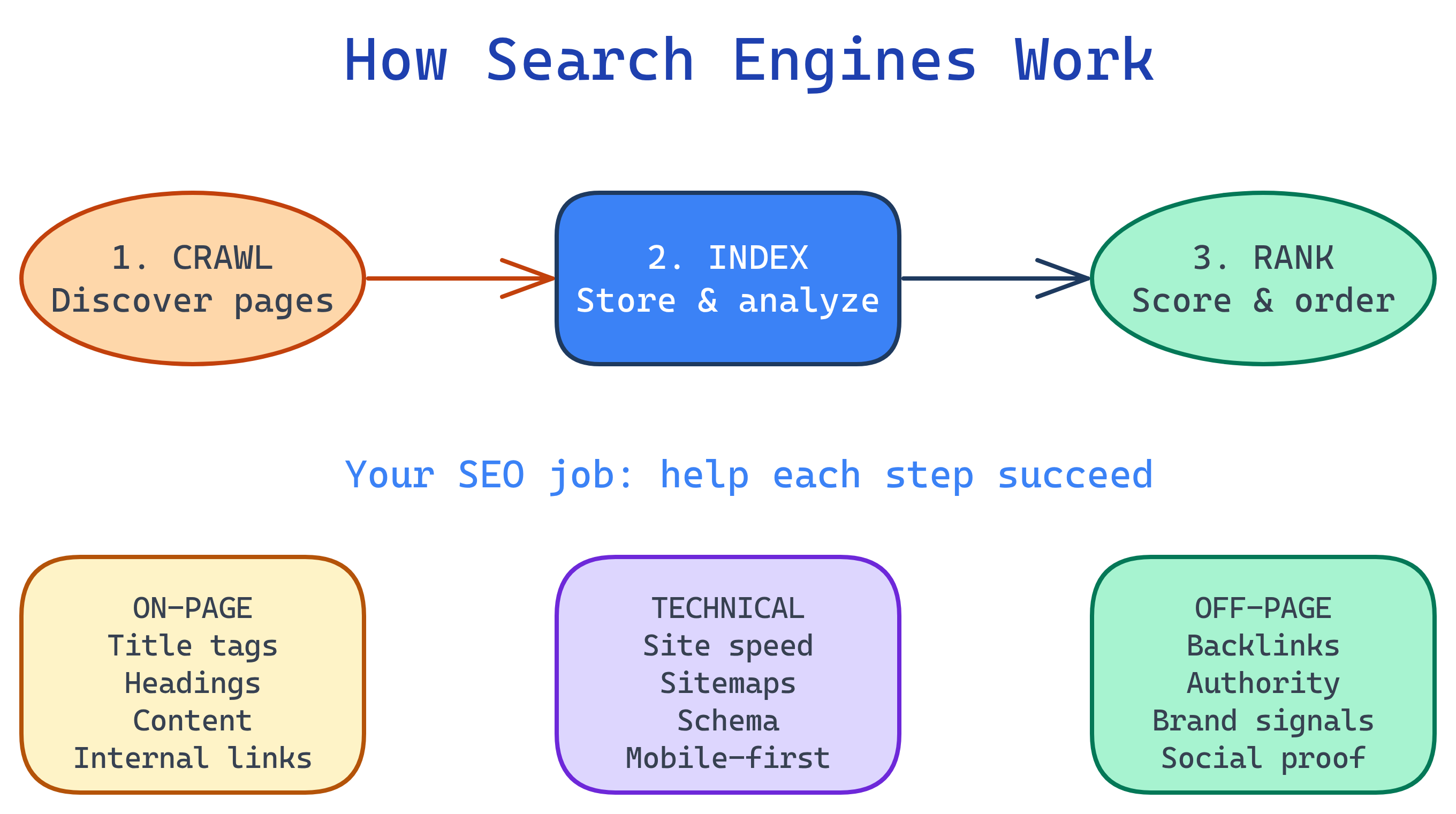
Search engines do three things in order:
- Crawl — Bots (called "spiders") follow links across the web, discovering new and updated pages.
- Index — The content of each page is analyzed and stored in a massive database.
- Rank — When someone searches, the engine scores every indexed page and returns the best results.
Your job with SEO is to make each step easy: let bots find your pages, help them understand your content, and prove your page deserves a top spot.
The Three Pillars of SEO
| Pillar | What It Covers | Key Tactics |
|---|---|---|
| On-Page SEO | Content quality & HTML optimization | Keywords, title tags, headings, internal links, content depth |
| Technical SEO | Site architecture & performance | Site speed, mobile-friendliness, sitemaps, schema markup, HTTPS |
| Off-Page SEO | External signals & authority | Backlinks, brand mentions, social proof, domain authority |
Who Is SEO For?
- Web developers building sites that need to rank
- Content creators writing blog posts and articles
- Marketers driving organic traffic to products
- Business owners who want free, sustainable traffic
- Anyone with a website who wants it found on Google
What You'll Learn
Test Yourself
What are the three pillars of SEO?
On-Page SEO (content & HTML), Technical SEO (site performance & crawlability), and Off-Page SEO (backlinks & authority).
What's the difference between organic and paid search results?
Organic results are free listings earned through SEO. Paid results (ads) are bought through platforms like Google Ads. Organic results appear below paid results but get ~70% of clicks because users trust them more.
In what order do search engines process web pages?
Crawl → Index → Rank. Bots discover pages (crawl), store and analyze the content (index), then score and order results when someone searches (rank).
Why is SEO considered "free" traffic?
Unlike paid ads where you pay per click, organic traffic from SEO costs nothing per visit. The investment is in time and effort to optimize your site, but each visitor after that is free. This makes SEO one of the highest-ROI marketing channels long-term.
