Active Recall & Spaced Repetition
Active Recall means testing yourself instead of re-reading. Spaced Repetition means reviewing at increasing intervals (1 day → 3 days → 7 days → 30 days). Together they are the most scientifically proven way to move knowledge into long-term memory.
Explain Like I'm 12
Your brain is like a path in the woods. The more you walk it, the clearer it gets. But if you walk it once and never come back, grass grows over it and you can't find it anymore.
Active Recall = walking the path (testing yourself, not just staring at a map). Spaced Repetition = coming back before the grass grows. Walk the path at Day 1, Day 3, Day 7, Day 30 — and it becomes a permanent trail.
The Forgetting Curve & Spaced Reviews
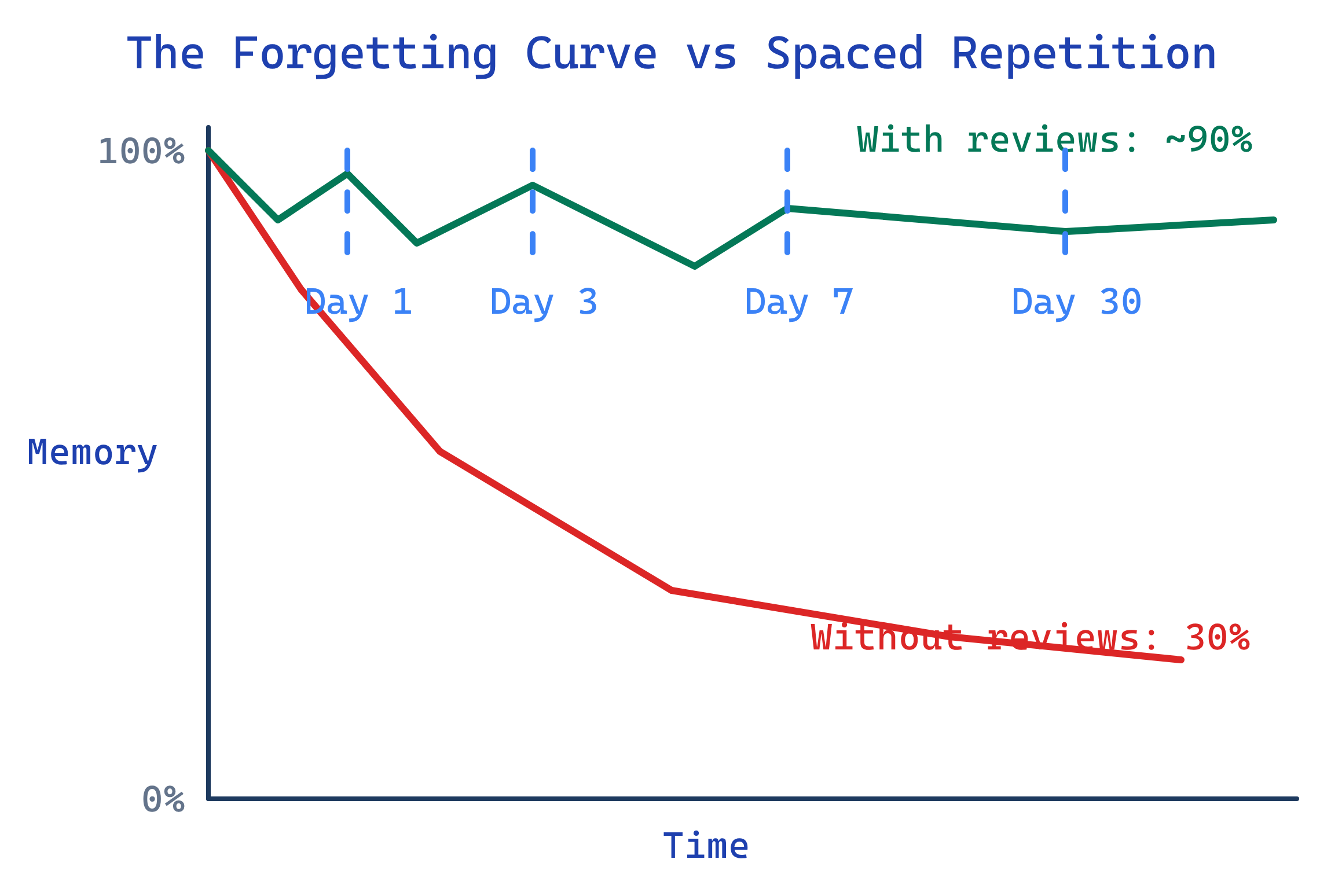
The Forgetting Curve (Ebbinghaus, 1885)
Hermann Ebbinghaus discovered something uncomfortable: we forget fast. Here's what happens to new information without any review:
| Time after learning | Retention (no review) | Retention (with spaced review) |
|---|---|---|
| 20 minutes | ~58% | — |
| 1 hour | ~44% | — |
| 24 hours | ~30% | ~80% (after 1 review) |
| 7 days | ~10% | ~85% (after 2 reviews) |
| 30 days | ~5% | ~90% (after 4 reviews) |
This isn't opinion — it's one of the most replicated findings in cognitive science. The good news: each review resets the curve, and it gets easier every time.
Active Recall — The Testing Effect
What it is
Active Recall is deliberately trying to retrieve information from memory — NOT re-reading your notes, NOT highlighting a textbook, NOT watching a video again. You close your materials and try to remember.
The science
Karpicke & Roediger (2008) ran a landmark study: students who tested themselves retained 80% of material after a week. Students who just re-read retained only 36%. Same material, same time spent — testing beat re-reading by more than 2x.
Why it works
The effort of remembering IS the exercise. Every time you try to pull a fact from memory, you strengthen the neural pathway. It's like lifting weights for your brain — the struggle is what builds the muscle.
6 practical methods
- Flashcards (Anki, Quizlet) — the classic. Question on front, answer on back.
- Brain dump — write everything you know from memory on a blank page. Then check what you missed.
- Practice problems — solve problems without looking at examples first.
- Teach someone else — if you can explain it, you know it.
- Practice tests — take sample exams under real conditions.
- QuickLearnPro's "Test Yourself" sections — like the one at the bottom of this page!
Spaced Repetition — Fighting the Forgetting Curve
The intervals
The magic schedule: 1 day → 3 days → 7 days → 14 days → 30 days → 90 days. Each review takes less time but has more impact.
| Review | When | Time needed | How it feels |
|---|---|---|---|
| Review 1 | Day 1 | ~15 minutes | Hard. You've forgotten a lot. This is normal. |
| Review 2 | Day 3 | ~10 minutes | Easier. Gaps are smaller. Confidence builds. |
| Review 3 | Day 7 | ~5 minutes | Mostly confident. Quick scan of weak spots. |
| Review 4 | Day 30 | ~2 minutes | Basically permanent now. Quick confidence check. |
Total time: ~32 minutes spread over a month vs 2 hours of cramming that vanishes in a week. Spaced Repetition isn't just more effective — it's more efficient.
Tools for Spaced Repetition
| Tool | Price | Best for | Auto-schedule? |
|---|---|---|---|
| Anki | Free (desktop & Android) | Serious learners. Medical students, language learners, certification prep. | Yes — algorithm shows cards you struggle with more often |
| Quizlet | Free tier available | Quick start. Social features. Pre-made decks. | Basic scheduling |
| RemNote | Free tier available | People who want notes + flashcards in one tool. | Yes |
| Calendar reminders | Free | Low-tech but effective. Set reminders at 1, 3, 7, 30 days. | Manual |
| QuickLearnPro | Free | Bookmark pages and revisit at intervals using the Test Yourself sections. | Manual |
Combining Active Recall + Spaced Repetition
Here's the day-by-day workflow that puts both techniques together:
| Day | Activity | Technique |
|---|---|---|
| Day 0 | Learn the topic using Feynman. Create flashcards (write questions, not answers — you'll recall the answers). | Feynman + Card creation |
| Day 1 | Active recall session: test yourself, check answers, mark what you got wrong. | Active Recall |
| Day 3 | Second recall. Easier now. Focus on what you missed last time. | Spaced Repetition |
| Day 7 | Third recall. Should be 80%+ correct. Quick pass. | Spaced Repetition |
| Day 30 | Final recall. Cemented in long-term memory. | Spaced Repetition |
Test Yourself
Q: What is Active Recall, and how is it different from re-reading?
Q: What is the forgetting curve, and what does it show?
Q: What are the recommended spaced repetition intervals?
Q: Name 3 practical methods for Active Recall.
Q: Why does cramming fail even though it feels productive?
Interview Questions
Q: How would you use spaced repetition to prepare for a certification exam?
Q: Explain the forgetting curve and how to beat it.
Q: What's the difference between recognition and recall in learning?