Core Concepts of Quick Learning
5 learning techniques that work: 80/20 Rule (focus on what matters), Feynman Technique (simplify to understand), Active Recall (test yourself), Spaced Repetition (time your reviews), and Immersion (surround yourself with context).
The Big Picture
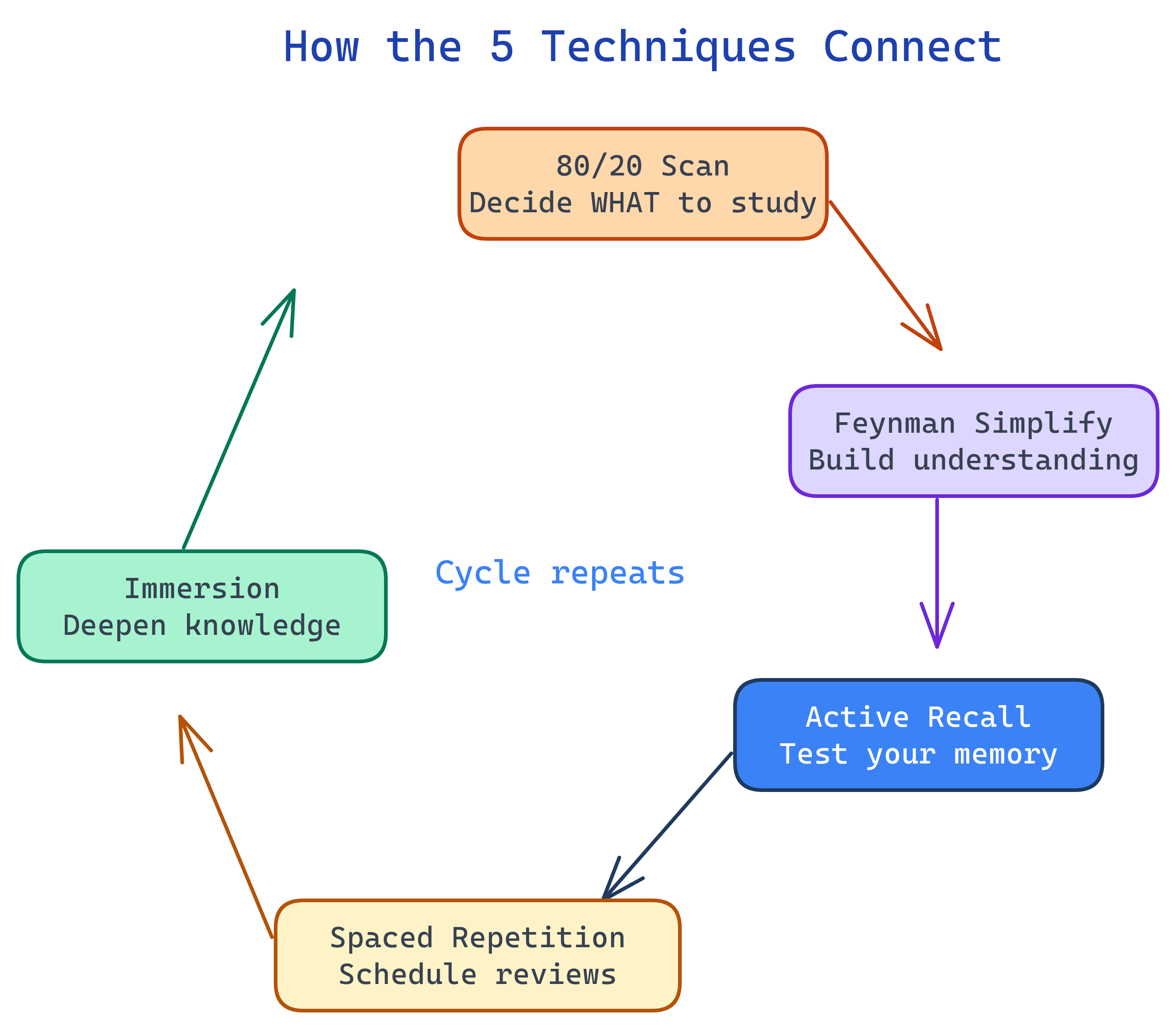
These 5 techniques aren't alternatives — they're a chain. Each one feeds into the next, and together they cover the entire learning cycle from "I know nothing" to "I could teach this."
Explain Like I'm 12
Learning is like building with LEGO. Step 1: Open the box and find the important pieces (80/20). Step 2: Read the instructions and explain them to your little brother (Feynman). Step 3: Try building WITHOUT looking at the instructions (Active Recall). Step 4: Take it apart and rebuild it a few days later, then a week later (Spaced Repetition). Step 5: Keep the finished model on your desk so you see it every day (Immersion). After a month, you could build it blindfolded.
Cheat Sheet
| Technique | The Rule | Practical Action |
|---|---|---|
| 80/20 Rule | 20% of input = 80% of output | Skim the TOC. Find the top 5 concepts. Ignore the rest (for now). |
| Feynman Technique | If you can't explain it simply, you don't understand it | Write a 1-paragraph ELI12 for each concept. No jargon allowed. |
| Active Recall | Testing > re-reading by 50%+ | After studying a section, close it. Write down everything you remember. |
| Spaced Repetition | Review at 1, 3, 7, 30 days | Use Anki, flashcards, or just calendar reminders. Don't cram. |
| Immersion | Context builds intuition | Follow experts on Twitter, listen to podcasts, join communities, do projects. |
The 5 Techniques in Detail
80/20 Rule (Pareto Principle)
Here's a secret that experienced learners know: 80% of results come from 20% of effort. The Italian economist Vilfredo Pareto noticed this pattern everywhere — 80% of land owned by 20% of people, 80% of peas from 20% of pods — and it applies to learning too.
In any subject, a small number of core concepts form the foundation that everything else builds on. Master those, and the rest clicks into place. Try to learn everything at once, and you drown in details that don't matter yet.
Example: In SQL, the commands SELECT, WHERE, JOIN, GROUP BY, and ORDER BY are probably the 20% that handle 80% of real-world queries. You don't need to memorize window functions, CTEs, and recursive queries on day one. Start with the vital few.
How to apply it:
- Skim the table of contents or course outline first — don't start reading from page 1
- Ask yourself: "If I could only learn 5 things about this subject, which 5 would let me do real work?"
- Prioritize those topics. Ignore the rest until you actually need them
- Talk to someone who already knows the subject: "What's the 20% I need?"
Feynman Technique
Named after the Nobel Prize-winning physicist Richard Feynman, who was famous for explaining impossibly complex physics in simple, everyday language. His secret wasn't that he was smarter than everyone else — it's that he refused to accept his own understanding until he could explain it simply.
The technique has 4 steps:
- Pick a concept you want to understand
- Explain it in plain English as if teaching a 12-year-old — no jargon, no hand-waving
- Identify the gaps — the places where your explanation gets fuzzy, where you say "um, it just kind of... works"
- Go back and fill the gaps — study specifically what you couldn't explain, then try again
The magic is in step 3. Writing the explanation exposes exactly what you don't understand. Most people skip this because it's uncomfortable to discover their own ignorance. But that discomfort is precisely where learning happens.
Real example: Can you explain how a database JOIN works to a 12-year-old? If you say "imagine you have two lists — one with students and their class numbers, and one with class numbers and teacher names — a JOIN matches them up so you get students with their teachers," you understand it. If you say "uh... it connects tables," you have a gap. Go fill it.
Active Recall
This is the single most research-backed learning technique in cognitive science. The testing effect shows that retrieving information from memory strengthens the memory trace far more than re-reading it. How much more? Studies consistently show 50%+ improvement in long-term retention compared to passive review.
The concept is dead simple: close the book, then try to write down everything you just learned. Don't peek. Don't use notes. Just brain-dump.
The stuff you remember? Great, it's getting reinforced. The stuff you can't remember? Even better — now you know exactly what to focus on. The struggle to recall something, even when you fail, strengthens the neural pathway for that memory.
Methods that use active recall:
- Flashcards — The classic. Question on one side, answer on the other. Anki automates the spacing.
- Practice problems — Doing exercises, not just reading solutions
- Summaries from memory — After reading a chapter, close it and write a summary without looking
- Teaching someone — Explaining a concept forces you to retrieve and organize it
- "Test Yourself" sections — Like the ones at the bottom of every QuickLearnPro page
Spaced Repetition
Remember the forgetting curve from the overview? Hermann Ebbinghaus showed that you forget about 70% of new information within 24 hours without review. That sounds depressing, but it has a powerful flip side: each review resets the curve AND makes it decay slower.
Here's how the intervals work:
- First review: 1 day later — Catches the steepest part of the forgetting curve. You'd have lost 70%, but this review brings you back to near-full retention.
- Second review: 3 days later — The curve is already decaying slower. This review is easier and faster.
- Third review: 7 days later — By now the memory is significantly stronger. A quick skim is usually enough.
- Fourth review: 30 days later — If you still remember it here, it's in long-term memory. Congratulations.
The key insight: spacing out your reviews is more effective than massing them together, even if you spend the same total amount of time. Three 20-minute sessions spread over a week beats one 60-minute cramming session every single time.
Tools that automate this:
- Anki (free) — The gold standard for spaced repetition flashcards. The community has pre-made decks for thousands of subjects.
- Quizlet — More beginner-friendly, with a built-in spaced repetition mode
- RemNote — Combines note-taking with spaced repetition
- Calendar reminders — Low-tech but effective. Set reminders at 1, 3, 7, and 30 days after learning something.
Immersion
Immersion is what separates "I studied this" from "I know this." It's the difference between someone who memorized Spanish vocabulary and someone who spent 3 months in Mexico. Your brain builds intuition through repeated, varied exposure in context — not just from focused study sessions.
Think of it as three levels:
- Passive immersion — Listening to podcasts, watching YouTube videos, following experts on social media. Low effort, high exposure. You absorb patterns and vocabulary without trying.
- Active immersion — Participating in forums, joining Discord servers, engaging in discussions, reading articles and blog posts with intention. You're processing and responding, not just consuming.
- Creative immersion — Building something, teaching someone, writing about what you've learned, contributing to a project. This is the deepest level because you're producing, not just consuming.
Example: Learning SQL? Here's what immersion looks like: Subscribe to SQL newsletters, follow database experts on social media, join r/SQL or a SQL Discord server, write queries daily at work (even if nobody asked you to), explain SQL concepts to your colleagues, build a personal project that uses a database. Within a few months, SQL stops being "something you're studying" and becomes "something you think in."
Immersion is the slowest of the 5 techniques. You won't see results in a day or a week. But it builds the deepest, most durable understanding — the kind that lets you solve novel problems, not just answer textbook questions.
How They Work Together
The 5 techniques aren't alternatives you pick from — they're a sequence. Each one answers a different question in the learning process:
You don't have to use all 5 at once. Start with 80/20 and Feynman for your first study session. Add Active Recall by session two. Layer in Spaced Repetition after your first week. Immersion builds naturally over time. The system compounds — the longer you use it, the faster you learn.
Test Yourself
What is the Feynman Technique's 4-step process?
Why is Active Recall more effective than re-reading?
What are the optimal intervals for Spaced Repetition?
How does the 80/20 rule apply to learning a new technology?
SELECT, WHERE, JOIN, GROUP BY, and ORDER BY handle 80% of real-world queries. Master the vital few first, then learn the rest as needed.Name 3 levels of immersion from passive to creative.