Your Learning System
A practical day-by-day system that combines all 5 techniques into a repeatable workflow: Week 1 (80/20 scan + Feynman notes), Week 2 (Active Recall + first review), Week 3 (Practice + Immersion), Week 4+ (Spaced Repetition + Deep Immersion). Includes templates, tools, and daily habits.
Explain Like I'm 12
It's like a workout plan for your brain. You wouldn't go to the gym and just randomly use machines — you'd follow a plan that tells you what to do each day. This is your learning gym plan: it tells you exactly what technique to use, when to use it, and how long to spend.
Week 1 = learn the basics. Week 2 = quiz yourself. Week 3 = practice for real. Week 4 = make it permanent. Follow the plan and you'll know any subject in 30 days.
The 4-Week Timeline
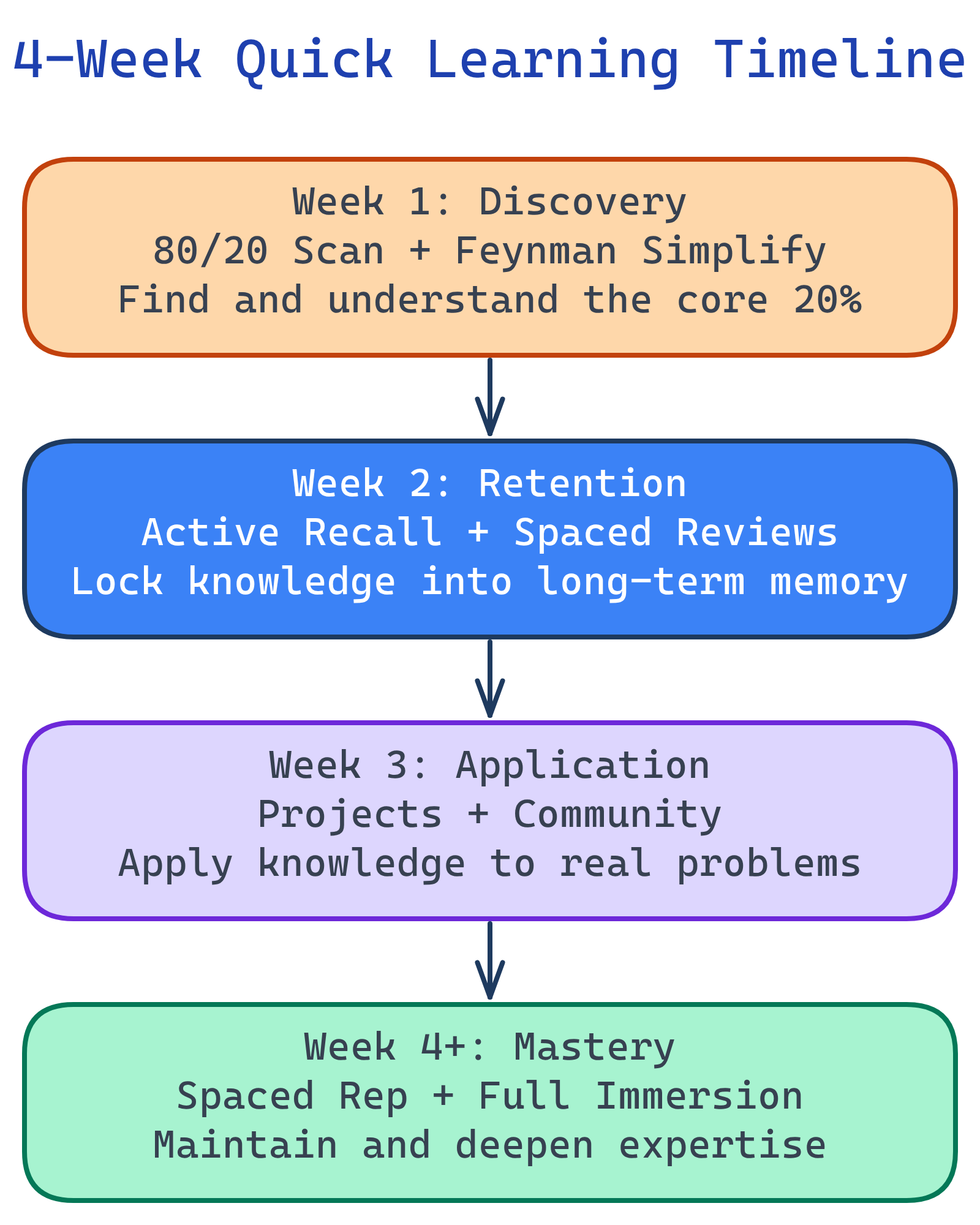
Week 1: Discovery (80/20 + Feynman)
Your only goal this week: find the important stuff and understand it simply.
| Day | Activity | Technique | Time |
|---|---|---|---|
| Day 1 | Skim the subject. Read table of contents, overview, introduction. Identify the top 5-7 concepts. | 80/20 | 1-2 hours |
| Day 2-3 | Study concepts 1-2. Write Feynman ELI12 explanations. Create flashcards. | Feynman | 1 hour/day |
| Day 4-5 | Study concepts 3-5. Same process: read, explain, create cards. | Feynman | 1 hour/day |
| Day 6 | Study concepts 6-7. Same process. | Feynman | 1 hour |
| Day 7 | Compile your "personal cheat sheet" — one page with all your Feynman explanations. | Synthesis | 30 min |
Week 2: Retention (Active Recall + First Reviews)
Now that you've learned the material, the goal is to lock it in before the forgetting curve erases it.
| Day | Activity | Technique | Time |
|---|---|---|---|
| Day 8 | First spaced review of all Week 1 material. Close notes, brain dump, check gaps. | Active Recall | 30 min |
| Day 9-10 | Go deeper into your weakest concepts. Re-do Feynman on what confused you. | Feynman | 45 min/day |
| Day 11 | Second review of Day 1-3 material (3-day interval). | Spaced Repetition | 15 min |
| Day 12-13 | Try a small project or practice problem using what you've learned. | Application | 1 hour/day |
| Day 14 | Review ALL material from memory. Update your cheat sheet with better explanations. | Active Recall | 30 min |
Week 3: Application (Practice + Immersion)
You know the theory. Now use it in the real world to make it stick.
| Day | Activity | Technique | Time |
|---|---|---|---|
| Day 15-17 | Build something. Solve real problems. Apply your knowledge to an actual project. | Application | 1-2 hours/day |
| Day 18 | 7-day spaced review of Week 1 material. Should be quick and confident now. | Spaced Repetition | 10 min |
| Day 19-20 | Join a community (Reddit, Discord, Slack). Start reading discussions, not just tutorials. | Immersion | 30 min/day |
| Day 21 | Teach someone what you've learned. Write a blog post, explain it to a colleague, or teach a rubber duck. | Feynman + Immersion | 1 hour |
Week 4+: Mastery (Spaced Repetition + Deep Immersion)
The foundation is built. Now you're maintaining and expanding.
- 30-day review of all core material. Should take under 5 minutes. If something's fuzzy, re-do the Feynman cycle for that concept.
- Continue daily immersion: podcasts, articles, conversations, following experts on social media.
- Expand into the remaining 80% as needed for specific projects. Now you have the foundation to learn advanced topics quickly.
- The goal: you can explain any core concept from memory, without notes, to a 12-year-old.
Daily Habits (15 minutes/day)
After the initial 4-week push, maintain your knowledge with just 15 minutes a day:
| Time | Activity | Technique |
|---|---|---|
| 5 min | Anki/flashcard review (spaced repetition) | Spaced Repetition |
| 5 min | Read one article or post about the subject (immersion) | Immersion |
| 5 min | Write one Feynman explanation from memory (active recall + Feynman) | Active Recall + Feynman |
Your Toolkit
| Tool | What it does | Free? |
|---|---|---|
| Anki | Spaced repetition flashcards with smart scheduling | Yes (desktop & Android) |
| Notion / Obsidian | Feynman notes, cheat sheets, linked knowledge base | Yes |
| QuickLearnPro | Ready-made TL;DRs, ELI12s, Test Yourself questions for common topics | Yes |
| Pomodoro timer | 25-minute focused sessions with 5-minute breaks | Yes (any timer app) |
| Calendar | Schedule spaced reviews at 1, 3, 7, 30 day intervals | Yes (Google Calendar or similar) |
Templates
Copy-paste these templates to get started immediately:
Feynman Note Template
| Field | What to write |
|---|---|
| Concept | [Name of the concept] |
| ELI12 | [Your plain-English explanation, as if teaching a 12-year-old] |
| Gaps I found | [Where you got stuck or hand-waved] |
| Simplified | [Your revised explanation after filling the gaps] |
Flashcard Template
| Side | Content |
|---|---|
| Front | A question about the concept (not a definition — a question you'd ask yourself) |
| Back | The answer in your own words (not copied from the source) |
Cheat Sheet Template
One page. 7 rows. Each row has:
| Concept | 1-sentence explanation | 1-sentence example |
|---|---|---|
| [Concept 1] | [Plain English] | [Concrete example] |
| [Concept 2] | [Plain English] | [Concrete example] |
| ... up to 7 concepts ... | ||
Common Pitfalls
| Pitfall | Why it happens | The fix |
|---|---|---|
| Spending too much time on tools instead of studying | Analysis paralysis. Setting up the perfect Notion template feels productive but isn't. | Pick one tool. Set up in 10 minutes. Start studying. |
| Skipping reviews because "I already know this" | Overconfidence. The forgetting curve is real even when you feel confident. | Do the review anyway. It takes 2 minutes. If you're right, great — it took 2 minutes. |
| Not actually testing yourself | Passive consumption feels easier and more comfortable. | After every section: close, recall, write, check. Every time. |
| Trying to learn too many things at once | Excitement. Shiny object syndrome. | One subject at a time. Master it in 4 weeks. Then move to the next. |
Test Yourself
Q: What happens in each of the 4 weeks of the learning system?
Q: What are the 3 daily habits, and how long do they take?
Q: Why should your cheat sheet fit on one page?
Q: What's the biggest pitfall in this system, and how do you avoid it?
Q: How much total study time does this system require over 30 days?
Interview Questions
Q: Describe your approach for learning a new technology in 30 days.
Q: How do you balance depth vs breadth when learning?
Q: What tools do you use for personal knowledge management?