IELTS Listening
30 minutes + 10 min transfer time. 4 sections (10 questions each), 40 questions total. Audios are played only once. Sections 1–2 use everyday contexts; Sections 3–4 use academic contexts. Main question types: form completion, MCQ, matching, map/plan labeling, note completion. Spelling errors cost marks — double-check transfer time.
The 4-Section Structure
The Listening section uses a carefully designed progression from easy to hard. Knowing what to expect in each section lets you mentally prepare and allocate focus.
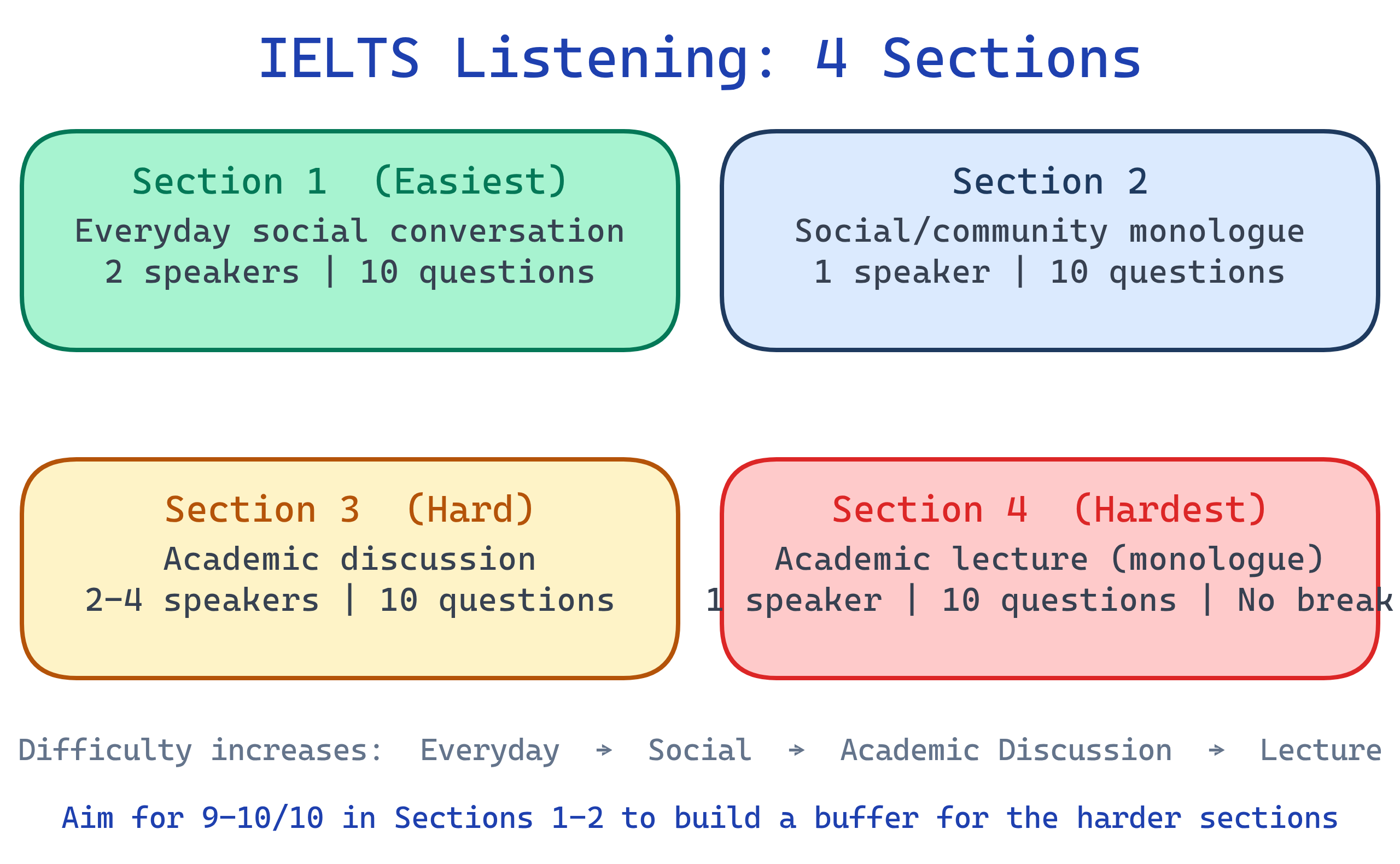
| Section | Context | Format | Difficulty |
|---|---|---|---|
| Section 1 | Everyday social situation (e.g., booking a hotel, registering for a course) | Conversation between 2 people | Easiest |
| Section 2 | Social or community context (e.g., a guided tour, local radio announcement) | Monologue by 1 person | Moderate |
| Section 3 | Academic context (e.g., students discussing an assignment, tutor giving feedback) | Conversation between 2–4 people | Hard |
| Section 4 | Academic lecture (e.g., university lecture on a scientific topic) | Monologue by 1 person (lecturer) | Hardest |
Question Types and Strategies
Form / Note / Table Completion
You fill in blanks in a form, set of notes, or table. The answers are usually single words, numbers, or short phrases from the audio. The maximum word count is specified (e.g., "write NO MORE THAN TWO WORDS AND/OR A NUMBER").
Example: "Date of birth: ___________" → You know to listen for a date format.
"Reason for visit: ___________" → You know to listen for a noun or short phrase.
Multiple Choice (MCQ)
Choose one answer from A/B/C, or multiple answers from a longer list. MCQ is tricky because the audio often mentions all options — you need to identify the correct one from context.
Matching
Match items in a list (e.g., people, times, features) to options from another list. The options are usually used only once, though some may not be used at all.
Map / Plan / Diagram Labeling
Label locations on a map or diagram. The speaker usually describes locations relative to each other ("The library is opposite the car park, next to the main entrance").
Sentence / Summary Completion
Complete sentences or a summary paragraph using words from the recording. Similar to note completion but in continuous prose form.
Common Traps and How to Avoid Them
- Homophones: "mail" vs "male", "there/their/they're", "flour/flower". Spell correctly — sound-alike mistakes are penalised.
- Distractors: The audio deliberately mentions wrong options to mislead. Listen for corrections and final decisions, not first mentions.
- Spelling: All answers must be spelled correctly. "Goverment" instead of "Government" = 0 marks. Practice spelling common words used in IELTS contexts.
- Plurals: "facilities" vs "facility" — the form must match the question exactly.
- Word limit: "NO MORE THAN TWO WORDS" means 1 or 2 words. Three words = automatic 0, even if the content is correct.
- Missing Section 4: Many test-takers zone out in Section 4 after a tiring Section 3. Section 4 is often the best opportunity to show academic vocabulary knowledge — stay focused.
Note-Taking During Listening
Effective note-taking is about writing key words — not full sentences — as you listen. Your goal is to record what you might need after the audio, not to transcribe it.
What to write: Numbers, names, key nouns, dates, prices, anything that directly answers a question blank.
What NOT to write: Articles ("a", "the"), prepositions unless they're part of a fixed phrase, connecting words ("because", "however").
Reaching Your Target Band
| Target Band | Correct Answers Needed | Key Focus |
|---|---|---|
| 6.0 | ~23–25 out of 40 | Sections 1–2 near-perfect; at least 5–7 correct in each of Sections 3–4 |
| 6.5 | ~26–29 out of 40 | Consistent accuracy in Sections 1–2; improve Section 3 matching and MCQ |
| 7.0 | ~30–31 out of 40 | Near-perfect Sections 1–2; solid Section 3; aim for 6–8 correct in Section 4 |
| 7.5+ | ~32+ out of 40 | Near-perfect across all sections; zero spelling errors |
Test Yourself
In IELTS Listening, the instructions say "Write NO MORE THAN TWO WORDS." You write "a yellow hat" — is this correct?
No. "a yellow hat" is three words. Even if the content is correct, exceeding the word limit results in zero marks. The correct answer would be "yellow hat" (two words). Articles like "a", "an", "the" count as words.
A speaker in Section 3 says: "We could go with Survey A... actually, let's use Survey B — it's more recent." You answer Survey A. Is this correct?
No. This is a classic distractor. The final decision is Survey B. In IELTS Listening, always wait for the speaker to complete their thought before recording an answer. Corrections and self-revisions are common traps.
Which section of the IELTS Listening test uses a monologue in an academic context?
Section 4. It is a university-style academic lecture delivered by one speaker. It has no breaks and is considered the hardest section because the content is complex and no conversation aids comprehension.
Practice Questions
Q: You hear a woman say her booking reference is "W for Whiskey, 4, 7, K for Kilo." What is the booking reference?
W47K. In Section 1, spelling out letters using the NATO phonetic alphabet (Alpha, Bravo, Charlie…) is extremely common. Learn the full NATO alphabet before your test.
Q: The map shows a car park, a library, and a sports centre. The speaker says: "From the car park, walk past the library and turn right — the sports centre is the second building on your left." Which direction is the sports centre from the library?
The sports centre is to the right of the library (since you turn right after passing the library, and it's the second building on your left). Map questions require you to track directional language carefully — draw arrows as you listen if that helps.