IELTS Reading
60 minutes, 3 passages, 40 questions. No extra transfer time — write directly on the answer sheet. Academic uses complex texts from journals/books; General Training uses everyday texts. The key skill: identify the question type first, then choose the right reading strategy (skim, scan, or detailed read). True/False/Not Given and matching headings trip up the most test-takers — understand their logic before test day.
Reading Section Format
| Feature | IELTS Academic | IELTS General Training |
|---|---|---|
| Texts | 3 long passages (total ~2,000–2,750 words) from academic sources — books, journals, magazines | Multiple shorter texts — advertisements, workplace notices, training manuals, everyday articles |
| Difficulty | Complex vocabulary and sentence structures; abstract topics | More accessible vocabulary; practical, real-world topics |
| Questions | 40 questions; difficulty increases from Passage 1 to Passage 3 | 40 questions across three sections with increasing difficulty |
| Timing | 60 minutes; no transfer time — write answers directly on answer sheet | 60 minutes; same rule |
The 14 Question Types
1. True / False / Not Given (TFNG)
You're given statements and must decide whether the passage confirms them (True), contradicts them (False), or doesn't mention them at all (Not Given).
Example:
Statement: "The researcher conducted experiments in three countries."
Passage says: "The researcher is known for her international work."
Answer: Not Given — the passage hints at international work but never says three countries.
2. Yes / No / Not Given (YNNG)
Similar to TFNG but tests whether a statement agrees with the writer's views/claims (Yes), disagrees (No), or is not addressed (Not Given). YNNG tests opinions and claims; TFNG tests factual information.
3. Matching Headings
Match headings from a list to sections/paragraphs of the passage. The heading should capture the main idea of the paragraph — not just mention one detail in it.
4. Matching Information
Match specific information (facts, claims, reasons) to the paragraph where they appear. You may use any letter more than once. Multiple correct answers may be in a single paragraph.
5. Matching Features
Match features (characteristics, findings, opinions) to a list of options (people, dates, categories). Options may be used more than once or not at all.
6. Multiple Choice (MCQ)
Choose the best answer from 3–4 options (or multiple correct answers from a longer list). All options will relate to the text — the difference lies in accuracy and completeness.
7. Sentence Completion
Complete sentences using words from the passage. The word limit (usually "NO MORE THAN TWO WORDS") applies. Copy words exactly as they appear in the passage.
8. Summary Completion
Complete a summary paragraph using words from the text, or choose from a box of words. Unlike sentence completion, the summary may paraphrase the passage — meaning you can't just scan for the exact words.
9. Note Completion
Fill in blanks in a set of notes or a table. Usually covers a specific section of the passage. Quick to answer once you've located the right part of the text.
10. Short-Answer Questions
Answer questions using words directly from the text (typically 1–3 words). The answers are specific facts — names, numbers, processes.
11. Diagram Label Completion
Label a diagram (a map, a process, a device) using words from the text. Usually covers a descriptive passage about a physical process or object.
12–14. Flow Chart, Table, and Pick from a List
These are less common variants. Flow chart and table completion work like note completion. "Pick from a list" asks you to choose 2–3 correct answers from a longer list.
Reading Strategies: When to Use Each
| Strategy | How to Do It | Best Used For |
|---|---|---|
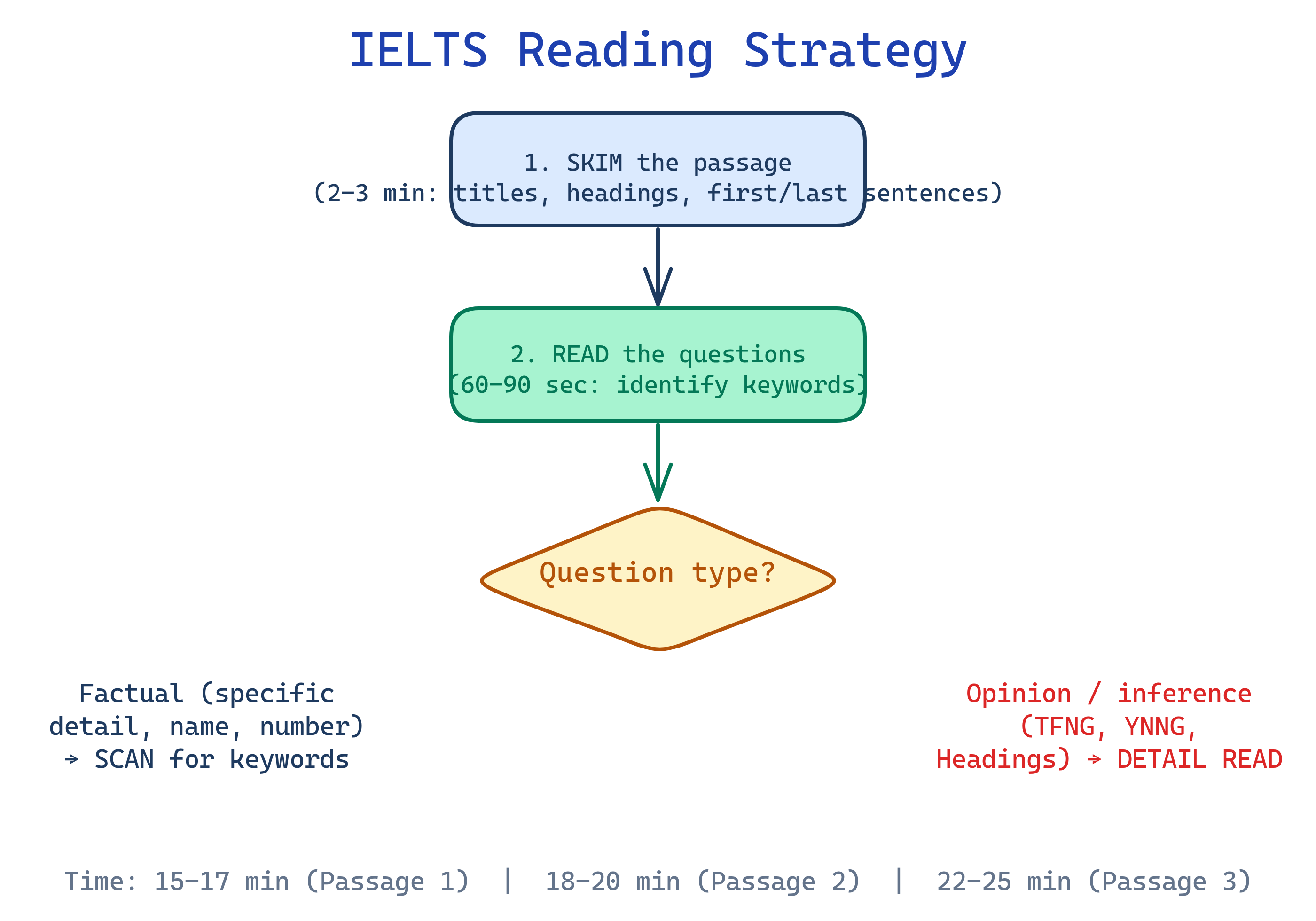
| Skimming | Read the title, subheadings, first/last sentences of paragraphs, and bold text. Takes 2–3 min per passage. | Getting the overall structure and main idea before answering questions. Always skim before reading questions. |
| Scanning | Move your eyes quickly over the text looking for a specific keyword, number, or name. Don't read sentences — hunt for the target. | Locating where in the text a specific fact, name, date, or figure appears. Then read around that area in detail. |
| Detailed Reading | Read carefully, sentence by sentence, tracking meaning across phrases. | TFNG, YNNG, MCQ, matching headings — questions that test inference and the writer's overall meaning. |
Time Management
Sixty minutes for three passages means a maximum of 20 minutes per passage. In practice, Passage 3 (hardest) needs more time than Passage 1 (easiest). A good allocation:
- Passage 1: 15–17 minutes
- Passage 2: 18–20 minutes
- Passage 3: 22–25 minutes
Common Mistakes
- Confusing False and Not Given — False requires explicit contradiction; Not Given means the text is silent on the matter.
- Using prior knowledge — Only use what's in the text. Your real-world knowledge about a topic is irrelevant (and often misleading).
- Exceeding word limits — "The Ancient Roman Empire" is 4 words. If the limit is 2 words, you might write just "Roman Empire".
- Misreading matching headings — A heading that picks up on one interesting detail from a paragraph is wrong; it must capture the paragraph's central argument.
- Not transferring directly — Unlike Listening, you write on the answer sheet from the start. Forgetting this leads to time pressure at the end.
Test Yourself
A passage says: "The ancient Romans built roads using a multi-layer technique." The statement says: "The Romans used a single-layer construction method for roads." How should you answer in a True/False/Not Given question?
False. The passage explicitly contradicts the statement — "multi-layer" vs "single-layer". This is a clear contradiction, so the answer is False (not Not Given).
A passage discusses solar panel technology. A statement says: "Solar panels were first invented in Japan." The passage never mentions Japan or who invented solar panels. What is the answer?
Not Given. The passage doesn't mention Japan or the origin of solar panels. You cannot conclude it's False — you can only say the information isn't in the text.
In IELTS Academic Reading, which passage is generally the most difficult?
Passage 3. The three passages increase in complexity from Passage 1 to Passage 3. Passage 3 often contains the most abstract ideas, the most complex vocabulary, and the most challenging question types (like Matching Headings and YNNG).
Practice Questions
Q: You need to answer a matching headings question. A paragraph starts: "Despite these challenges, researchers found a solution that reduced costs by 40%. The method, while complex, proved durable over time." Which type of heading is most likely correct?
A heading that reflects the main idea of "finding a solution despite challenges" — something like "A Cost-Effective Breakthrough" or "Overcoming Technical Barriers." A heading about "40% cost reduction" alone would be too narrow — it's a detail, not the whole paragraph's focus.
Q: In a sentence completion task, the instruction says "NO MORE THAN ONE WORD." The passage says "...the company relocated its headquarters to the financial district." The question is "The company moved its _________ ." What is the answer?
headquarters. One word from the passage. Note: "financial district" from the passage is a distraction — it answers "where", not "what" was moved. The blank follows "its" so you need a noun that completes "its headquarters."