IELTS Writing
60 minutes, 2 tasks. Task 1 (20 min): describe a graph/chart/map/process (Academic) or write a formal/informal letter (GT). Task 2 (40 min): argumentative essay on a general topic. Task 2 is worth double the marks — prioritise it. Both tasks are scored on four equal criteria: Task Achievement, Coherence & Cohesion, Lexical Resource, Grammatical Range & Accuracy.
Task 1 vs Task 2 at a Glance
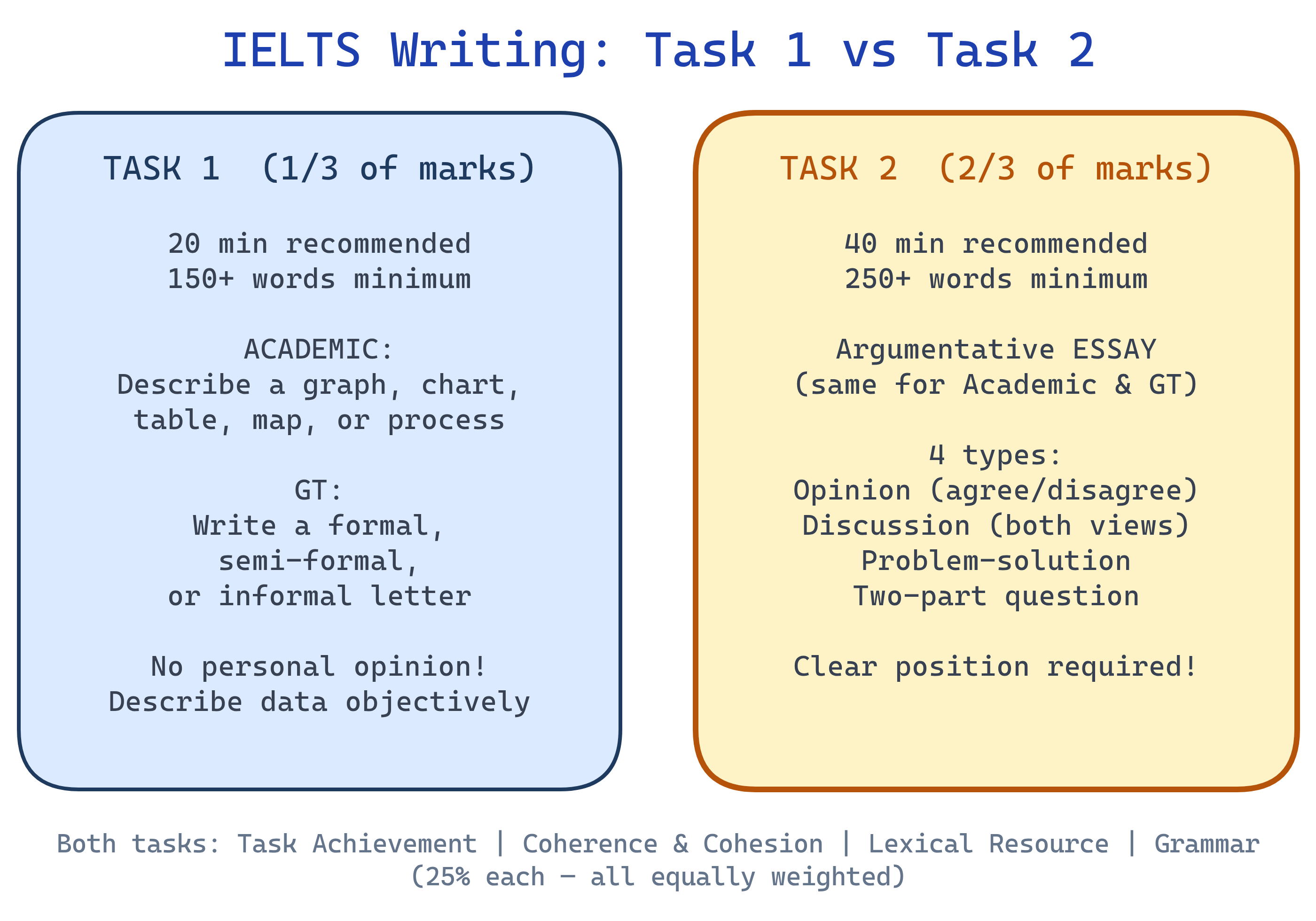
| Feature | Task 1 | Task 2 |
|---|---|---|
| Academic prompt | Describe a graph, chart, table, map, or process | Argumentative essay (opinion, discussion, problem-solution, two-part question) |
| GT prompt | Write a letter (formal, semi-formal, or informal) | Same as Academic Task 2 |
| Minimum words | 150 words | 250 words |
| Recommended time | 20 minutes | 40 minutes |
| Weight | 1/3 of Writing score | 2/3 of Writing score |
Scoring Criteria (Both Tasks)
Each task is scored on four criteria, each weighted equally at 25%:
| Criterion | What It Measures | Band 7 Example |
|---|---|---|
| Task Achievement / Task Response | Did you fully address the task? Is your position clear and well-supported? | All parts of the task addressed; clear position with relevant, extended ideas |
| Coherence & Cohesion | Is the essay logically organised? Are ideas connected with appropriate linking devices? | Clear progression; appropriate use of linking words; cohesive devices not overused |
| Lexical Resource | Vocabulary range, accuracy, and sophistication | Sufficient vocabulary with flexibility; occasional minor errors; uses less common items |
| Grammatical Range & Accuracy | Sentence structure variety and accuracy | Mix of simple and complex structures; frequent error-free sentences |
Task 1: Academic — Graph and Chart Description
You will be given one visual: a line graph, bar chart, pie chart, table, map (showing change over time), or process diagram. You must describe the key features objectively — do not interpret, explain causes, or give opinions.
Task 1 Academic Structure (4 paragraphs)
- Introduction (1–2 sentences): Paraphrase the title/caption to state what the visual shows. Do NOT copy the question verbatim.
- Overview (2–3 sentences): The 2–3 most significant trends, features, or comparisons. This is the most important paragraph — it shows you understand the big picture.
- Body 1 (3–5 sentences): Describe one major feature in detail with data.
- Body 2 (3–5 sentences): Describe another major feature in detail with data.
Example overview for a bar chart:
"Overall, it is evident that Country A consistently had the highest sales figures throughout the period, while Country C experienced the most dramatic increase, particularly between 2015 and 2020."
Task 1 GT — Letter Writing
General Training Task 1 requires a letter of at least 150 words. The tone depends on the audience:
- Formal: Writing to a company, government, or stranger. Use "Dear Sir/Madam", "I am writing to…", "I would be grateful if…", "Yours faithfully."
- Semi-formal: Writing to a manager, landlord, or someone you know professionally. Use "Dear Mr/Ms [Name]", "I hope this letter finds you well.", "Yours sincerely."
- Informal: Writing to a friend or family member. Use "Dear [First Name]", colloquial language, contractions ("I've", "you're"), "Best wishes" or "Take care."
Task 2: The Essay
Task 2 essays all fall into four main question types. Identifying the type immediately tells you what structure to use.
Essay Types and Structures
| Essay Type | Signal Words | Structure |
|---|---|---|
| Opinion (Agree/Disagree) | "To what extent do you agree or disagree?" | Intro (paraphrase + clear opinion) → BP1 (first reason) → BP2 (second reason) → Conclusion (restate opinion) |
| Discussion (Both Views) | "Discuss both views and give your opinion" | Intro → BP1 (View A) → BP2 (View B) → BP3 (your opinion) → Conclusion |
| Problem-Solution | "What are the causes of X? What solutions can you suggest?" | Intro → BP1 (cause 1 + cause 2) → BP2 (solution 1 + solution 2) → Conclusion |
| Two-Part Question | "Why is X happening? Is this a positive or negative development?" | Intro → BP1 (answer to Q1) → BP2 (answer to Q2) → Conclusion |
Task 2 Introduction Formula
Sentence 1: Paraphrase the topic (don't copy the question).
Sentence 2: State your position or indicate what the essay will discuss.
Example prompt: "Some people think that the best way to improve road safety is to increase the minimum age for driving. To what extent do you agree?"
Model introduction: "Road safety is a growing concern in many countries, and some argue that raising the minimum driving age would be the most effective way to address this issue. While I agree that young drivers pose a higher risk, I believe that stricter driver training programmes would be a more practical and comprehensive solution."
Linking Words for Band 7+
Using a variety of linking words (not just "also", "but", "and") is essential for Coherence and Cohesion.
- Adding: Furthermore, Moreover, In addition, What is more
- Contrasting: However, Nevertheless, On the other hand, Conversely, Despite this
- Cause/Result: As a result, Consequently, Therefore, Hence, This leads to
- Exemplifying: For instance, For example, To illustrate, A case in point is
- Conceding: Admittedly, It is true that, While X is the case, Granted
Getting to Band 7
- Write at least 150 words for Task 1 and 250+ for Task 2 — undercounting loses marks automatically
- Always include an overview in Task 1 Academic — no overview = maximum Band 5 for Task Achievement
- Use paraphrasing in your introduction — copying the question verbatim shows poor Lexical Resource
- Vary sentence structures: mix simple, compound, and complex sentences
- Avoid informal language in Academic/Formal contexts: "a lot of" → "a significant number of", "good" → "beneficial", "bad" → "detrimental"
- Leave 2–3 minutes to proofread: fix subject-verb agreement, articles ("a", "the"), and plural/singular errors
Test Yourself
An IELTS Academic Task 1 shows a bar chart. You write 160 words and include only one body paragraph describing all the bars. What is likely to be your biggest weakness?
Missing an overview paragraph (or writing one that isn't clearly identified as an overview). Without an overview — which summarises the 2–3 most significant trends — Task Achievement is capped at Band 5. Split your body into two paragraphs to allow for better organisation (Coherence & Cohesion).
A Task 2 prompt says: "Some people believe that social media has had a negative impact on society. To what extent do you agree or disagree?" You decide to argue that you partially agree. How would you structure your essay?
For a "partially agree" position, use a semi-agree structure: Introduction (paraphrase + state partial agreement) → BP1 (arguments for the negative impact — the side you agree with) → BP2 (arguments against, showing positives — why it's not entirely negative) → Conclusion (restate partial position). This is also called a "concession" structure.
Your Task 2 essay word count is 230 words. Is this acceptable?
No. The minimum for Task 2 is 250 words. Writing fewer than 250 words results in a penalty under Task Response (the examiner notes "under-length" response). Aim for 265–290 words — long enough to cover the topic fully, not so long you run out of time.
Practice Questions
Q: Write an introduction for this Task 2 prompt (practice paraphrasing): "Many people believe that university education should be free for all students. Others think that students should pay for their own tuition. Discuss both views and give your own opinion."
Model introduction: "The debate over whether higher education should be publicly funded or individually financed has been ongoing for decades. While proponents of free university argue that equal access to education is a basic right, others contend that students who benefit directly should bear the cost. This essay will examine both perspectives before arguing that a mixed model, combining government subsidies with income-contingent loans, offers the most equitable solution."
Key features: Topic paraphrased (not copied), both views acknowledged, personal position signposted.