IELTS Vocabulary
IELTS rewards precise, varied vocabulary — called Lexical Resource in the scoring criteria. Master the Academic Word List (570 word families covering ~10% of academic texts), learn topic vocabulary for 8 common IELTS themes, use accurate collocations, and develop strong paraphrasing skills. Avoid overused words like "good", "bad", "a lot", and "very". Lexical Resource is equally weighted with Grammar, Coherence, and Task Achievement.
Why Vocabulary Matters
Lexical Resource is one of the four equally weighted scoring criteria in both IELTS Writing and Speaking. At Band 6, you use adequate vocabulary with some repetition and occasional errors. At Band 7, you use a wider range with flexibility, and errors are rare and don't cause misunderstanding. At Band 8+, you use less common vocabulary naturally, paraphrase effectively, and show stylistic awareness.
The Academic Word List (AWL)
The Academic Word List (Coxhead, 2000) contains 570 word families that appear frequently in academic texts but not in general everyday conversation. Knowing these words boosts your Reading comprehension and gives you the vocabulary to achieve higher bands in Writing and Speaking.
Top AWL Word Families to Know
| Word Family | Noun | Verb | Adjective |
|---|---|---|---|
| analyse | analysis, analyst | analyse | analytical |
| assess | assessment | assess | assessable |
| significant | significance | signify | significant |
| establish | establishment | establish | established |
| contribute | contribution, contributor | contribute | contributory |
| define | definition | define | definitive, defined |
| evidence | evidence | — | evident, evidential |
| indicate | indicator, indication | indicate | indicative |
| demonstrate | demonstration | demonstrate | demonstrable |
| impact | impact | impact | impactful |
Topic Vocabulary by Theme
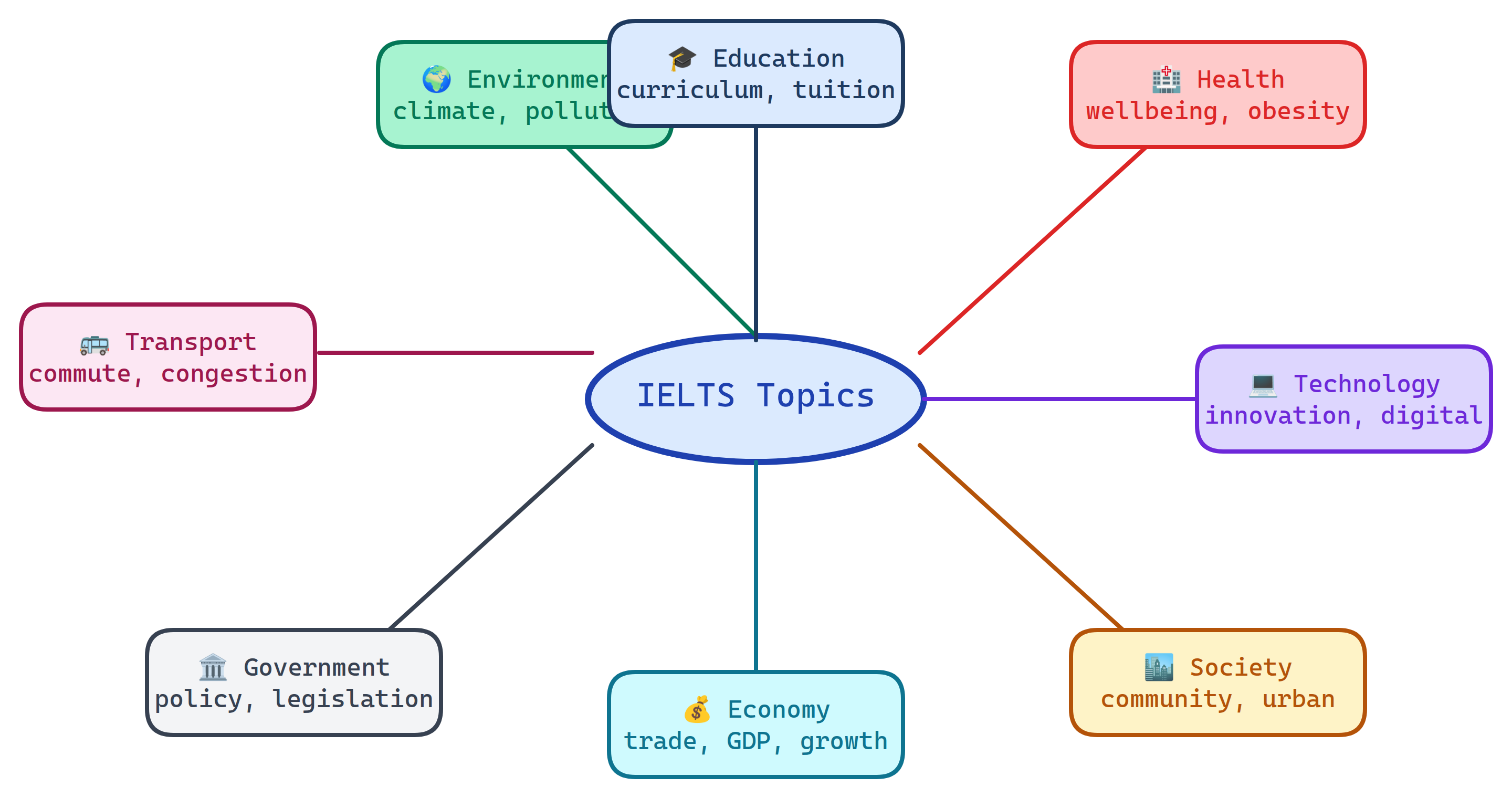
IELTS Writing Task 2 and Speaking Part 3 draw from a limited set of recurring themes. Preparing vocabulary for each theme gives you immediate access to relevant words during the test.
1. Environment
- Key nouns: carbon emissions, deforestation, biodiversity, renewable energy, ecosystem, pollution, climate change, habitat destruction, greenhouse gases
- Key verbs: deplete, devastate, mitigate, offset, sustain, contaminate, conserve
- Key phrases: "the ecological footprint of", "a sustainable approach to", "irreversible damage to the environment", "the net-zero target"
2. Education
- Key nouns: curriculum, academic performance, tuition fees, vocational training, higher education, literacy rate, pedagogical approach
- Key verbs: enroll, facilitate, assess, impart, broaden (knowledge), nurture (talent)
- Key phrases: "equal access to education", "the quality of teaching", "lifelong learning", "academic achievement"
3. Health
- Key nouns: healthcare system, obesity, mental health, preventive medicine, life expectancy, sedentary lifestyle, well-being
- Key verbs: treat, diagnose, prevent, deteriorate, combat, tackle (obesity)
- Key phrases: "rising rates of chronic disease", "a balanced diet", "physical and mental well-being", "public health initiatives"
4. Technology
- Key nouns: artificial intelligence, automation, digital divide, cybercrime, innovation, surveillance, social media, algorithm
- Key verbs: disrupt, transform, automate, monitor, infringe (on privacy), leverage
- Key phrases: "the pace of technological advancement", "digital literacy", "the ethical implications of AI", "data privacy concerns"
5. Society and Culture
- Key nouns: social cohesion, multiculturalism, inequality, gender gap, immigration, ageing population, community
- Key verbs: integrate, assimilate, marginalise, bridge (the gap), foster, promote
- Key phrases: "social mobility", "cultural diversity", "generational divide", "the erosion of traditional values"
6. Economy
- Key nouns: GDP, unemployment, inflation, globalisation, income inequality, emerging market, entrepreneurship
- Key verbs: stimulate, boost, decline, fluctuate, generate (revenue), alleviate (poverty)
- Key phrases: "the widening wealth gap", "economic growth rate", "fiscal policy", "the cost of living"
7. Government and Law
- Key nouns: legislation, regulation, policy, corruption, democracy, taxation, law enforcement
- Key verbs: enforce, implement, restrict, prohibit, penalise, incentivise
- Key phrases: "stricter regulations on", "a deterrent against crime", "government intervention", "civil liberties"
8. Transport and Urban Development
- Key nouns: infrastructure, congestion, public transport, urban sprawl, pedestrian zone, emission standards
- Key verbs: commute, alleviate (congestion), expand, redevelop, prioritise
- Key phrases: "sustainable urban planning", "traffic congestion", "investment in infrastructure", "the carbon footprint of transport"
Key Collocations
Collocations are word pairs that naturally go together in English. Using correct collocations improves your Lexical Resource band significantly — examiners notice when learners choose the "wrong" partner word.
| Incorrect Collocation | Correct Collocation |
|---|---|
| make a big increase | experience / show a significant increase |
| do a crime | commit a crime |
| make research | conduct / carry out research |
| get a solution | find / provide a solution |
| raise awareness to | raise awareness of / about |
| strong evidence of | strong evidence for / that |
| take a decision | make a decision |
| highly impossible | virtually impossible |
Paraphrasing Techniques
Paraphrasing — expressing the same idea in different words — is essential for IELTS Writing (introduction and summary) and helps avoid repetition throughout your response.
4 Paraphrasing Methods
| Method | Original | Paraphrase |
|---|---|---|
| Synonyms | "Children spend too much time watching TV." | "Young people devote excessive amounts of time to watching television." |
| Change word form | "The pollution of rivers is a serious problem." | "River pollution presents a significant challenge." |
| Change sentence structure | "The government should invest more in education." | "Greater investment in education by the government is essential." |
| Change perspective | "Many people believe social media is harmful." | "There is a widespread view that social media has a negative impact." |
Words to Replace for Band 7+
| Avoid | Use Instead |
|---|---|
| good | beneficial, effective, advantageous, valuable, favourable |
| bad | detrimental, harmful, adverse, damaging, problematic |
| a lot of / lots of | a significant number of, a considerable amount of, numerous, a growing proportion of |
| very (adjective) | extremely, remarkably, particularly, highly, considerably |
| big | substantial, significant, considerable, major, extensive |
| small | minimal, modest, marginal, negligible, limited |
| show / shows | illustrate, demonstrate, indicate, reveal, suggest |
| get / gets | obtain, acquire, receive, achieve, attain |
| think | believe, argue, contend, maintain, assert |
| because | due to, as a result of, owing to, since, given that |
Test Yourself
Improve this sentence: "The internet is very good for people because they can get lots of information easily."
Model improvement: "The internet is highly beneficial for individuals, as it provides immediate access to a vast range of information."
Changes made: "very good" → "highly beneficial", "people" → "individuals", "can get" → "provides access to", "lots of information" → "a vast range of information", "easily" → removed (implied by "immediate access").
What is the difference between "make research" and "conduct research"?
Collocation error. In English, you "conduct", "carry out", or "undertake" research — not "make" research. "Make" collocates with "a decision", "a mistake", "progress", "an effort" — but not "research". Using the wrong collocation reduces your Lexical Resource band even if the meaning is understood.
Paraphrase this Task 2 introduction: "Many people think that working from home has more advantages than disadvantages."
Model paraphrase: "Remote work is widely regarded as offering more benefits than drawbacks." OR "There is a growing belief that the advantages of working remotely outweigh the disadvantages." Key changes: "think" → "regarded / belief", "working from home" → "remote work / working remotely", "advantages/disadvantages" → "benefits/drawbacks".
Practice Questions
Q: Replace the underlined word with a more precise academic alternative: "The report shows that air pollution levels have gone up significantly in urban areas over the past decade."
"The report reveals / demonstrates that air pollution levels have increased / risen / escalated significantly in urban areas over the past decade."
"Risen" and "increased" are the most natural; "escalated" conveys a faster, more alarming increase.
Q: Which of these is a collocation error? (a) "commit a crime", (b) "make a research", (c) "raise concerns"
(b) "make a research" is the error. The correct collocation is "conduct research" or "carry out research". Options (a) and (c) are correct collocations.