IELTS Study Plan
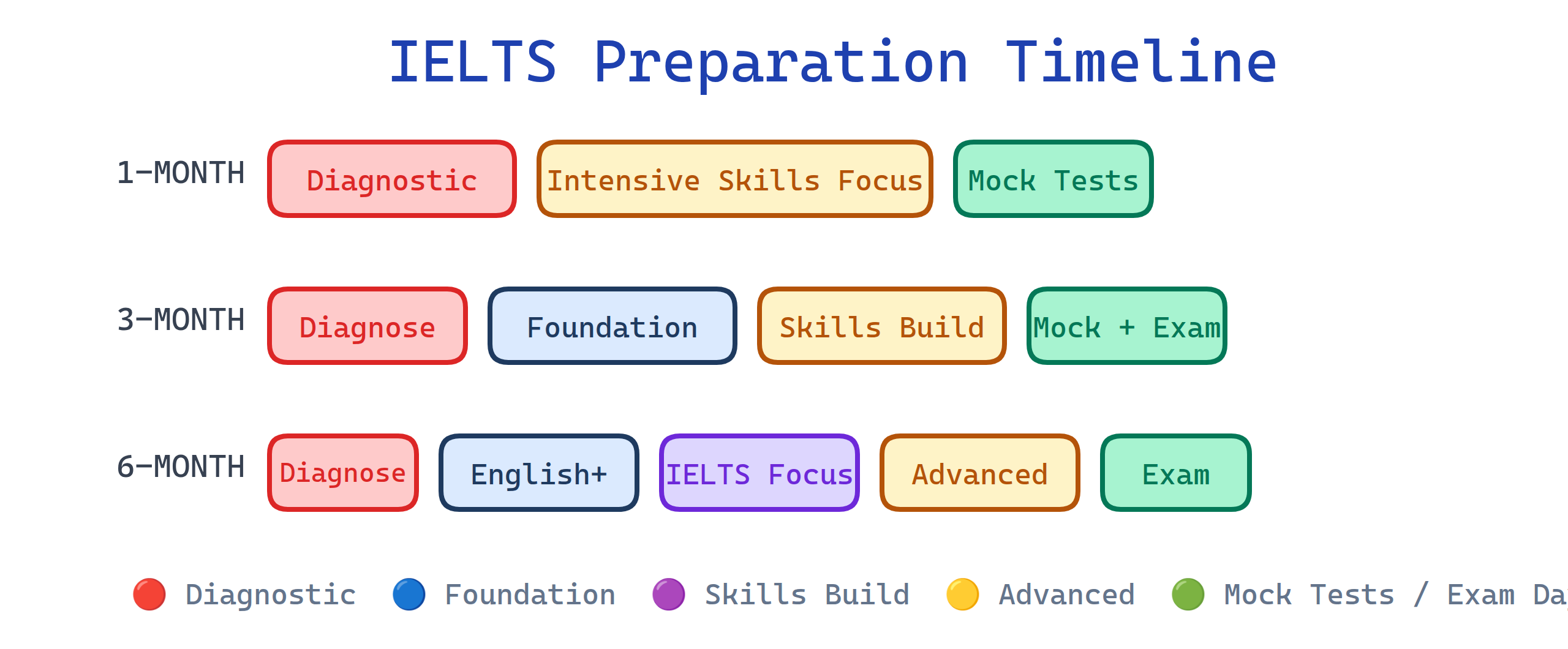
Start with a diagnostic test (Cambridge IELTS Practice Test) to identify your current level and weak areas. Then choose your timeline: 1 month (band boost of ~0.5–1.0), 3 months (sustainable improvement of 1.0–1.5 bands), or 6 months (significant improvement of 1.5–2.0 bands). Focus 40% of study time on your weakest section. Use official Cambridge IELTS books (1–18) as your primary resource.
Step 0: Take a Diagnostic Test First
Before starting any study plan, take a full-length practice test under timed conditions. This gives you your baseline band score and — more importantly — shows exactly where your marks are being lost.
How to Run a Diagnostic Test
- Use a full Cambridge IELTS practice test (from books 1–18 or the Cambridge IELTS Online platform)
- Complete all sections under strict time conditions (Listening: 30 min + 10 transfer; Reading: 60 min; Writing: 60 min)
- Mark Listening and Reading using the answer key — convert raw scores to band scores
- For Writing: use the official band descriptors to self-assess, or have a teacher review it
- For Speaking: record yourself on the cue card and a Part 3 question, then listen back critically
Target Band Scores by Goal
| Goal | IELTS Version | Typical Minimum Required |
|---|---|---|
| UK Student Visa (Tier 4) | Academic (or UKVI approved) | Overall 5.5–6.5 (varies by university) |
| UK Graduate Route / Work Visa | Academic or GT | Overall 4.0–5.0 (some roles higher) |
| Australia Skilled Visa (Subclass 189/190) | Academic or GT | Overall 6.0 (each band ≥ 6.0 for top points) |
| Australia Temporary Skilled Migration (482) | Academic or GT | Overall 5.0–6.0 depending on occupation |
| Canada Express Entry (Federal Skilled Worker) | Academic or GT | CLB 7 = approximately Overall 6.0 each band ≥ 6.0 |
| UK/Australian University (Undergraduate) | Academic | Overall 6.0–6.5 (most); 7.0 (top universities) |
| UK/Australian University (Postgraduate) | Academic | Overall 6.5 (most); 7.0–7.5 (competitive programmes) |
| UK NHS Nurse / Midwife (NMC) | Academic (UKVI) | Each band ≥ 7.0 |
| UK GMC Medical Registration | Academic (UKVI) | Overall 7.5; each band ≥ 7.0 |
1-Month Study Plan (Intensive)
Suitable if: your current band is close to your target (within 0.5–1.0), or you have a fixed upcoming test date. This requires 2–3 hours of focused study per day.
| Week | Focus | Activities |
|---|---|---|
| Week 1 | Diagnostic + Fundamentals | Take diagnostic test; study IELTS Core Concepts; review test format for all 4 sections; start vocabulary (environment + education topics) |
| Week 2 | Weakest Section Deep Dive | Spend 60% of time on your weakest section; do 1 full Listening + 1 full Reading practice per day; begin Writing Task 2 practice (1 essay per day) |
| Week 3 | Writing + Speaking | Write 1 Task 1 + 1 Task 2 per day; record Speaking Part 2 cue card responses; review vocabulary (health + technology topics); do timed Reading practice daily |
| Week 4 | Full Tests + Test Day Prep | Take 2–3 full timed practice tests; review all errors; revise vocabulary; go through test day checklist; rest 24 hours before test |
3-Month Study Plan (Balanced)
Suitable for most test-takers starting 0.5–1.5 bands below their target. Requires 1.5–2 hours per day (or more intensive weekend sessions).
| Month | Focus | Weekly Goal |
|---|---|---|
| Month 1 | Foundations | Learn all question types for each section; study Academic Word List (50 words/week); start Listening practice (4 sections/week); complete 2 Reading passages/week with analysis |
| Month 2 | Section-by-Section Improvement | 1 full Writing Task 2 per week (with self-assessment against band descriptors); Speaking Part 2 recording + review 3× per week; complete 2 timed Reading passages + 1 full Listening test per week; vocabulary: topic themes 3–5 |
| Month 3 | Integration + Full Tests | 1 full timed practice test per week (all 4 sections); identify recurring error patterns; intensive review of weak areas; 2 Speaking mock sessions with a partner or tutor; test day preparation |
6-Month Study Plan (Comprehensive)
Best for test-takers more than 1.5 bands below their target, or those who want to build English proficiency holistically alongside test preparation.
| Phase | Duration | Focus |
|---|---|---|
| Phase 1: Immersion | Months 1–2 | Daily English reading (quality newspapers, BBC News); daily English listening (BBC Radio, TED Talks, academic podcasts); grammar review; Academic Word List (40 words/week) |
| Phase 2: IELTS Skills | Months 3–4 | All question types for each section; Writing Task 1 and Task 2 practice; Speaking recordings; Listening + Reading timed practice; vocabulary by IELTS topic themes |
| Phase 3: Test Practice | Months 5–6 | 1 full practice test per week; detailed error analysis; Writing feedback (teacher or tutor); Speaking mock tests; final band benchmarking; test registration and test day prep |
Recommended Resources
| Resource | Type | Best For |
|---|---|---|
| Cambridge IELTS 1–18 (Cambridge University Press) | Official practice books | Authentic practice tests — use books 14–18 first (most recent and closest to current exam format) |
| IELTS.org (British Council) | Official website | Free practice materials, registration information, test format details |
| IDP IELTS Official | Official website | Computer-delivered IELTS practice; IELTS online booking |
| E2Language | Online video course | Method-based Writing and Speaking preparation; structured lessons |
| Magoosh IELTS | Online prep platform | Video lessons and practice questions with explanations |
| IELTS Liz (ieltsliz.com) | Free website | Extensive free Writing Task 2 lessons; model essays; vocabulary lessons |
| BBC Learning English | Free online/podcast | General English immersion; pronunciation; vocabulary in context |
Test Day Checklist
- ✓ Valid photo ID (passport for international candidates; must match registration)
- ✓ Arrive at the test centre 30 minutes before the scheduled start time
- ✓ Bring 2–3 pencils (HB) and an eraser for paper-based IELTS (for Listening and Reading answer sheets)
- ✓ Bring a pen for Writing tasks (paper-based)
- ✓ Leave phones, smart watches, and all electronic devices in the locker (not at your desk)
- ✓ For computer-based IELTS: arrive 15–20 minutes early; a keyboard and a typing test will be offered beforehand
- ✓ Know the Speaking test venue and time (it may be separate from Listening/Reading/Writing)
- ✓ Get 8 hours sleep the night before; have a light meal beforehand
- ✓ Do NOT study the morning of the test — review only a brief vocabulary list or do light reading
Daily Practice Routine (1 Hour)
When you can't do a full session, this 1-hour routine maintains momentum:
- 10 min: Review 10 new vocabulary items (topic-based or AWL) — write them in a sentence
- 20 min: Complete 1 Reading passage or 1 Listening section with analysis of errors
- 20 min: Write 1 Task 2 body paragraph (or 1 Task 1 full response) — focus on the weakest criterion
- 10 min: Speak on a cue card topic aloud for 2 minutes — record and listen back
Test Yourself
Why should you take a diagnostic test before starting any IELTS study plan?
A diagnostic test establishes your current baseline band score and identifies your weakest sections. Without this, you risk spending equal time on all sections when you should be focusing 40%+ of study time on your specific weak areas. It also helps you choose the right study plan length — if you're 0.5 below target, 1 month may be enough; if you're 2 bands below, you need 6 months.
You need Band 7.0 for a UK postgraduate programme. Your diagnostic shows: Listening 7.0, Reading 7.5, Writing 5.5, Speaking 6.5. Where should you spend the most study time?
Writing is the critical weakness at Band 5.5 — it needs a 1.5 band improvement. Writing is the slowest section to improve because it requires developing both language complexity and structural understanding. Focus 50%+ of study time on Writing Task 2 (essays), particularly Task Achievement and Coherence & Cohesion. Also dedicate time to Speaking to push from 6.5 to 7.0.