IELTS Speaking
11–14 minutes, 3 parts. Part 1 (4–5 min): familiar topic questions. Part 2 (3–4 min): 1-minute prep + 2-minute monologue on a cue card. Part 3 (4–5 min): abstract discussion linked to Part 2. Scored on Fluency, Lexical Resource, Grammatical Range, Pronunciation. Speak naturally and at length — the examiner rewards development and specificity, not just correct answers.
The 3-Part Structure
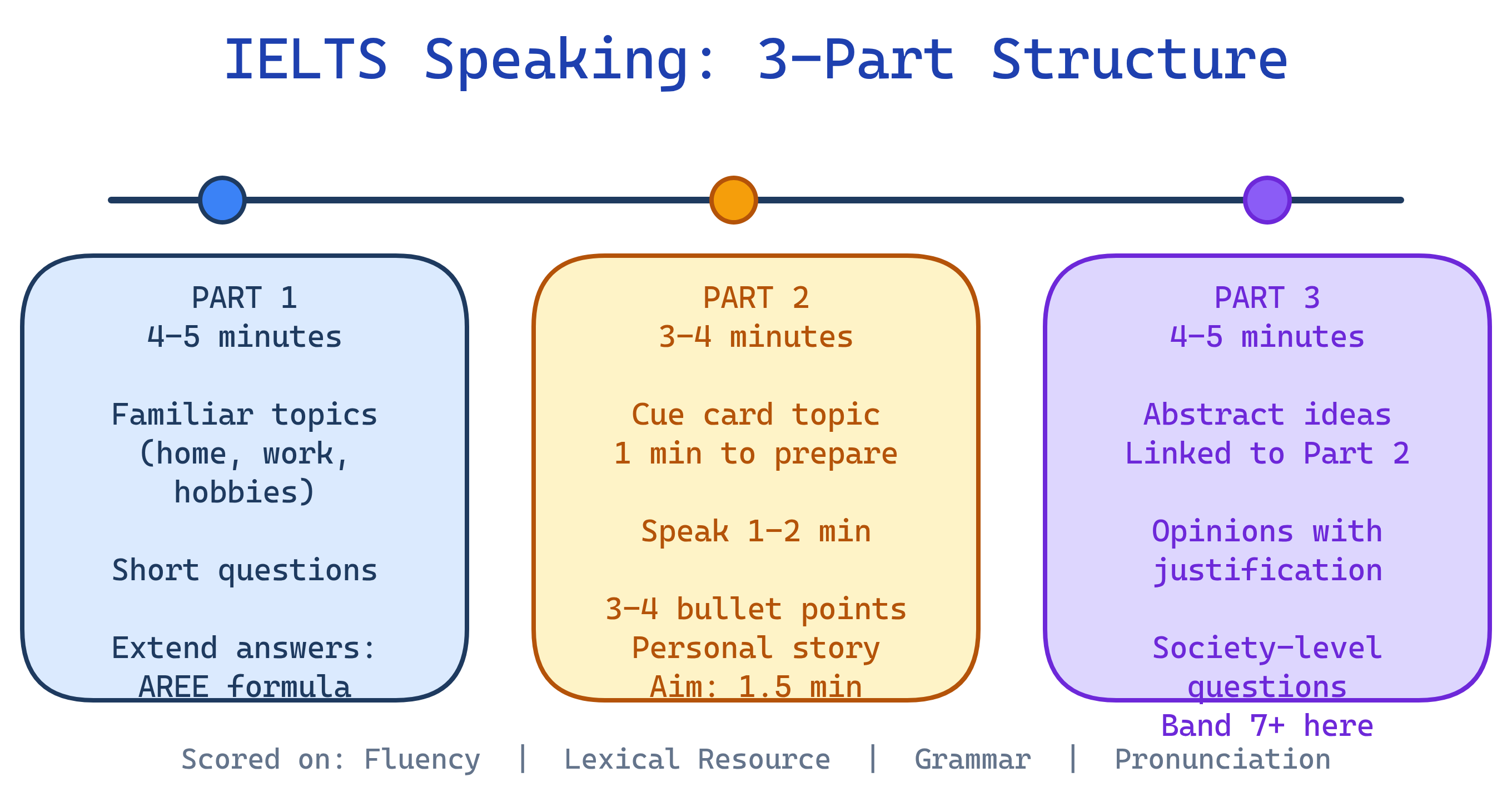
| Part | Duration | Format | Topic Complexity |
|---|---|---|---|
| Part 1 | 4–5 min | Examiner asks 4–6 questions on 2–3 familiar topics (home, work, hobbies, routines, food, travel) | Simple, personal topics — your daily life and preferences |
| Part 2 | 3–4 min | Cue card with a topic + 3–4 bullet points. 1 minute preparation, then 1–2 minute monologue. 1–2 follow-up questions from examiner. | Personal experience, description, narrative |
| Part 3 | 4–5 min | Examiner-led discussion of abstract ideas related to Part 2's theme | Complex social, economic, or global issues — opinions and justifications expected |
The 4 Scoring Criteria
| Criterion | What the Examiner Checks | To Score Band 7 |
|---|---|---|
| Fluency & Coherence | Can you speak at length without long pauses? Are ideas logically connected? | Speaks at length with rare repetition; ideas clearly connected; occasional self-correction |
| Lexical Resource | Range and precision of vocabulary; ability to paraphrase when needed | Uses less common vocabulary flexibly; minor errors don't impede understanding |
| Grammatical Range & Accuracy | Variety of sentence structures; how often you make errors | Mix of simple and complex structures; frequent error-free sentences; errors are minor |
| Pronunciation | Clarity of individual sounds, word stress, sentence intonation, intelligibility | Accent doesn't impede understanding; correct word stress and sentence rhythm |
Part 1 Strategies
Part 1 questions are deliberately simple. The trap is giving one-word or one-sentence answers. Examiners want you to extend your responses naturally.
Q: "Do you enjoy cooking?"
Poor answer: "Yes, I do."
Good answer: "Yes, I really enjoy it — especially at weekends when I have more time. I find cooking relaxing after a busy week, and I enjoy trying out new recipes from different cuisines. Italian food is probably my favourite thing to make."
Use the AREE formula for Part 1 answers: Answer + Reason + Example + Extend (add a bit more).
Part 2: The Cue Card
The cue card typically follows this structure:
Describe a [person/place/thing/event/experience]
You should say:
• What/who it is
• Where/when/how [context]
• [Specific detail bullet point]
And explain why it is [significant/memorable/interesting] to you.
The 1-Minute Preparation Strategy
Use your 1 minute to jot down keywords only — not full sentences. Think: Who? What? When? Where? Why? One word or phrase per bullet point is enough.
Example cue card: "Describe a memorable journey you have taken."
Notes in 1 minute: Nepal trek / 2019 / Annapurna / 3 weeks / challenging / beautiful views / met interesting people / changed perspective on simplicity
Cue Card Response Structure (2 minutes)
- Opening (10 sec): "I'd like to talk about… This happened/This is…"
- Context (30 sec): Describe who, what, when, where
- Detail (45 sec): The specific experience — what happened, what it was like, sensory details
- Reflection (35 sec): Why it was memorable/significant — personal impact, feelings, what you learned
Part 3: The Discussion
Part 3 asks you to go beyond personal experience and discuss abstract ideas. Questions often use "people in general" rather than "you". This is where complex language is expected.
Part 2 topic: "A memorable journey"
Part 3 questions might be: "Do you think people today travel more than in the past? Why?" | "How has tourism affected local cultures?" | "Is it better to travel abroad or explore your own country? Why?"
Use these opinion phrases to show sophisticated language:
- "From my perspective, it seems that…"
- "There are two sides to this — on one hand… but on the other hand…"
- "The evidence suggests that… though I think this depends on…"
- "In an ideal world, I would say… however, the reality is…"
- "It's a complex issue, but I believe the key factor is…"
Common Mistakes
- Memorised responses: Examiners are trained to detect rehearsed answers. Giving a memorised speech to an unexpected question is penalised under Fluency and Coherence.
- Repeating the question: "Do I enjoy cooking? Well, cooking is…" wastes time and sounds unnatural.
- Stopping after one sentence: Development is crucial. Every answer in Parts 1–3 should be at least 3–4 sentences.
- Using simple vocabulary throughout: Words like "good", "bad", "nice", "a lot" are low-band indicators. Replace them with "beneficial", "detrimental", "remarkable", "a significant number of".
- Whispering or rushing: Speak at a natural, confident pace. Examiners cannot score what they cannot hear clearly.
Test Yourself
An IELTS Speaking Part 2 cue card says "Describe a book you have read recently." You have read very few books recently. What should you do?
You can describe any book you have read — it doesn't have to be recent. The examiners are not checking the truth of your answer; they are assessing your English. Say something like: "I don't read as much as I'd like these days, but I remember reading a book about two years ago that really impressed me…" Then describe that book.
Which of the four IELTS Speaking scoring criteria assesses how well you connect ideas and maintain a logical flow?
Fluency and Coherence. This criterion covers both the fluency of your delivery (no long, unnatural pauses; no excessive repetition) AND the coherence of your ideas (logical progression, appropriate use of connectives and discourse markers).
In IELTS Speaking Part 3, the examiner asks: "Do you think young people today spend too much time on social media?" You answer: "Yes." What is wrong with this answer?
It is a one-word answer. Part 3 requires extended discussion with justification, examples, and nuanced opinions. A good answer would agree/disagree, explain why, give examples, and possibly add a contrasting perspective — at least 4–6 sentences.
Practice Questions
Q: Practice extending this Part 1 answer. Question: "Do you prefer to spend time indoors or outdoors?" Poor answer: "I prefer outdoors." How would a Band 7 answer sound?
Band 7 model answer: "I'd say I prefer spending time outdoors, especially in good weather. I find that being outside helps me clear my head after spending most of my working day sitting at a desk. I particularly enjoy going for long walks in the countryside or cycling along the river near my home — it's a great way to disconnect from technology. That said, when it's cold or raining, I'm more than happy to stay indoors with a good book!"
Key features: Extended (5+ sentences), uses a contrast ("That said"), specific details (walking, cycling, river), informal but accurate language.