IELTS Core Concepts
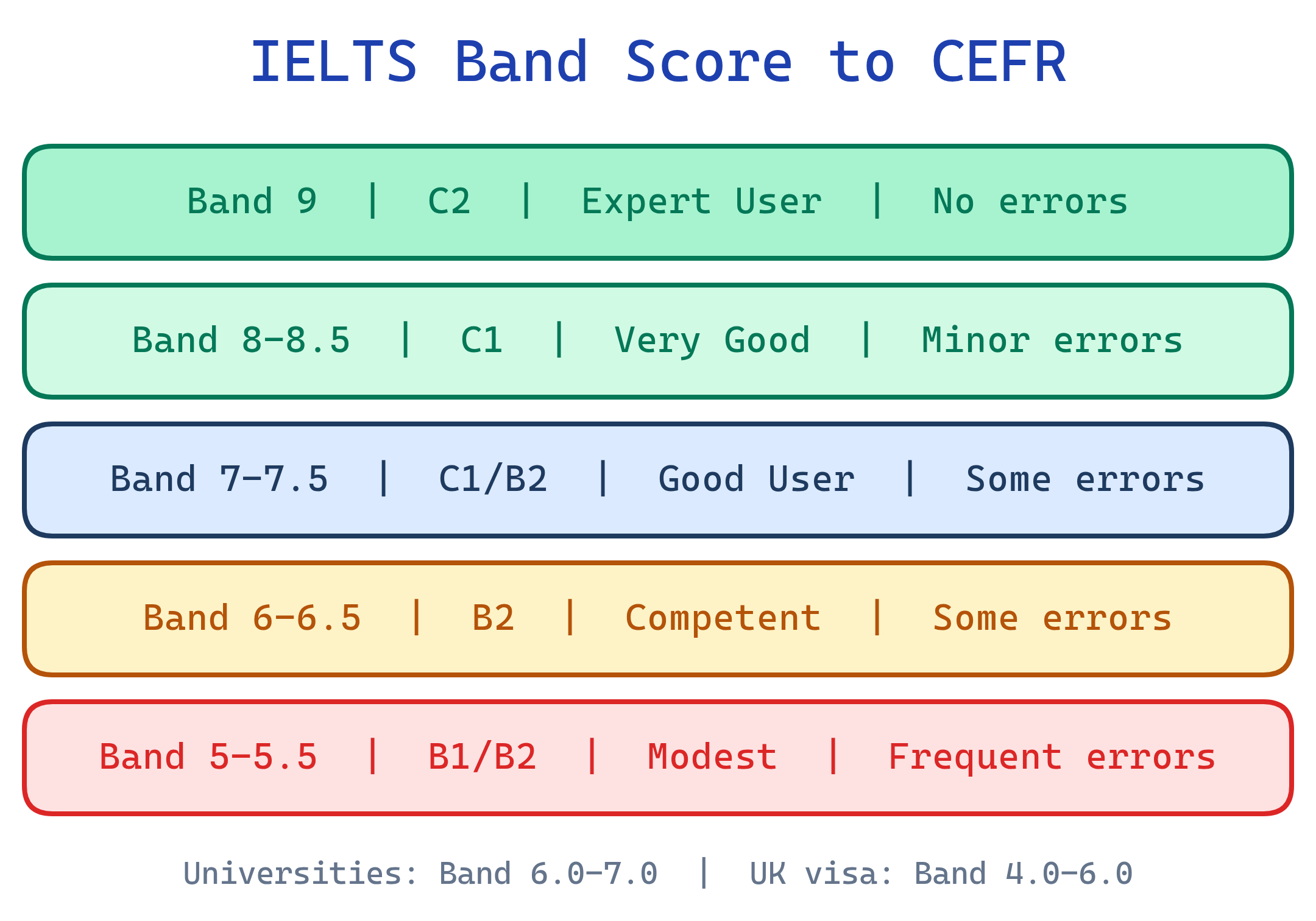
IELTS has 4 sections: Listening (30 min, 40 Q), Reading (60 min, 40 Q), Writing (60 min, 2 tasks), Speaking (11–14 min, 3 parts). Total time: ~2h 45min. Each section scores 0–9; your Overall Band Score is the average of all four, rounded to the nearest 0.5. Band 6 = B2 (Competent User), Band 7 = C1 (Good User), Band 8+ = C1/C2 (Very Good/Expert).
The Big Picture
Understanding the IELTS test structure is the first step to preparing efficiently. Each section has a fixed format, duration, and number of questions that never changes — so there are no surprises on test day once you know the rules.
Explain Like I'm 12
Think of IELTS like a school report card with four subjects. You get a mark in each subject (Listening, Reading, Writing, Speaking), and then they average it out. The marks go from 0 (didn't attempt) to 9 (perfect). Most good universities want at least a 6.5 or 7.0 average — like needing a B or B+ in all subjects to get into a school.
Cheat Sheet
| Section | Format | Duration | Question Types | Band Score Focus |
|---|---|---|---|---|
| Listening | 4 sections, 10 questions each; audios played once | 30 min + 10 min transfer | Form completion, MCQ, matching, map/diagram labeling, note completion | Accuracy (spelling counts); ability to follow fast speech |
| Reading | 3 passages (Academic) or varied texts (GT); 40 questions | 60 min (no extra transfer time) | T/F/NG, MCQ, matching headings, sentence completion, short answer | Locating information quickly; understanding global and specific meaning |
| Writing | Task 1 (150+ words) + Task 2 (250+ words) | 60 min recommended (20 + 40) | Graph/chart description (Academic) or letter (GT); argumentative essay | Task Achievement, Coherence, Lexical Resource, Grammar |
| Speaking | 3 parts: interview, cue card monologue, discussion | 11–14 min | Face-to-face with examiner; recorded | Fluency, Lexical Resource, Grammatical Range, Pronunciation |
The Building Blocks
1. Listening: Follow Along Once
The Listening section consists of four recordings played just once. Sections 1 and 2 deal with everyday social situations (a conversation about renting a flat, a community announcement); Sections 3 and 4 deal with academic contexts (a group discussion about an assignment, a university lecture).
Difficulty increases from Section 1 to Section 4. You have time to read the questions before each section begins — use this strategically to predict what information you'll hear.
2. Reading: Speed vs Depth
The Reading section has 3 passages (Academic) totalling around 2,000–2,750 words. You have exactly 60 minutes with no extra transfer time — write directly on the answer sheet. Each passage has around 13–14 questions.
The key skill is knowing when to skim (get the gist quickly), when to scan (find a specific fact), and when to read in detail (for complex inference questions).
3. Writing: Two Tasks, Unequal Weight
Writing has two tasks. Task 1 (recommended 20 min) asks you to describe or explain visual data (Academic) or write a letter (GT). Task 2 (recommended 40 min) requires an argumentative essay. Task 2 is worth double the marks of Task 1 — it is by far the most important task in the Writing section.
Each writing task is scored on four criteria, each carrying equal weight:
- Task Achievement / Task Response — Did you fully address the task? Is your position clear?
- Coherence and Cohesion — Is the essay logically organised? Are ideas connected with appropriate linking words?
- Lexical Resource — Do you use a wide range of vocabulary accurately? Do you avoid repetition?
- Grammatical Range and Accuracy — Do you use a variety of sentence structures? Are there errors?
4. Speaking: A Conversation, Not a Monologue
Speaking is the only face-to-face section. It has three parts:
- Part 1 (4–5 min): The examiner asks general questions about familiar topics — your hometown, work, hobbies, daily routines.
- Part 2 (3–4 min): You receive a cue card with a topic and 3–4 bullet points. You have 1 minute to prepare, then speak for 1–2 minutes. The examiner may ask 1–2 follow-up questions.
- Part 3 (4–5 min): The examiner asks more abstract, discussion-based questions related to the Part 2 topic.
5. How Band Scores Are Calculated
For Listening and Reading, band scores are converted from raw scores using a conversion table (which varies slightly by test paper). The number of correct answers maps to a band score:
| Raw Score (out of 40) | Approximate Band |
|---|---|
| 39–40 | 9.0 |
| 37–38 | 8.5 |
| 35–36 | 8.0 |
| 32–34 | 7.5 |
| 30–31 | 7.0 |
| 26–29 | 6.5 |
| 23–25 | 6.0 |
| 18–22 | 5.5 |
| 16–17 | 5.0 |
For Writing and Speaking, trained human examiners (and AI-assist tools for IELTS Online) assess work against the four scoring criteria. Each criterion is equally weighted within the section band score.
Test Yourself
In the Listening section, how many recordings are played, and how many questions are in each?
There are 4 recordings, each with 10 questions (40 questions total). Each recording is played only once.
Task 2 of IELTS Writing is worth how many times the marks of Task 1?
Task 2 is worth twice the marks of Task 1. This is why you should spend approximately 40 minutes on Task 2 and only 20 minutes on Task 1.
Name the four scoring criteria for IELTS Writing.
Task Achievement (or Task Response for Task 2), Coherence and Cohesion, Lexical Resource, and Grammatical Range and Accuracy. Each is equally weighted.
How much time do you have to transfer Listening answers to the answer sheet?
10 minutes after the recordings finish. Use the listening time to write answers on the question paper, then carefully transfer them. In the Reading section, there is no transfer time — write directly on the answer sheet.