What is IELTS?
IELTS (International English Language Testing System) is the world's most popular English proficiency test, taken by 3.5 million+ people annually and accepted by 11,000+ organisations in 140 countries. It tests four skills — Listening, Reading, Writing, and Speaking — on a 0–9 band scale. There are two versions: Academic (for university entry and professional registration) and General Training (for migration and work visas).
The Big Picture
IELTS was launched in 1989 as a joint venture between the British Council, IDP Australia, and Cambridge Assessment English. Today it is the most widely accepted English test in the world. Whether you're applying to study at a UK university, migrating to Australia, or seeking professional registration as a nurse or doctor, IELTS is likely on the list of accepted tests.
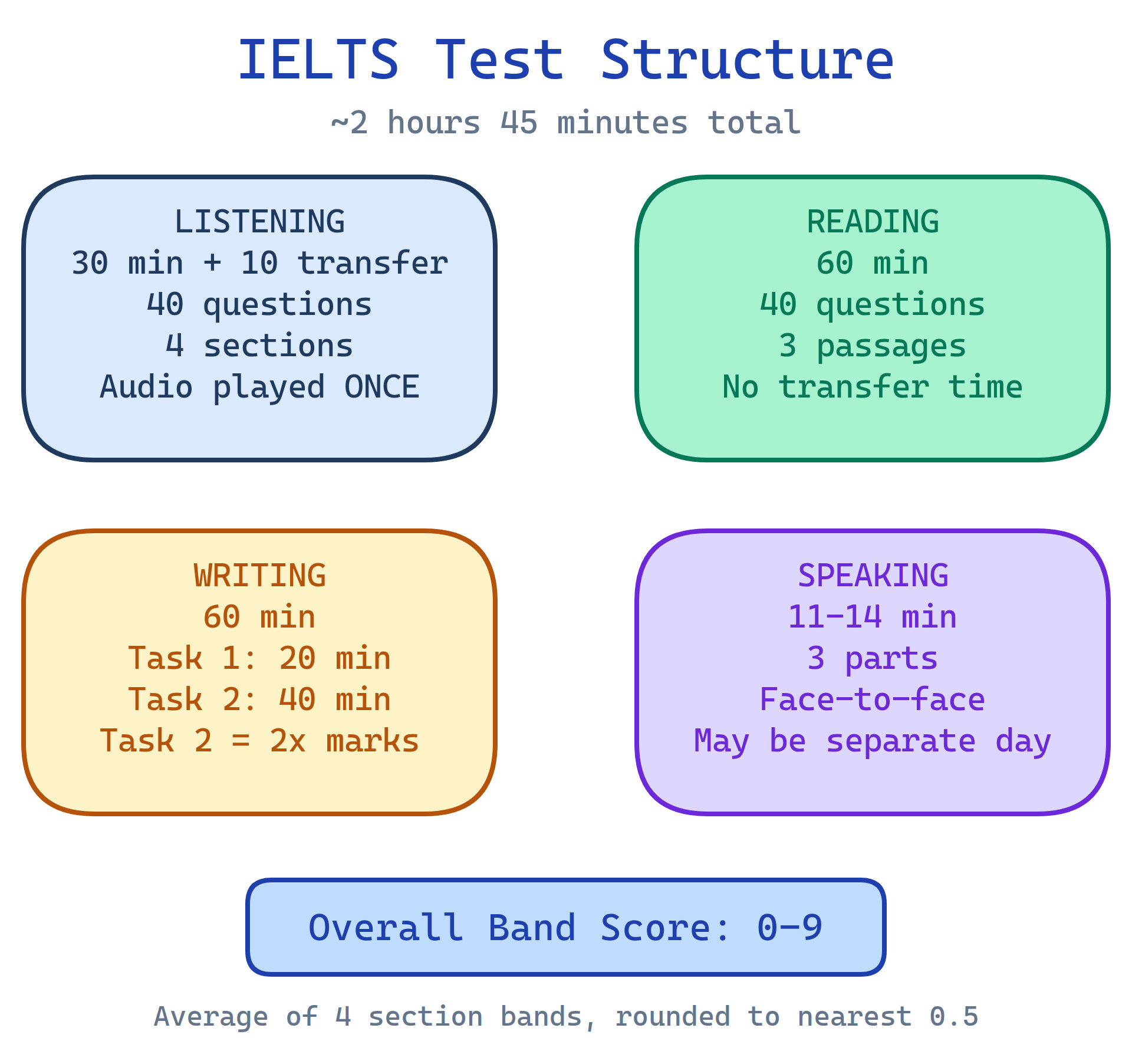
The test lasts approximately 2 hours and 45 minutes. Three sections — Listening, Reading, and Writing — are taken on the same day. Speaking is taken either on the same day or within 7 days before or after.
Explain Like I'm 12
Imagine you moved to a new country where everyone speaks English. Before they let you into university or give you a work visa, they want to check how well you understand and use English. IELTS is that test. It checks four things: can you understand what you hear (Listening), can you read and understand articles (Reading), can you write clearly (Writing), and can you speak fluently and confidently (Speaking)?
At the end, you get a score between 0 and 9 — like a grade, but in decimals. A score of 7.0 means you're a "good user" of English. Most universities want at least 6.0–7.0 to let you study there.
Academic vs General Training
IELTS has two versions. The one you need depends entirely on why you're taking the test:
| Feature | IELTS Academic | IELTS General Training |
|---|---|---|
| Purpose | University/higher education entry; professional registration | Secondary education, work experience, migration |
| Reading texts | Extracts from books, journals, magazines — complex academic language | Advertisements, notices, workplace materials, everyday texts |
| Writing Task 1 | Describe a graph, chart, table, map, or process diagram (150+ words) | Write a formal or informal letter (150+ words) |
| Writing Task 2 | Argumentative essay on a general topic (250+ words) | Argumentative essay on a general topic (250+ words) |
| Listening & Speaking | Identical in both versions | Identical in both versions |
| Difficulty | Reading is harder; academic vocabulary required | Reading is more accessible; everyday vocabulary |
How IELTS Is Scored
Each of the four sections is scored individually on a 0–9 scale (in 0.5 increments). The four scores are averaged to give your Overall Band Score, rounded to the nearest 0.5.
| Band | Level | CEFR | Description |
|---|---|---|---|
| 9 | Expert | C2 | Full operational proficiency — no errors |
| 8–8.5 | Very Good | C1 | Fully operational, minor inaccuracies |
| 7–7.5 | Good | C1 | Handles complex language well; some inaccuracies |
| 6–6.5 | Competent | B2 | Generally effective; some errors in unfamiliar situations |
| 5–5.5 | Modest | B1/B2 | Partial command; frequent problems |
| 4–4.5 | Limited | B1 | Basic competence in familiar situations only |
| 3–3.5 | Extremely Limited | A2 | Conveys only general meaning; frequent breakdowns |
| 1–2.5 | Intermittent/Non-User | A1 | No real communication; barely attempted |
Which English Test Should I Take?
IELTS, PTE Academic, and TOEFL iBT are all widely accepted. Here's how they compare:
| Feature | IELTS | PTE Academic | TOEFL iBT |
|---|---|---|---|
| Owner | British Council / IDP / Cambridge | Pearson | ETS |
| Format | Paper or Computer-based | Computer-based only | Internet-based (iBT) |
| Duration | ~2h 45min | ~3h | ~3h |
| Score Scale | 0–9 (band) | 10–90 (PTE score) | 0–120 (TOEFL score) |
| Results | 3–5 business days (computer); 13 days (paper) | 24–48 hours | 4–8 business days |
| AI Scored? | Mostly human; Speaking & Writing partly AI-assisted | Fully AI-scored | Mostly AI; some human review |
| Best for | UK, Australia, Canada, NZ migration and study | Australia migration (fast results); tech-comfortable test-takers | US university entry; widely accepted globally |
| Validity | 2 years | 2 years | 2 years |
Who Accepts IELTS?
- Universities: Oxford, Cambridge, MIT, Harvard, University of Toronto, University of Melbourne, and 11,000+ others worldwide
- Immigration: UK Home Office (UKVI-approved), Australian Department of Home Affairs, Immigration, Refugees and Citizenship Canada (IRCC), New Zealand Immigration
- Professional bodies: General Medical Council (GMC), Nursing and Midwifery Council (NMC), General Pharmaceutical Council, Law Society
- Employers: Many multinational employers use IELTS scores in hiring decisions for roles requiring strong English
What You'll Learn
Test Yourself
What are the two versions of IELTS, and what is each used for?
IELTS Academic is used for university entry and professional registration (e.g., doctors, nurses). IELTS General Training is used for secondary education, work experience abroad, and immigration (e.g., Australia PR, UK work visa).
What is the highest possible band score in IELTS and what does it represent?
The highest score is Band 9, called "Expert User." It represents full operational proficiency with no errors in English usage. In CEFR terms, it corresponds to C2 (Mastery).
Which IELTS section is taken on a different day from the others?
The Speaking section. Listening, Reading, and Writing are always taken together on the same day. Speaking is taken within a 7-day window before or after — either the same day or a different day, depending on the test centre's schedule.
How is the Overall Band Score calculated?
Each of the four sections receives a band score from 0–9. These four scores are averaged and then rounded to the nearest 0.5 to produce the Overall Band Score. For example: Listening 7.0 + Reading 6.5 + Writing 6.0 + Speaking 7.5 = 27.0 ÷ 4 = 6.75, rounded to 7.0.
What band score is typically required for a skilled worker immigration visa to Australia?
Most skilled worker visas for Australia require an Overall Band 6.0, though some occupations and visa subclasses require 7.0 or higher (e.g., some healthcare professions). Always verify the exact requirement for your specific visa subclass and occupation.