What is PTE Academic?
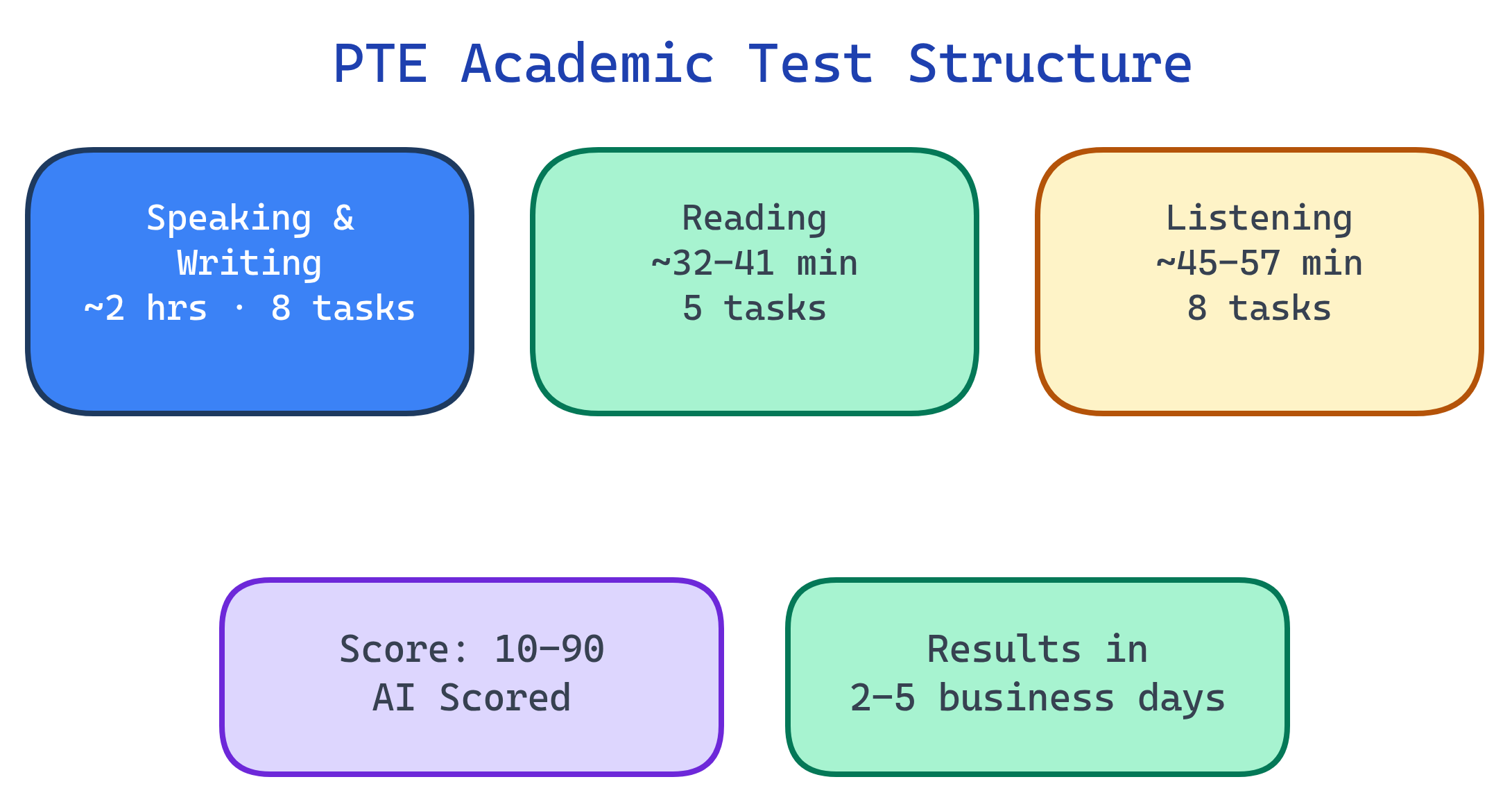
PTE Academic (Pearson Test of English) is a fully computer-based English proficiency test scored by AI — no human examiners. It has 3 sections: Speaking & Writing (~77–93 min), Reading (~32–41 min), and Listening (~45–57 min). Scores range from 10 to 90. Results arrive in 2–5 business days. Accepted by 3,000+ universities and immigration offices in the UK, Australia, Canada, and New Zealand.
The PTE Academic scoring engine operates on AI-based assessment rather than human marking, which means it rewards specific, measurable features of language performance: pronunciation clarity, oral fluency (pace and rhythm without unnatural pauses), and written discourse coherence. Unlike IELTS, where a human examiner might credit you for an interesting argument despite imperfect grammar, PTE's algorithm scores phoneme-level pronunciation accuracy and hesitation patterns. Pacing matters more than most test-takers realize: speaking too fast reduces clarity scores, speaking too slowly triggers fluency penalties. The Pearson PTE preparation resources include scoring guides for each task type.
The Read Aloud task is the highest-impact task in the Speaking section because it contributes to both Speaking and Reading scores simultaneously. Candidates who practice cold reading — recording themselves reading unfamiliar texts and reviewing for mispronounced words — improve faster than those who only practice with familiar material. The PTE test guide documents the exact scoring criteria per task.
PTE Academic is worth choosing over IELTS if you are applying to Australian or UK universities that accept both, and if you want faster score delivery (results in 2–5 business days vs. IELTS 13 days for paper-based). PTE also allows unlimited retakes with no cooling-off period between attempts, which matters if you are working against a visa application deadline.
The Big Picture
PTE Academic stands out from other English tests because a computer — not a human — evaluates your answers. This means no examiner bias, no waiting weeks for results, and a highly consistent scoring system. The test is run by Pearson and is widely accepted for study visas, skilled worker immigration, and university admission.
Explain Like I'm 12
Imagine a test where you speak into a microphone, type answers on a keyboard, and a supercomputer marks everything instantly. No teacher listening, no hand-writing — just you and a computer. When you finish, the computer checks how clearly you spoke, how well you wrote, how much you understood when reading, and how well you listened. Two days later, you get a number from 10 to 90 telling you how good your English is. That's PTE!
Test Format at a Glance
| Section | Duration | No. of Tasks | Skills Tested |
|---|---|---|---|
| Speaking & Writing | ~77–93 min | 8 task types | Speaking, Writing (+ Reading, Listening) |
| Reading | ~32–41 min | 5 task types | Reading (+ Writing) |
| Listening | ~45–57 min | 8 task types | Listening (+ Speaking, Writing) |
| Total | ~2 hours | 21 task types | All 4 skills (integrated) |
PTE Score Scale (10–90)
| Score Range | CEFR Level | Description | Typical Requirement |
|---|---|---|---|
| 79–90 | C2 | Expert / Native-like | Top research universities |
| 73–78 | C1 | Advanced | Competitive universities |
| 59–72 | B2 | Upper-Intermediate | Most universities, UK skilled visa |
| 43–58 | B1 | Intermediate | Pre-sessional courses, some visas |
| 30–42 | A2 | Pre-Intermediate | Foundation programmes |
Each of the 4 skills (Speaking, Writing, Reading, Listening) also receives its own score from 10–90, plus 10 enabling skills sub-scores (Grammar, Oral Fluency, Pronunciation, Spelling, Vocabulary, Written Discourse, and more).
PTE vs IELTS vs TOEFL
| Feature | PTE Academic | IELTS Academic | TOEFL iBT |
|---|---|---|---|
| Test type | Computer-based | Paper + computer | Computer-based |
| Examiner | AI only | Human (Speaking) | AI + human (Writing) |
| Score scale | 10–90 | 0–9 (bands) | 0–120 |
| Duration | ~2 hours | ~2 hrs 45 min | ~2 hours |
| Results | 2–5 days | 13 days (paper) | 4–8 days |
| Accepted by | 3,000+ institutions | 11,000+ institutions | 12,000+ institutions |
| Retake wait | 5 calendar days | None (any time) | 3 days |
| Best for | Fast results, Australia/NZ | UK, global recognition | US universities |
Who Accepts PTE Academic?
- Universities: ANU, University of Melbourne, LSE, Manchester, Toronto, UBC, and 3,000+ others
- Australia: Department of Home Affairs (student and skilled migration visas)
- UK: UKVI-approved for student visas (selected test centres)
- Canada: Immigration, Refugees and Citizenship Canada (IRCC)
- Professional bodies: Nursing and Midwifery Council (UK), Australian Health Practitioner Regulation Agency
What You'll Learn
Test Yourself
How long does it typically take to receive PTE Academic results?
2–5 business days — much faster than IELTS (13 days for paper) or TOEFL (4–8 days). This makes PTE popular for urgent visa applications.
What does "integrated scoring" mean in PTE?
Some PTE tasks contribute to more than one skill score. For example, Repeat Sentence contributes to both your Speaking AND Listening scores. Read Aloud contributes to both Speaking AND Reading. This means a single task affects multiple parts of your final score.
What is the PTE Academic score range, and which CEFR level corresponds to a score of 65?
PTE scores range from 10 to 90. A score of 65 falls in the 59–72 range, corresponding to CEFR B2 (Upper-Intermediate). This is sufficient for most UK skilled worker visa applications and many university programmes.
Who marks your PTE Speaking responses?
AI only — no human examiner ever listens to your responses. The computer evaluates your pronunciation, oral fluency, and content using speech recognition algorithms. This removes examiner bias but means you need to speak clearly (not necessarily in any particular accent).
Name the three sections of the PTE Academic test and their approximate durations.
1. Speaking & Writing — ~77–93 minutes
2. Reading — ~32–41 minutes
3. Listening — ~45–57 minutes
Total: approximately 2 hours (plus check-in time).