PTE Core Concepts
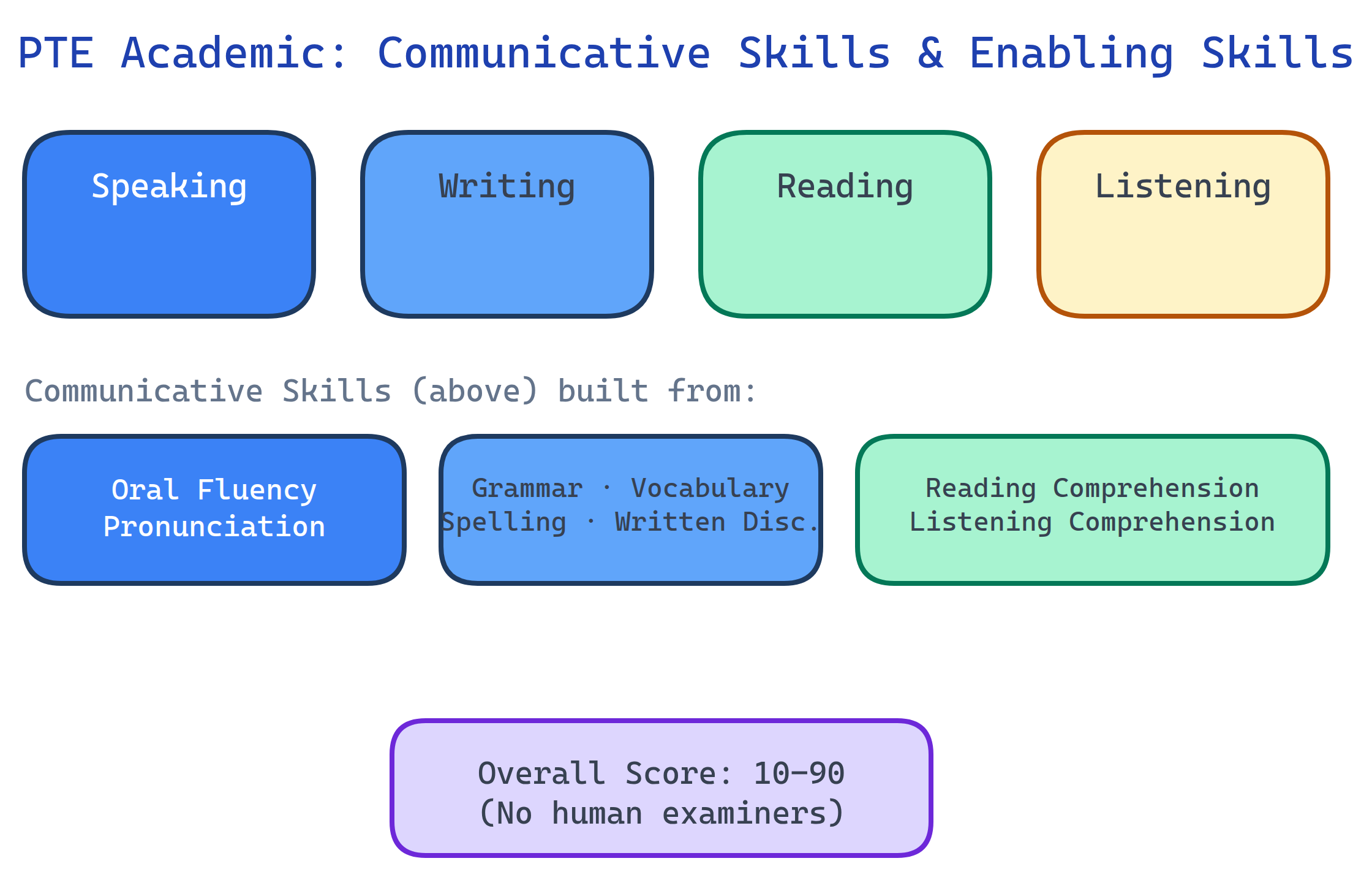
PTE Academic has 3 sections: Speaking & Writing (~77–93 min, 8 task types), Reading (~32–41 min, 5 task types), and Listening (~45–57 min, 8 task types). AI scores everything on a 10–90 scale. Some tasks contribute to multiple skill scores (integrated scoring). You also receive sub-scores for 10 enabling skills including pronunciation, oral fluency, spelling, and grammar.
Test Structure Overview
Explain Like I'm 12
Think of PTE like a video game with three levels. In Level 1 (Speaking & Writing) you speak into a microphone and type essays. In Level 2 (Reading) you read passages and answer questions. In Level 3 (Listening) you hear recordings and write what you heard. At the end, a computer gives you a score from 10 to 90 — like getting a percentage, but on a 90-point scale. The cool thing is that some tasks count towards two skill scores at once!
Cheat Sheet
| Section | Duration | Task Types | Skills Scored | Scoring Method |
|---|---|---|---|---|
| Speaking & Writing | ~77–93 min | Personal Intro, Read Aloud, Repeat Sentence, Describe Image, Re-tell Lecture, Answer Short Question, Summarize Written Text, Write Essay | Speaking, Writing (+ Reading, Listening via integrated tasks) | AI: pronunciation, fluency, content, grammar |
| Reading | ~32–41 min | R&W Fill in the Blanks, MCQ Multiple, Re-order Paragraphs, Reading FIB, MCQ Single | Reading (+ Writing via R&W FIB) | AI: correct answers; partial credit on some tasks |
| Listening | ~45–57 min | Summarize Spoken Text, MCQ Multiple, Fill in Blanks, Highlight Correct Summary, MCQ Single, Select Missing Word, Highlight Incorrect Words, Write from Dictation | Listening (+ Writing via SST and WFD) | AI: accuracy, word recognition, writing quality |
The Building Blocks
1. Integrated Scoring — The PTE Multiplier
This is the most important concept unique to PTE. Unlike IELTS where each skill is scored separately, several PTE tasks contribute to multiple skill scores simultaneously. Performing well on these tasks gives your overall score a multiplier effect.
| Task | Contributes to Speaking | Contributes to Reading | Contributes to Listening | Contributes to Writing |
|---|---|---|---|---|
| Read Aloud | ✅ Yes | ✅ Yes | — | — |
| Repeat Sentence | ✅ Yes | — | ✅ Yes | — |
| Re-tell Lecture | ✅ Yes | — | ✅ Yes | — |
| Summarize Written Text | — | ✅ Yes | — | ✅ Yes |
| Summarize Spoken Text | — | — | ✅ Yes | ✅ Yes |
| R&W Fill in the Blanks | — | ✅ Yes | — | ✅ Yes |
| Write from Dictation | — | — | ✅ Yes | ✅ Yes |
2. Enabling Skills — Your 10 Sub-Scores
PTE reports 10 enabling skills alongside your 4 main section scores. These help diagnose exactly where to improve.
| Enabling Skill | Linked to | How to Improve |
|---|---|---|
| Grammar | Writing, Speaking | Study sentence structures; review essay feedback |
| Oral Fluency | Speaking | Practise speaking without pausing; use filler sounds sparingly |
| Pronunciation | Speaking | Speak clearly; computer rewards clarity over native accent |
| Spelling | Writing | Write from Dictation practice; learn common academic spellings |
| Vocabulary | Writing, Reading | Academic Word List; topic vocabulary by theme |
| Written Discourse | Writing | Essay structure; paragraph coherence; linking devices |
| Reading | Reading | Skimming and scanning; academic text comprehension |
| Listening | Listening | Active listening; note-taking; Write from Dictation |
| Speaking | Speaking | Read Aloud; Repeat Sentence; Describe Image templates |
| Writing | Writing | Essay planning; Summarize Written Text coherence |
3. How AI Scores Your Responses
PTE's AI (built by Pearson and SpeechRater™ for speaking tasks) evaluates your responses against specific criteria. Understanding what the AI looks for helps you optimise your answers.
| For Speaking Tasks | For Writing Tasks | For Reading/Listening Tasks |
|---|---|---|
|
Pronunciation: Phoneme accuracy Oral Fluency: Pace, no long pauses Content: Words from the stimulus reproduced |
Content: Task addressed fully Form: Word count met Grammar: Sentence accuracy Vocabulary: Range and precision |
Correct answers: 1 point per correct item Partial credit: Some tasks award partial marks Negative marking: MCQ Multiple can deduct points |
4. Score to Requirement Mapping
| Goal | Overall Score | Per-Skill Minimum |
|---|---|---|
| Australian Skilled Migration (189/190) | 65 | 65 each skill |
| Australian Student Visa | 50–65 | Varies by institution |
| UK Student Visa (UKVI) | 59 | 59 each skill |
| New Zealand Skilled Migrant | 50–65 | Varies |
| Most undergraduate programmes | 58–65 | 50–58 each |
| Most postgraduate programmes | 65–79 | 58–65 each |
Test Yourself
Which two PTE tasks have the greatest multiplier effect on your total score, and why?
Repeat Sentence (contributes to both Speaking and Listening) and Write from Dictation (contributes to both Listening and Writing). Because they contribute to two skill scores simultaneously, improving on these tasks boosts your overall score most efficiently.
What is the difference between a "skill score" and an "enabling skill score" in PTE?
Skill scores are the 4 main scores: Speaking, Writing, Reading, Listening (each 10–90). Enabling skill scores are 10 sub-scores (Grammar, Oral Fluency, Pronunciation, Spelling, Vocabulary, Written Discourse, etc.) that break down what underlies your 4 skill scores. Enabling skills help identify specific areas for targeted improvement.
Why should you be careful with MCQ Multiple Answers in the Reading section?
MCQ Multiple Answers uses negative marking — incorrect selections deduct points from correct ones. If you select 3 correct and 1 incorrect answer, you lose a point for the wrong one. Strategy: only select answers you are confident about. Do not guess wildly.