PTE Speaking & Writing
The first and longest PTE section (~77–93 min) has 8 task types. Speaking tasks are scored by AI on Pronunciation, Oral Fluency, and Content. Key insight: Read Aloud counts towards both Speaking AND Reading; Repeat Sentence counts towards both Speaking AND Listening. The essay (Write Essay, 20 min) requires a clear position and 200–300 words minimum.
Section Overview
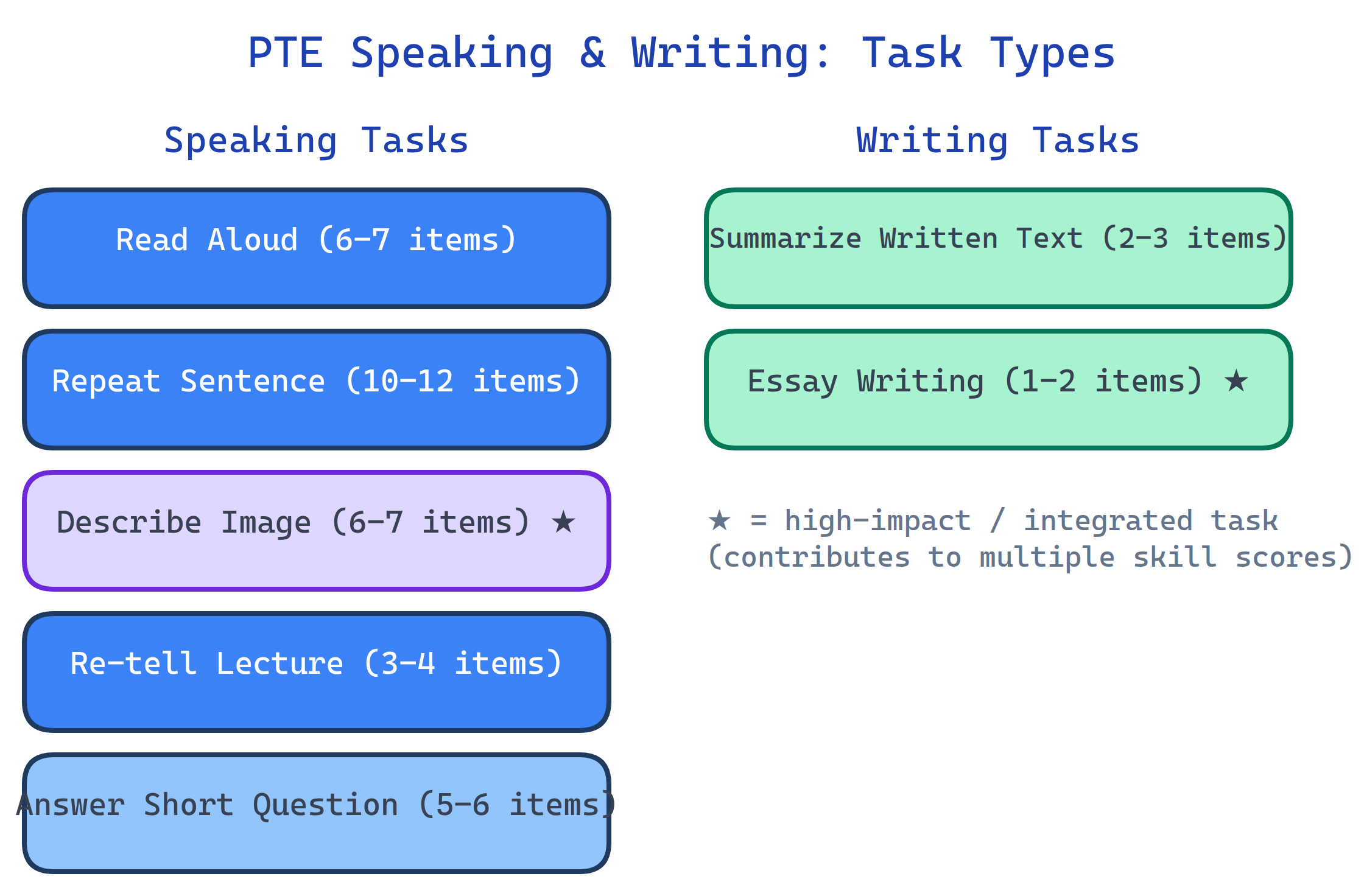
| Task | Items | Time per Item | Skills Scored |
|---|---|---|---|
| Personal Introduction | 1 | 30 sec prep + 30 sec response | Unscored (sent to institutions) |
| Read Aloud | 6–7 | 30–40 sec | Speaking + Reading |
| Repeat Sentence | 10–12 | Up to 15 sec | Speaking + Listening |
| Describe Image | 6–7 | 40 sec | Speaking |
| Re-tell Lecture | 3–4 | 40 sec | Speaking + Listening |
| Answer Short Question | 10–12 | 10 sec | Speaking + Listening |
| Summarize Written Text | 1–2 | 10 min each | Reading + Writing |
| Write Essay | 1–2 | 20 min each | Writing |
Explain Like I'm 12
Imagine you have a phone with a microphone. A computer reads you a sentence and you have to repeat it back exactly — that's Repeat Sentence. Then you see a picture of a graph and have to describe it in 40 seconds — that's Describe Image. Finally, you write a proper essay about a topic. The computer listens to how clearly you speak, checks your spelling, and sees how well you organised your ideas.
Task 1: Read Aloud
You see a text of 60–90 words and must read it aloud within the time limit. Scored on Pronunciation, Oral Fluency, and Content (which words you reproduced correctly). This task also contributes to your Reading score.
Common mistakes: Skipping words, mispronouncing and pausing to self-correct (hurts fluency), and speaking in a monotone. Practise reading academic texts aloud daily.
Task 2: Repeat Sentence
You hear a sentence (3–9 seconds long) and must repeat it exactly. No preparation time — you must respond immediately after the recording ends. This high-value task contributes to both Speaking and Listening.
Key insight: With 10–12 items, Repeat Sentence has the highest volume of any speaking task. Mastering it gives you the greatest score gain.
Task 3: Describe Image
You see an image (bar chart, line graph, pie chart, map, diagram, or table) and have 40 seconds to describe it. Scored on Pronunciation, Oral Fluency, and Content. Use a 4-part template every time:
Opening: "This image shows / illustrates / depicts [topic]."
Main trend: "The most notable feature is that [highest/lowest/trend]."
Supporting detail: "Additionally / Furthermore, [second observation]."
Closing: "Overall, [summary in one sentence]."
Task 4: Re-tell Lecture
You hear and/or see a lecture (60–90 seconds) then have 40 seconds to re-tell its key points. Scored on Pronunciation, Oral Fluency, and Content. Contributes to Listening score.
Template: "The lecture discusses [topic]. The speaker mentions that [main point 1]. Furthermore, [main point 2]. In conclusion, [key takeaway]."
Task 5: Answer Short Question
You hear a question and must answer in one or a few words (10 seconds). These are factual, common-knowledge questions (e.g., "What do you call a person who fixes teeth?"). Contributes to Listening.
Task 6: Summarize Written Text
You read a passage (~300 words) and write a one-sentence summary in 10 minutes. The sentence must be between 5 and 75 words. Contributes to Reading and Writing. Scored on Content, Form (one sentence), Grammar, Vocabulary.
Template: "[Main subject] [main verb], [supporting detail], and [conclusion/implication], demonstrating that [overall point]."
Example: "Urban migration, driven by economic opportunities and rural poverty, is transforming city infrastructure and social dynamics, highlighting the need for sustainable urban planning policies."
Task 7: Write Essay
You write a 200–300 word essay on a general topic in 20 minutes. Scored on Content, Form (word count), Grammar, Vocabulary, and Written Discourse (structure and coherence).
Essay types: Argumentative (agree/disagree), Discussion (both sides), Problem/Solution, Advantages/Disadvantages.
4-paragraph structure:
Para 1 (Introduction): Paraphrase the question + state your position.
Para 2 (Main argument): Your strongest point + example/evidence.
Para 3 (Counter-argument or second point): Acknowledge other view or add another argument.
Para 4 (Conclusion): Restate position + final thought.
| Scoring Criterion | What the AI Checks | Band 7+ Requires |
|---|---|---|
| Content | Is the task addressed? Is the position clear? | All parts addressed; clear position throughout |
| Form | Word count (200–300 words) | Stay within range; paragraphing present |
| Grammar | Sentence accuracy | Mostly error-free; complex structures used |
| Vocabulary | Range and precision | Academic words; no repetition |
| Written Discourse | Logical flow; connectors | Clear progression; appropriate linking |
Test Yourself
For the Describe Image task, what 4 parts should every response include?
1. Opening — state what the image shows.
2. Main trend — the most notable feature (highest, lowest, biggest change).
3. Supporting detail — a second observation.
4. Closing — a one-sentence overall summary.
Why is Repeat Sentence the most impactful speaking task to practise?
Two reasons: (1) It has the highest item count (10–12 items), so it contributes more data points to your score than any other single task. (2) It is an integrated task contributing to both Speaking AND Listening scores — so strong performance has a double effect on your overall result.
What is the biggest Form mistake to avoid in Summarize Written Text?
Writing more than one sentence. The task requires a single sentence of 5–75 words. Using a full stop to create a second sentence scores 0 on Form, which causes a catastrophic loss of marks. Use commas, semicolons, and relative clauses to pack all your ideas into one sentence.
Practice Questions
You hear: "The discovery of antibiotics revolutionised medical treatment in the twentieth century." Practise repeating this back. What strategy helps you retain longer sentences?
Use chunking: break the sentence into meaningful groups: [The discovery of antibiotics] / [revolutionised medical treatment] / [in the twentieth century]. Hear each chunk as a unit. If you miss a chunk, keep going with what you remember — partial credit is given.
For this bar chart showing that renewable energy grew from 15% in 2010 to 42% in 2023, practise a 40-second Describe Image response using the template.
"This bar chart illustrates the growth of renewable energy as a share of total energy production from 2010 to 2023. The most notable feature is that renewable energy nearly tripled, rising from 15% to 42% over this period. This upward trend was consistent year-on-year, with the steepest growth occurring between 2018 and 2023. Overall, the data suggests a significant shift towards cleaner energy sources over the past decade." (~70 words — ideal length)