PTE Reading
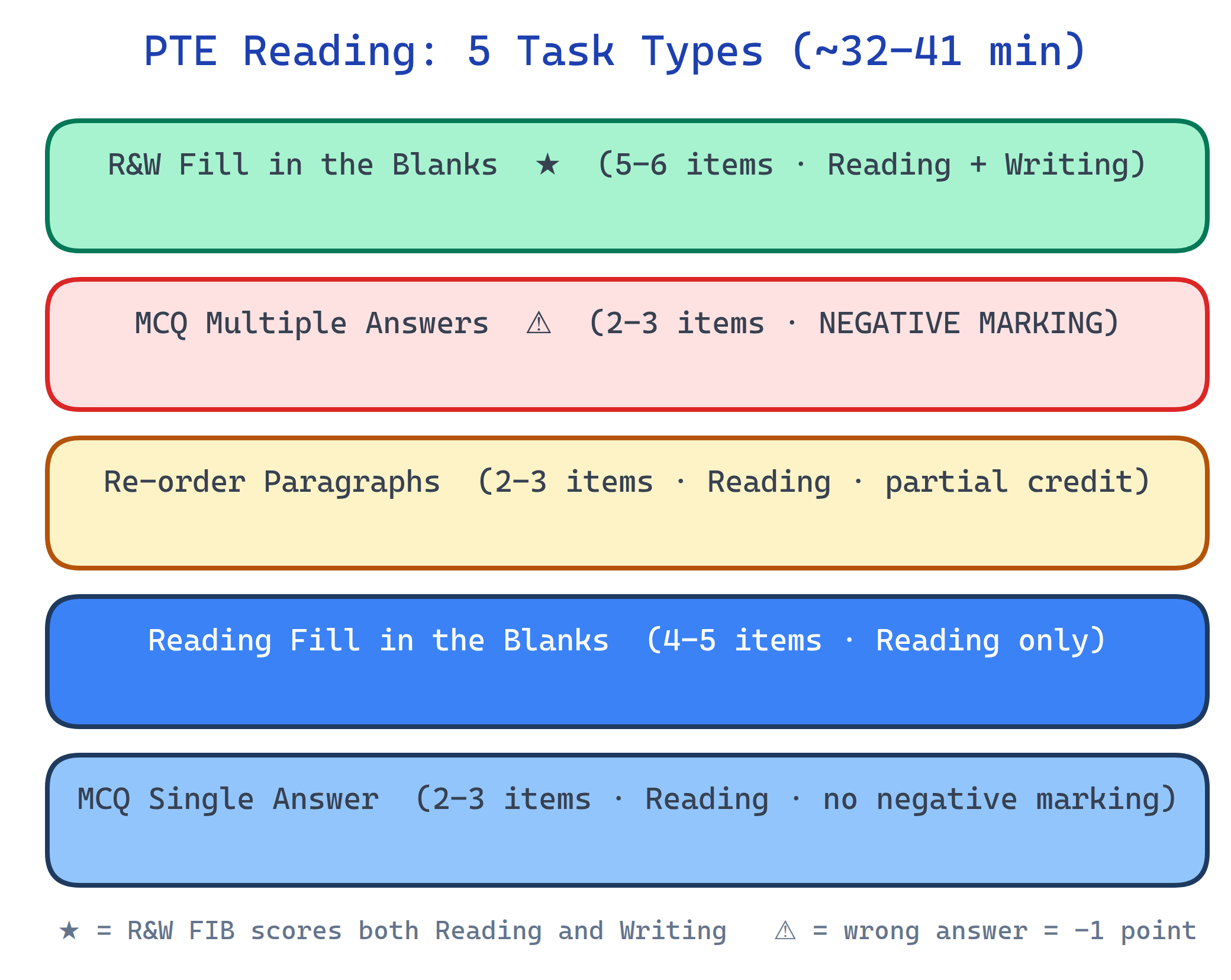
PTE Reading (~32–41 min) has 5 task types. The most important: Reading & Writing: Fill in the Blanks (contributes to Writing score too) and Re-order Paragraphs (requires logic, not vocabulary). MCQ Multiple Answers has negative marking — only select options you are confident about. Manage time: ~8 min per task type on average.
Section Overview
| Task Type | Items | Skills Scored | Partial Credit? |
|---|---|---|---|
| R&W: Fill in the Blanks | 5–6 | Reading + Writing | Yes (per blank) |
| MCQ Multiple Answers | 2–3 | Reading | Yes (but negative marking) |
| Re-order Paragraphs | 2–3 | Reading | Yes (per correct adjacent pair) |
| Reading: Fill in the Blanks | 4–5 | Reading | Yes (per blank) |
| MCQ Single Answer | 2–3 | Reading | No |
Explain Like I'm 12
In the Reading section, you're like a detective with a broken jigsaw puzzle. For Re-order Paragraphs, someone shuffled the paragraphs of a passage and you need to put them back in order. For Fill in the Blanks, there are gaps in the text and a word bank — you drag the right word to each gap. The whole section is like a reading comprehension test, but with no extra time, so you need to be fast!
Task 1: Reading & Writing — Fill in the Blanks
A text with multiple blanks. Each blank has a dropdown with 4–6 word options. Choose the best word for each blank. Contributes to both Reading AND Writing — making it a high-value task.
Common trap: Confusing similar-looking words (e.g., affect vs effect, principal vs principle). Always check meaning AND grammar fit.
Task 2: MCQ Multiple Answers
Read a passage and select ALL correct answers from a list (usually 5–7 options, 2–3 are correct). Negative marking applies — each wrong selection subtracts from correct ones.
Task 3: Re-order Paragraphs
A passage is broken into 4–6 text boxes and scrambled. Drag them into the correct order. Scored on the number of correct adjacent pairs — so even partially correct ordering earns marks.
Look for these clues:
| Clue Type | Example | What it signals |
|---|---|---|
| Topic sentence | "Renewable energy has transformed..." | First paragraph (introduces topic) |
| Pronoun reference | "It / They / This" | Must follow the noun being referred to |
| Discourse connector | "However / Furthermore / As a result" | Not the opening sentence |
| Conclusion signal | "In conclusion / Overall / Ultimately" | Last paragraph |
| Time/order signal | "First... Second... Finally..." | Sequential flow |
Task 4: Reading — Fill in the Blanks
Similar to R&W FIB but simpler: drag words from a word bank into blanks in the text. The word bank usually has more options than blanks. Scored only on Reading (not Writing).
Task 5: MCQ Single Answer
Read a passage and choose the ONE correct answer from 4–5 options. No negative marking. Scored on Reading only.
Common traps: Options that are true in general knowledge but not stated in the passage — always ground your answer in what the text says, not what you know.
Time Management
The Reading section has no individual time limits per task — you manage your own 32–41 minutes across all tasks.
| Task Type | Suggested Time | Priority |
|---|---|---|
| R&W Fill in the Blanks (5–6 items) | 8–10 min | High (contributes to Writing) |
| Re-order Paragraphs (2–3 items) | 6–8 min | High (full marks if logical) |
| Reading Fill in the Blanks (4–5 items) | 6–8 min | Medium |
| MCQ Multiple (2–3 items) | 5–6 min | Medium (careful with neg marking) |
| MCQ Single (2–3 items) | 4–5 min | Lower (no partial credit) |
Test Yourself
You're on MCQ Multiple Answers and you've identified 2 clearly correct options. There are 2 more options you're unsure about. What do you do?
Select only the 2 you are confident about. Because of negative marking, selecting an incorrect option subtracts from your correct ones. With 2 correct options already selected, you're at +2. Selecting a wrong guess drops you to +1. Do not gamble — stick with certainty.
In Re-order Paragraphs, how do you identify the opening paragraph?
The opening paragraph typically: (1) introduces the topic without referring back to anything, (2) contains no pronouns (it, they, this) that refer to content in another box, (3) has no discourse connectors like "However" or "Furthermore" at the start. It establishes the subject of the whole passage.
Why does R&W Fill in the Blanks deserve the most time in the Reading section?
Because it contributes to both Reading AND Writing scores (integrated task), making it the highest-value task in the Reading section. With 5–6 items and dual-skill scoring, maximising your score here has a greater multiplier effect than other reading tasks.
Practice Questions
Blank: "The study _______ that urban areas consume 70% of the world's energy." Options: (a) implies (b) concludes (c) reveals (d) insists. Which is correct and why?
(c) reveals. "Reveals" means to make known something previously unknown — appropriate for research findings. "Implies" means to suggest indirectly (the study isn't being indirect about a statistic). "Concludes" is possible but typically used for deductions. "Insists" means to demand/assert forcefully — wrong register for academic reporting. Check: part of speech (verb ✓), meaning fit ✓, collocation ✓.