PTE Listening
PTE Listening (~45–57 min) has 8 task types. The single highest-impact task is Write from Dictation — it contributes to both Listening and Writing scores and appears 3–4 times. Summarize Spoken Text is also Writing-integrated. Take notes for every audio clip. There is no rewind — each clip plays once.
Section Overview
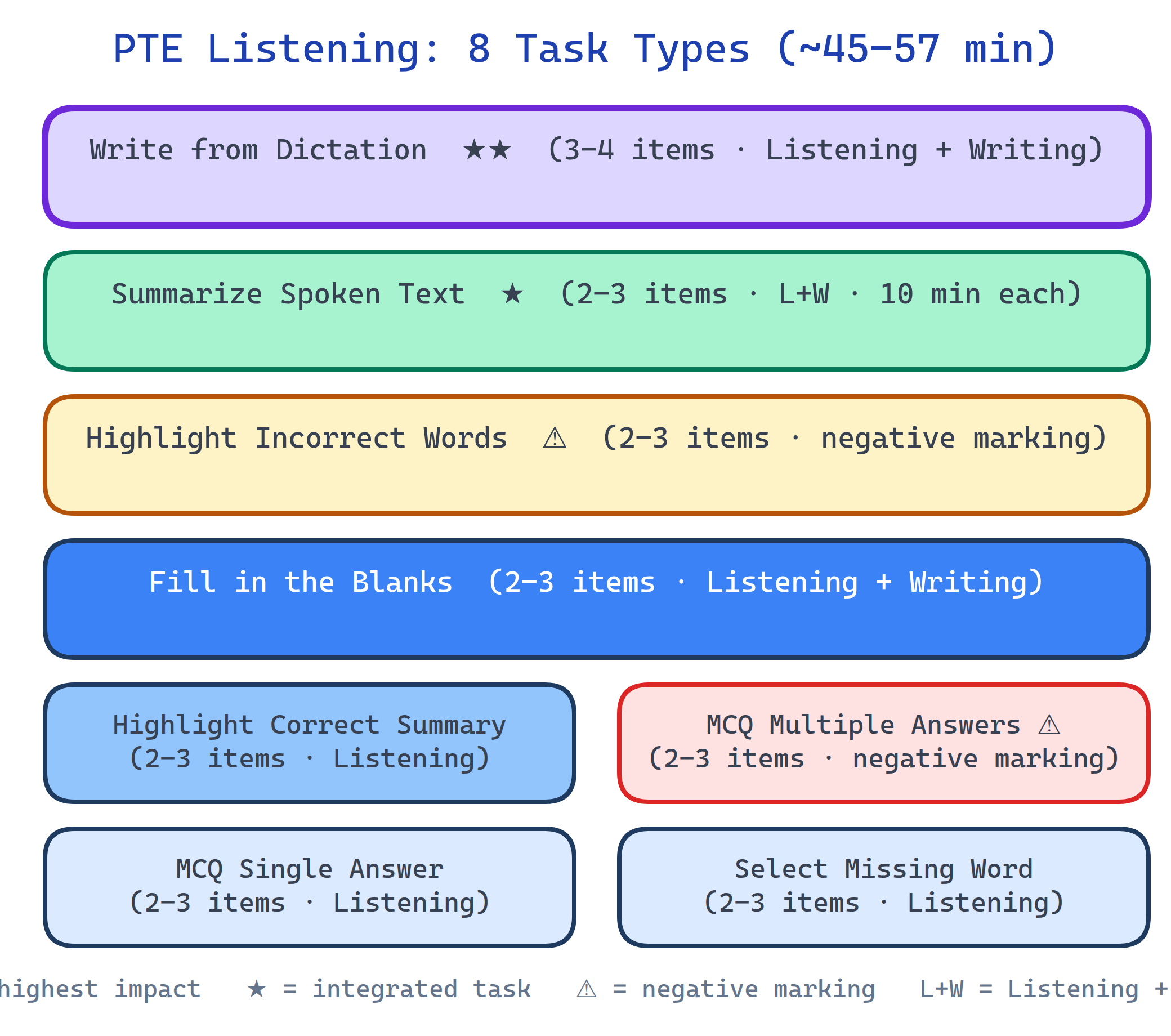
| Task Type | Items | Skills Scored | Partial Credit? |
|---|---|---|---|
| Summarize Spoken Text | 2–3 | Listening + Writing | Yes (content + form) |
| MCQ Multiple Answers | 2–3 | Listening | Yes (negative marking) |
| Fill in the Blanks | 2–3 | Listening + Writing | Yes (per blank) |
| Highlight Correct Summary | 2–3 | Listening + Reading | No |
| MCQ Single Answer | 2–3 | Listening | No |
| Select Missing Word | 2–3 | Listening | No |
| Highlight Incorrect Words | 2–3 | Listening + Reading | Yes (negative marking) |
| Write from Dictation | 3–4 | Listening + Writing | Yes (per word) |
Explain Like I'm 12
Imagine someone reads a book chapter out loud — only once — and you can't ask them to repeat it. Then you answer questions about it. That's PTE Listening. The hardest part is Write from Dictation, where you hear a sentence and type it exactly, letter by letter, every word correct. It's like a spelling test where the teacher speaks really fast. The good news: you get marks for every correct word, so partial credit adds up.
Summarize Spoken Text
Format: Listen to a lecture (60–90 seconds), then write a 50–70 word summary in 10 minutes.
Note-Taking Template
| What to Capture | Note Symbol | Example |
|---|---|---|
| Topic / Main Idea | Topic: | Topic: urban heat islands |
| Key Points (2–3) | → | → dark surfaces absorb heat → temp rises 3°C |
| Supporting Detail | () | (cities 30% more rainfall) |
| Conclusion | ∴ | ∴ green roofs reduce heat |
Response Template
The lecture discusses [topic]. The speaker explains that [key point 1] and [key point 2]. Furthermore, [key point 3]. In conclusion, [main takeaway].
Write from Dictation
Format: Hear a sentence (5–12 words). Type the sentence exactly as spoken. Usually 3–4 items.
Scoring
Each correct word scores 1 point. An incorrect, missing, or extra word deducts 1 point. Minimum score is 0 (no negative total).
Example: "The committee reviewed all the submitted proposals carefully."
If you write "The committee reviewed all submitted proposals carefully" — you miss "the" before "submitted" → score = 7/8
Strategies
- Use the whiteboard/notepad: The test provides a notepad. Write the sentence in shorthand as you hear it, then type it out.
- Listen for sentence rhythm: English sentences have a natural stress pattern — content words (nouns, verbs) are louder, function words (articles, prepositions) are softer. Don't miss soft words.
- Articles and prepositions: These are the most commonly missed words. Say the sentence back to yourself mentally to check grammar.
- Spelling counts: "recieve" instead of "receive" loses that word's point. Practice common academic spelling errors.
Listening: Fill in the Blanks
Format: See a transcript with blanks. Hear the audio. Type the missing words as you hear them.
Unlike Reading FIB (drag-and-drop), Listening FIB requires typing — so spelling must be exact. The audio plays once and covers a short academic lecture.
Strategy
- Pre-read the transcript during the preparation time — understand context and predict word types for each blank (noun? verb? adjective?).
- Listen ahead: Look at the next blank while typing the current answer.
- Word form matters: If the context is "the results were _____ significant", you need an adverb ("highly"), not an adjective.
Highlight Incorrect Words
Format: Read a transcript while listening. Click on every word in the transcript that differs from what was actually spoken.
Strategy
- Listen while reading — track word by word.
- The changed words are often synonyms or related words (e.g., spoken: "large", transcript: "small").
- Changes are always single words — not phrases or sentence structure changes.
- If unsure, skip — the penalty is equal to the reward.
Highlight Correct Summary
Format: Listen to a recording (60–90 sec), then choose which of 3–5 written paragraphs best summarises it.
Common traps: answers that are partially correct but miss the main point, or that use words from the audio but distort the meaning. The correct answer paraphrases without adding external information.
MCQ Multiple Answers
Format: Listen to a recording. Select multiple correct answers from 5–7 options.
Select Missing Word
Format: The end of the audio is replaced with a beep. Choose which word or phrase most logically completes the recording from 3–5 options.
Strategy: predict what type of word/idea would logically follow before hearing the options. Eliminate options that contradict the tone or topic of the recording.
MCQ Single Answer
Format: Listen to a recording, answer a question by selecting one correct answer from 3–4 options. No negative marking. Always answer — if unsure, eliminate and guess.
Universal Note-Taking System
Since audio plays only once, good notes are essential for Summarize Spoken Text, MCQ, and Highlight Correct Summary tasks.
| Symbol | Meaning | Example |
|---|---|---|
| → | leads to / causes | pollution → health problems |
| ↑ / ↓ | increase / decrease | temp ↑ 2°C |
| = | is / equals / means | GDP = economic output |
| ≠ | is not / differs from | organic ≠ pesticide-free |
| ∴ | therefore / conclusion | ∴ policy change needed |
| eg | for example | eg solar, wind energy |
| w/ | with | study w/ group |
| + | also / and / benefit | + reduces costs |
Test Yourself
Q: Which PTE Listening task contributes to both Listening AND Writing scores and appears 3–4 times?
Write from Dictation. It is the highest-impact task in PTE Listening. It tests your ability to hear, retain, and accurately reproduce a sentence — contributing points to both your Listening and Writing enabling skill scores.
Q: In Summarize Spoken Text, what happens if you write only 45 words?
You receive zero marks for Form (2 points lost). The minimum word requirement is 50 words. The task demands 50–70 words. Going under the minimum is one of the most preventable scoring mistakes.
Q: In Highlight Incorrect Words, you are unsure whether a word differs from the audio. Should you click it?
No. Negative marking applies: a wrong click costs −1, same as a correct click earns +1. When unsure, skip the word. Only click words you are confident were changed in the transcript.
Q: Why are articles (a, an, the) the most commonly missed words in Write from Dictation?
Articles are unstressed function words — they are spoken quietly and quickly. Test takers focused on content words (nouns, verbs) often mishear or forget articles. Practice by reading your typed sentence aloud to yourself and checking grammar: does a noun need an article? Is it countable?
Q: You have 60 seconds before Summarize Spoken Text audio begins. What should you do?
Use the preparation time to read any visible text prompt and prepare your notepad shorthand symbols. Set up a note-taking template (Topic / Key Points / Conclusion) before the audio starts so you can capture information systematically rather than reacting to each sentence.
Practice Questions
Q: The audio for a Summarize Spoken Text task discusses the "circular economy." You write: "The circular economy is a system where products are reused and recycled to reduce waste and environmental impact, contrasting with the traditional linear economy." Count the words — is this acceptable?
That sentence is 28 words — too short (minimum is 50 words). You need to add more specific points from the lecture: What are 2–3 specific mechanisms? What are the benefits mentioned? What did the speaker conclude? Aim for 2–3 sentences covering the main idea and key supporting points.
Q: In Write from Dictation, you hear: "Researchers have identified several critical factors affecting biodiversity." You type: "Researchers have identified several critical factors effecting biodiversity." What is your score?
7/8. You spelled "effecting" instead of "affecting." "Affect" (verb) means to influence; "effect" (noun) means a result. This is a classic homophone confusion. Score = 7 correct words × 1 point. Practice commonly confused word pairs: affect/effect, principal/principle, complement/compliment.
Q: In Highlight Incorrect Words, the audio says "The researchers found a significant correlation" but the transcript shows "The researchers found a strong correlation." Is "strong" an incorrect word? Should you click it?
Yes, click it. The transcript word "strong" differs from the audio word "significant." These are synonyms but the transcript must match the audio exactly. Any word in the transcript that differs from what was spoken — even a synonym — is an "incorrect word."