PTE Vocabulary
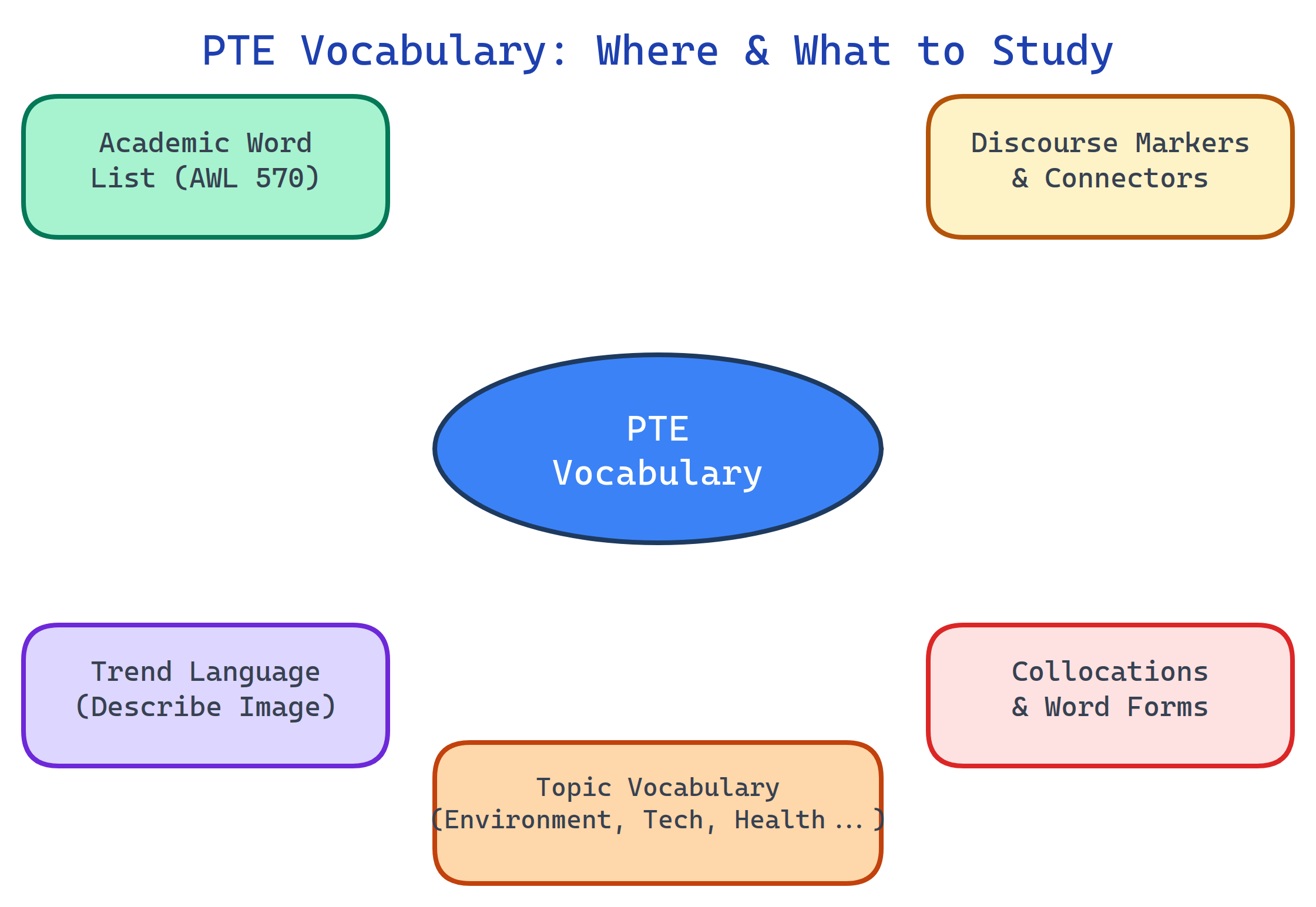
PTE vocabulary is about precision and form, not just meaning. Focus on: Academic Word List (AWL) for Fill in the Blanks, discourse markers for essays and Summarize Spoken Text, trend language for Describe Image, and word families (noun/verb/adjective/adverb forms) to avoid grammatical errors that cost points.
Where Vocabulary Is Tested
| Task | Vocabulary Demand | Key Vocabulary Type |
|---|---|---|
| Describe Image | High | Trend language, data vocabulary |
| Summarize Written Text | High | Paraphrase synonyms, academic nouns |
| Essay Writing | High | Discourse markers, academic collocations |
| R&W Fill in the Blanks | High | Collocations, word forms (AWL) |
| Reading FIB | High | Part-of-speech awareness |
| Summarize Spoken Text | Medium | Synonyms for paraphrasing |
| Write from Dictation | Medium | Spelling of academic words |
| MCQ tasks | Low-Medium | Understanding nuance and register |
Explain Like I'm 12
Vocabulary in PTE isn't about knowing rare words — it's about knowing how words work together. Saying "the data increased largely" sounds wrong because "largely" doesn't collocate with "increased." You say "increased significantly" or "rose sharply." Also, word form matters: "Analyse" is a verb; "analysis" is a noun; "analytical" is an adjective. Using the wrong form loses marks even if you know the concept. Think of vocabulary like Lego — knowing the pieces isn't enough; you need to know how they fit.
Academic Word List (AWL) Essentials
The AWL contains 570 word families that account for ~10% of academic text. Mastering these gives you the highest return in Fill in the Blanks tasks.
High-Frequency AWL Word Families
| Root Word | Noun | Verb | Adjective | Adverb |
|---|---|---|---|---|
| analyse | analysis | analyse | analytical | analytically |
| assess | assessment | assess | assessable | — |
| constitute | constitution | constitute | constitutional | constitutionally |
| establish | establishment | establish | established | — |
| significant | significance | signify | significant | significantly |
| vary | variation | vary | variable / varied | variably |
| indicate | indication | indicate | indicative | — |
| assume | assumption | assume | assumed | — |
| derive | derivation | derive | derived | — |
| generate | generation | generate | generative | — |
Discourse Markers
Discourse markers signal the logical relationship between ideas. They are essential for essay writing and Summarize Spoken/Written Text tasks. Using them correctly boosts your Coherence score.
| Function | Markers |
|---|---|
| Adding information | Furthermore, Moreover, In addition, Additionally, Also, Besides |
| Contrasting | However, Nevertheless, Nonetheless, On the other hand, In contrast, Yet, Although |
| Cause and Effect | Therefore, Thus, Consequently, As a result, Hence, Due to, Owing to |
| Exemplifying | For instance, For example, Such as, Specifically, In particular |
| Sequencing | Firstly, Subsequently, Meanwhile, Eventually, Finally, Prior to |
| Conceding | Admittedly, Granted, While it is true that, Despite, Even though |
| Summarising | In conclusion, To summarise, Overall, In sum, On balance |
Describe Image Vocabulary
For charts, graphs, diagrams, and tables — you need precise language for trends, comparisons, and proportions.
Trend Language
| Trend | Verbs | Nouns | Adverbs / Adjectives |
|---|---|---|---|
| Increase | rose, climbed, grew, surged, jumped | rise, growth, increase, surge | sharply, significantly, steadily, gradually, dramatically |
| Decrease | fell, dropped, declined, plummeted, dipped | fall, decline, drop, decrease | sharply, significantly, slightly, marginally |
| Stay flat | remained stable, levelled off, plateaued | plateau, stability | relatively constant, unchanged |
| Fluctuate | fluctuated, varied | fluctuation, variation | considerably, unpredictably |
| Peak | peaked, reached a peak/high of | peak, high, maximum | — |
| Trough | bottomed out, hit a low of | trough, low, minimum | — |
Comparison Language
X was higher than Y. / X was twice as high as Y.
X and Y were roughly equal. / There was little difference between X and Y.
X accounted for the largest share at 45%. / Y represented the smallest proportion.
Process / Diagram Language
The diagram illustrates the process of... / The first stage involves... / This leads to... / The final step is...
Key Collocations
Collocations are word pairs that naturally go together. Using the right collocation signals fluency and raises your Oral Fluency and Vocabulary scores.
| Wrong Collocation | Correct Collocation |
|---|---|
| make a research | conduct research / carry out research |
| do a mistake | make a mistake |
| strong difference | significant difference / marked difference |
| high temperature | high temperature ✓ (but "strong cold" ✗ → severe cold) |
| solve a problem | solve a problem ✓ / address a problem / tackle a problem |
| increase largely | increase significantly / rise sharply |
| important role | play a crucial / key / significant role |
| take care of the environment | protect the environment / preserve the environment |
Topic Vocabulary
PTE essays and lectures commonly cover these themes. Build vocabulary sets for each.
Environment
climate change, carbon footprint, greenhouse gases, fossil fuels, renewable energy, deforestation, biodiversity, ecosystem, sustainability, emissions, global warming, ozone depletion, conservation, desertification, carbon neutrality
Education
curriculum, pedagogy, vocational training, academic achievement, standardised testing, critical thinking, lifelong learning, distance learning, blended learning, grade inflation, scholarships, literacy rate, tuition fees, higher education, digital literacy
Health
public health, preventive medicine, chronic disease, obesity epidemic, mental health, universal healthcare, pharmaceutical industry, immunisation, sedentary lifestyle, healthcare expenditure, sanitation, infant mortality, life expectancy
Technology
artificial intelligence, automation, digital divide, cybersecurity, data privacy, algorithm, machine learning, innovation, disruption, surveillance, social media, screen time, e-commerce, cloud computing, remote work
Society & Economics
urbanisation, inequality, poverty alleviation, social mobility, immigration, multiculturalism, globalisation, GDP, unemployment rate, inflation, consumer behaviour, demographic shift, ageing population, welfare state, austerity
Commonly Confused Words
| Pair | Distinction |
|---|---|
| affect / effect | Affect = verb (to influence). Effect = noun (the result). "Pollution affects health; its effects are severe." |
| principal / principle | Principal = main / school head. Principle = rule or belief. |
| compliment / complement | Compliment = praise. Complement = goes well with. |
| stationary / stationery | Stationary = not moving. Stationery = writing materials. |
| fewer / less | Fewer = countable nouns. Less = uncountable nouns. "Fewer people, less pollution." |
| imply / infer | The speaker implies; the listener infers. |
| economic / economical | Economic = relating to the economy. Economical = cost-effective, efficient. |
Test Yourself
Q: Fill in the blank: "The study __________ a strong correlation between exercise and mental well-being." (establish/established/establishment/establishing)
established. Past tense verb needed — the study is a completed action. "Establishment" is a noun and doesn't fit the verb slot. "Establishing" would need an auxiliary verb ("is establishing").
Q: Which discourse marker best fits this sentence? "Many people support renewable energy. __________, the high upfront cost remains a barrier."
However — signalling a contrast between support (positive) and cost barrier (negative). "Furthermore" would add another positive point, "Therefore" would suggest causation. "Nevertheless" also works but is more formal and slightly less natural here.
Q: You are describing a bar chart. Sales rose from £20m in 2020 to £35m in 2023. Write one sentence using precise trend vocabulary.
"Sales increased significantly from £20 million in 2020 to £35 million in 2023, representing a 75% rise." — Uses: "increased significantly" (correct collocation), specific figures, and a calculation to add insight. Avoid: "went up a lot," "grew largely," "became higher."
Q: What is the difference between "economic" and "economical"? Use each in a sentence.
Economic: "The government introduced new economic policies to reduce unemployment." (relating to the economy)
Economical: "The new engine design is more economical — it uses 30% less fuel." (cost-effective / efficient)
Confusing these two is a common PTE Writing error.
Q: Name 3 collocations with the word "research."
conduct research, carry out research, publish research, groundbreaking research, peer-reviewed research, research findings, research methodology. Never: "make a research" or "do a research" — these are incorrect collocations in academic English.
Practice Questions
Q: In a Reading & Writing Fill in the Blanks task, the sentence reads: "The report provided a comprehensive __________ of the current economic situation." Options: analyse, analysis, analytical, analysing. Which is correct?
analysis. The blank follows the article "a" — an article signals a noun is needed. "Analysis" is the noun form of "analyse." "Analytical" is an adjective and doesn't fit after "a comprehensive." Rule: article → noun; "a/an/the" before blank = you need a noun.
Q: Write a one-sentence summary of a lecture about urbanisation using at least two discourse markers and one AWL word.
"The lecture examines the rapid growth of cities worldwide; consequently, urban infrastructure faces increasing strain, and furthermore, rural-to-urban migration continues to constitute a significant policy challenge." — AWL words: "constitute," "significant." Discourse markers: "consequently," "furthermore."
Q: A PTE candidate writes: "The data shows that pollution levels increased largely over the decade." Identify the vocabulary error and correct it.
The error is "increased largely" — this is a collocation mistake. "Largely" modifies adjectives/verbs of extent (e.g., "largely responsible") but not trends. The correct collocations are: "increased significantly," "increased substantially," "rose sharply," or "climbed steadily."