PTE Study Plan
Always start with a diagnostic mock test to find your weakest tasks. Then follow the plan that fits your timeline. PTE rewards task-specific practice more than general English study — drill Write from Dictation, Describe Image, and Essay writing daily. Official Pearson mock tests are the gold standard for score prediction.
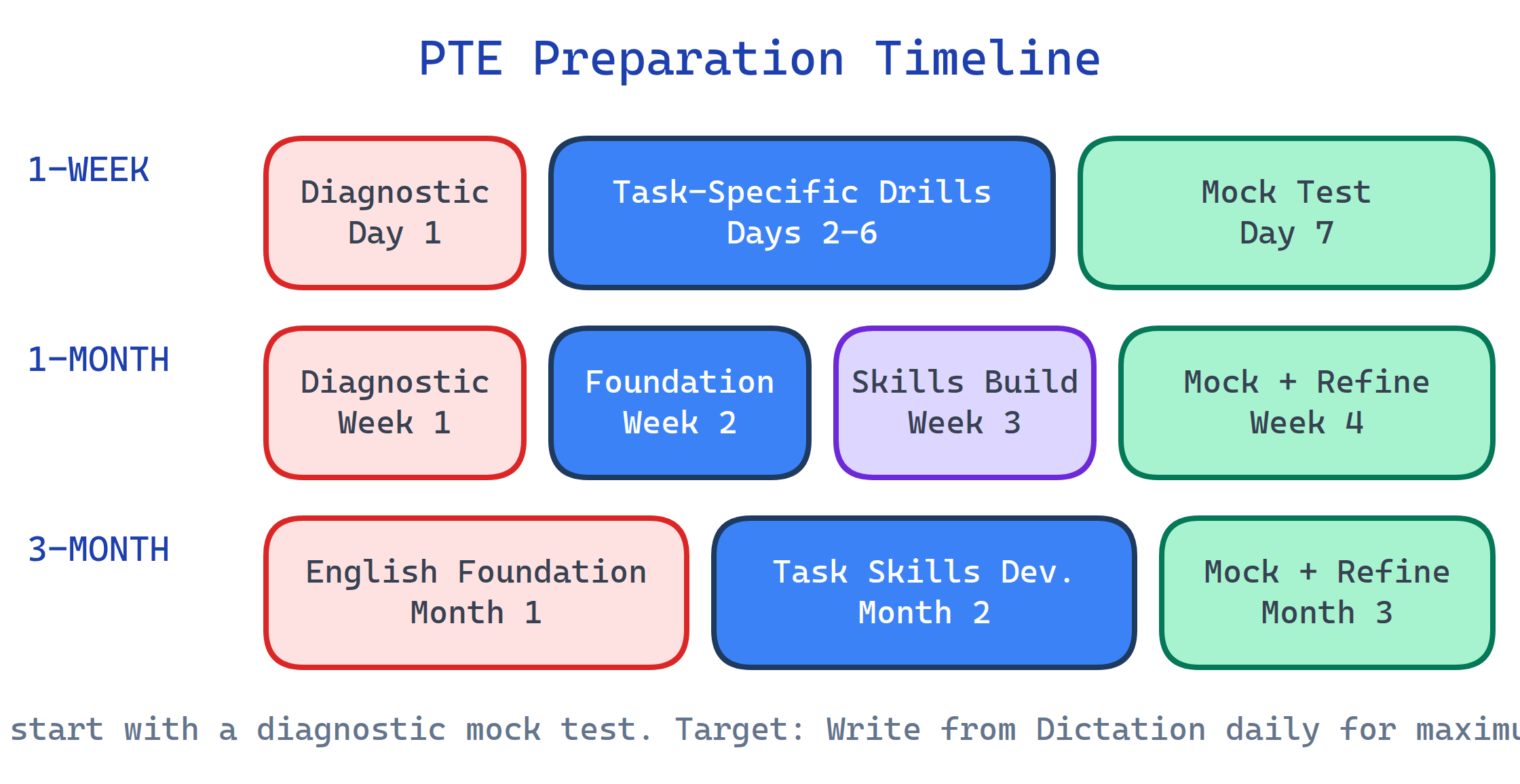
Preparation Timeline
Explain Like I'm 12
Think of PTE prep like training for a sport. You wouldn't train by doing random exercises every day — you'd find your weakest skill (dribbling? shooting? stamina?) and work on that specifically. PTE is the same. First, play a practice game (mock test) to see where you lose points. Then do targeted drills. Each week, play another game to check your progress. The last few days, rest and do light review. Don't try to cram everything the night before — your brain needs sleep to consolidate language skills.
Step 0: Diagnostic Assessment
Before following any plan, establish your baseline with a full-length mock test.
| What to Note | Where to Find It |
|---|---|
| Current overall score (10–90) | Scorecard summary |
| Communicative skills breakdown (Speaking, Writing, Reading, Listening) | Scorecard communicative skills |
| Enabling skills breakdown (10 sub-scores) | Scorecard enabling skills |
| Tasks you ran out of time on | Your test notes / experience |
| Tasks you found confusing | Your test notes |
1-Week Emergency Plan
Target: Improve 5–10 points. Best for: retakers who already know the test format.
| Day | Focus | Daily Tasks (2–3 hrs) |
|---|---|---|
| Day 1 | Diagnostic + Overview | Full mock test, review scorecard, note weak areas |
| Day 2 | Speaking | Read Aloud ×10, Describe Image ×5, Re-tell Lecture ×3 |
| Day 3 | Writing | Summarize Written Text ×3, Essay ×1 (timed), review template |
| Day 4 | Reading | Re-order Paragraphs ×5, R&W FIB ×5, Reading FIB ×5 |
| Day 5 | Listening | Write from Dictation ×15, Summarize Spoken Text ×3, Fill in Blanks ×5 |
| Day 6 | Weak Tasks | 3 hours on your 2 lowest-scoring task types from Day 1 |
| Day 7 | Mock + Light Review | Timed mock test, review errors, rest, no new concepts |
1-Month Plan
Target: Improve 10–20 points. Best for: first-time takers with some English proficiency.
| Week | Phase | Focus Areas |
|---|---|---|
| Week 1 | Diagnostic & Foundation |
Mock test Day 1 → score analysis Learn all task types and scoring rules Study templates: Summarize Written Text, Essay, Describe Image Begin daily Read Aloud (10 min/day) and Write from Dictation (15 min/day) |
| Week 2 | Speaking & Writing Skills |
Describe Image ×5/day (bar, pie, line, process, map) Essay writing ×1 every 2 days with template Re-tell Lecture ×3/day Vocabulary: discourse markers + AWL word families |
| Week 3 | Reading & Listening Skills |
Re-order Paragraphs daily (logical connectors focus) R&W Fill in the Blanks ×5/day Write from Dictation ×20/day (highest priority) Summarize Spoken Text ×2/day Mock test mid-week, review, adjust focus |
| Week 4 | Full Practice & Refinement |
Full timed mock test Days 22 and 26 Error analysis after each mock Drill weakest 2 task types every day Day 28–30: light review only, no new material, rest |
3-Month Plan
Target: Improve 20–35 points. Best for: test takers starting from intermediate English (B1/B2 level).
| Month | Phase | Primary Activities |
|---|---|---|
| Month 1 | English Foundations + PTE Awareness |
Build core English: daily reading (news, academic articles), listening (podcasts, lectures) Grammar: complex sentences, conditionals, passive voice Vocabulary: AWL 570 word families — 10 words/day Introduction to all PTE task types — understand scoring Diagnostic mock test at end of Month 1 |
| Month 2 | Task-Specific Skills Development |
Speaking: Read Aloud and Describe Image daily (record yourself, review) Writing: Essay writing 3×/week with peer review or AI feedback Reading: FIB and Re-order Paragraphs — logic and grammar focus Listening: Write from Dictation ×20/day, Summarize Spoken Text ×2/day Mock test at end of Month 2 — compare with Month 1 baseline |
| Month 3 | Test-Condition Practice & Refinement |
Weeks 1–2: Full timed mocks every 5 days Drill persistent weak tasks daily Week 3: Focus on time management (pacing per task type) Week 4: Taper — 1 mock, light vocabulary review, rest Final 3 days: No new practice, sleep well, review templates only |
Sample Daily Schedule (1–1.5 hrs)
| Time | Activity | Why |
|---|---|---|
| 10 min | Read Aloud ×5 passages | Maintains fluency + pronunciation daily |
| 15 min | Write from Dictation ×10 | Highest ROI task — Listening + Writing |
| 15 min | Describe Image ×3 | Speaking score — use the 4-part template |
| 15 min | Weak task drill | Target your personal lowest-scoring task |
| 10 min | AWL vocabulary | 10 new words + review previous 10 |
| 15 min | Extensive listening/reading | Background English input (podcast / article) |
Mock Test Schedule
Mock tests should be taken under real conditions: timed, uninterrupted, with headphones. Review your score breakdown — not just your total score.
| Plan | Mock Tests | Timing |
|---|---|---|
| 1-week plan | 2 mocks | Day 1 (diagnostic), Day 7 (final) |
| 1-month plan | 3–4 mocks | Day 1, Day 14, Day 22, Day 26 |
| 3-month plan | 6–8 mocks | End of each month + weekly in final month |
Recommended Resources
| Resource | Best For | Cost |
|---|---|---|
| Pearson PTE Official Practice | Scored mock tests that mimic real AI scoring | Paid (per test) |
| E2Language | Structured video lessons by task type, templates, feedback | Free + Paid |
| PTE Magic | High-volume task practice, Write from Dictation library | Paid |
| Swoosh English | YouTube tutorials, free strategy videos | Free |
| PTE Study Guide (Pearson) | Official test format reference | Free PDF |
| Academic Word List | Vocabulary building for Fill in the Blanks | Free online |
Score Improvement Strategies
Highest-Impact Actions
- Master Write from Dictation — Practice 15–20 sentences daily. This single task type can move your Listening and Writing scores significantly.
- Perfect the Describe Image template — Use the 4-part structure consistently. The AI rewards structured, fluent delivery over impressive vocabulary.
- Never skip answers — Unlike IELTS, PTE has no "skip" — the next question loads automatically. Plan your time allocation per task type in advance.
- Enabling skills over communicative skills — Target the enabling skills with the widest gap from your goal. Oral Fluency and Pronunciation contribute to Speaking; Spelling and Grammar contribute to both Writing and Listening.
Common Plateau-Breaking Tips
- If your Speaking score stalls: Record yourself, listen back critically. Most issues are pacing (too fast/too slow) or hesitation fillers ("um", "uh").
- If your Writing score stalls: Get essay feedback using the official Pearson criteria. Vocabulary range and coherence markers are often the culprit.
- If your Listening score stalls: Increase dictation practice. Also practice Highlight Incorrect Words — this is a heavily weighted listening task many students underestimate.
Test Yourself
Q: Why should you take a mock test before starting your study plan, rather than after your first week of preparation?
A pre-study diagnostic gives you an unbiased baseline. Without it, you might spend equal time on all areas — including strengths you don't need to improve. The diagnostic reveals exactly which enabling skills are below your target, letting you allocate study time where it will have the most impact.
Q: You have 3 weeks until your PTE test and your target score is 65 (for Australian PR). You scored 52 overall on your diagnostic, with Listening at 45. What should your week 2 focus be?
Focus heavily on Write from Dictation (the highest-weighted Listening task) and Summarize Spoken Text (also contributes to Writing). Aim for 20 WfD sentences per day. Run mock tests at the end of each week and track only the Listening sub-score. Also check enabling skills: is Spelling dragging down Write from Dictation? Is Oral Fluency low from SST?
Q: You are 3 days from your PTE test. Your overall score in your last mock was 68 (target: 65). What should you do?
Taper and consolidate. Do not attempt to learn new strategies or grind new content. Light review of templates (Describe Image 4-part, Essay structure), 5–10 Write from Dictation sentences for muscle memory, and ensure good sleep (language processing depends heavily on sleep quality). Over-cramming in the final 3 days can cause anxiety and over-thinking during the actual test.