What is QA Automation?
QA Automation uses scripts and tools to test software automatically — catching bugs faster, enabling CI/CD, and freeing humans for exploratory testing. Instead of clicking through the app manually every release, you write tests once and run them thousands of times.
Flaky tests are a reliability crisis hiding in plain sight. A test suite with a 2% flake rate might seem fine, but with 500 tests running in parallel on every PR, you expect 10 failures per CI run that have nothing to do with the code change. Teams start ignoring red CI checks, which defeats the purpose entirely. The most common cause is async timing: sleep(2) instead of waiting for a specific condition. Playwright and Cypress both have explicit auto-wait mechanisms that eliminate this class of flakiness. The Google Testing Blog post on flaky tests quantifies the impact on developer productivity.
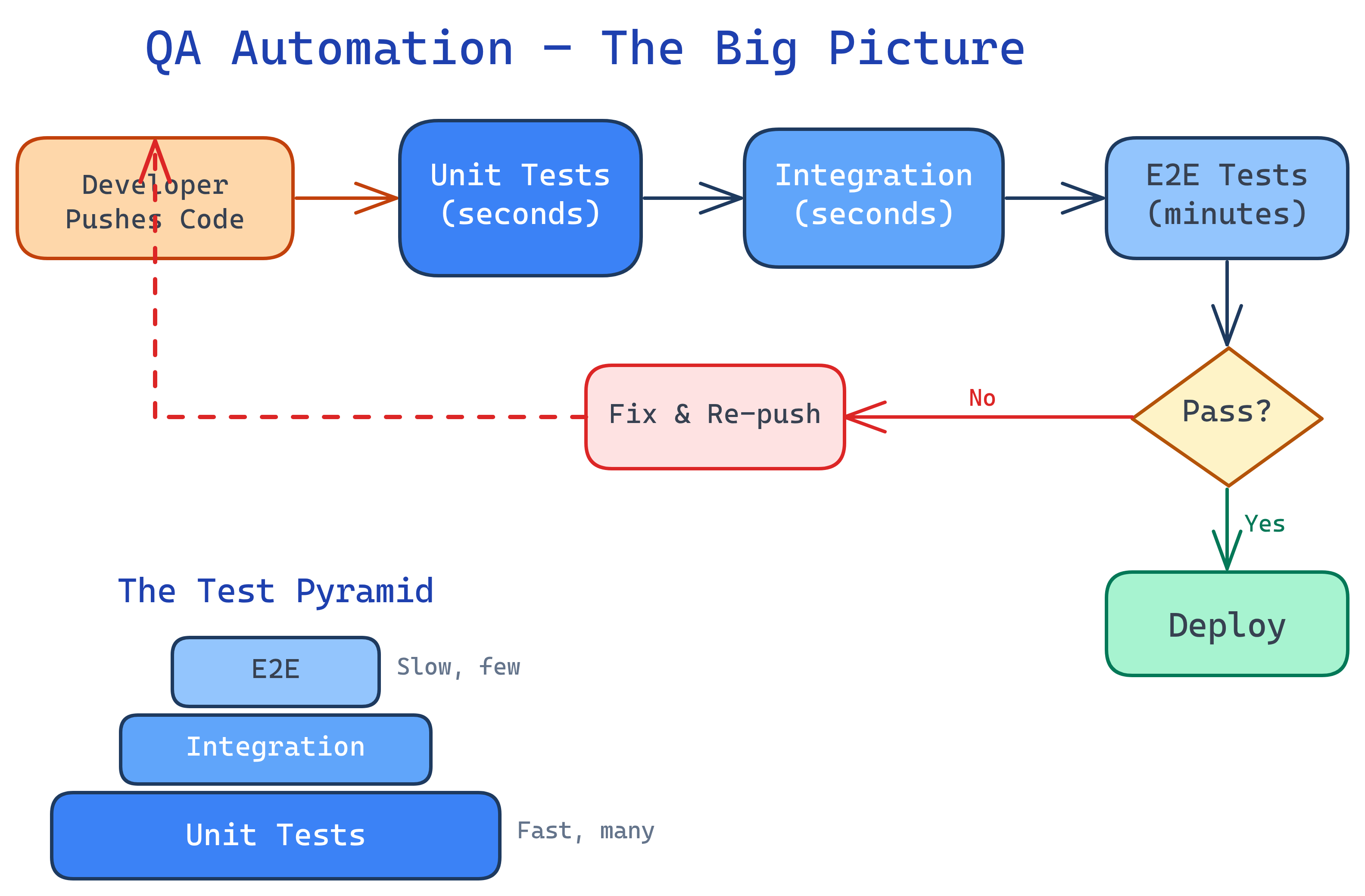
The test pyramid — many unit tests, fewer integration tests, fewest E2E tests — exists because faster tests give faster feedback, not because E2E tests are bad. An E2E test that takes 4 minutes to run will not be run locally by developers; a unit test that takes 40 ms will. Design your test suite so developers actually run it before pushing. The Martin Fowler article on the practical test pyramid is the foundational reference for this thinking.
Invest heavily in QA automation if you deploy frequently (daily or more) or if regressions are expensive (financial, healthcare, or safety-critical domains). The ROI calculation is: cost of a manual regression test cycle vs. cost of writing and maintaining automated equivalents. For most teams deploying weekly or more, automation wins after 3–5 test cycles.
The Big Picture
Every time your team ships code, something could break. Manual testing is slow, error-prone, and doesn't scale. QA Automation solves this by turning repetitive test cases into scripts that run on every commit — giving you fast, reliable feedback before code reaches users.
Explain Like I'm 12
Imagine you build a LEGO castle every day. Before showing it to your friends, you check: Does the drawbridge open? Do the walls hold? Does the flag stay up?
Doing those checks by hand every single day is boring and you might forget one. QA Automation is like building a little robot that checks all those things for you automatically. You teach the robot once what "correct" looks like, and it checks everything in seconds every time you rebuild.
If something breaks, the robot tells you immediately — before your friends see a wobbly castle.
What is QA Automation?
Quality Assurance (QA) Automation is the practice of using software tools to execute tests, compare actual results with expected results, and report pass/fail — all without human intervention. It covers everything from unit tests that check a single function to end-to-end tests that simulate a real user clicking through your app.
The goal isn't to replace manual testing entirely. It's to automate the repetitive, predictable tests so humans can focus on creative, exploratory testing — the kind where you try weird edge cases and think "what if a user does THIS?"
Why It Matters
| Without Automation | With Automation |
|---|---|
| Manual testers click through the app before every release | Tests run automatically on every commit in CI/CD |
| Release cycles take days or weeks | Ship multiple times per day with confidence |
| Bugs found late in production | Bugs caught in minutes after code is written |
| Regression testing is expensive and often skipped | Full regression suite runs in minutes, every time |
| Team scales linearly — more features = more testers | Tests scale with the codebase, not the team size |
Who Is It For?
- QA Engineers & SDETs — Build and maintain test suites, design automation frameworks
- Software Developers — Write unit and integration tests as part of development
- DevOps Engineers — Integrate test pipelines into CI/CD workflows
- Tech Leads & Managers — Understand test strategy and quality metrics
- Career Switchers — QA Automation is one of the most accessible entry points into tech
Key Capabilities
- Test Pyramid — Balance unit, integration, and E2E tests for speed and coverage
- Framework Selection — Choose from Selenium, Cypress, Playwright, pytest, JUnit, and more
- CI/CD Integration — Run tests automatically on every push via GitHub Actions, Jenkins, etc.
- Page Object Model — Organize UI test code for maintainability
- Test Data Management — Generate, seed, and isolate test data reliably
- Parallel Execution — Run tests concurrently to cut pipeline time
- Reporting & Metrics — Track pass rates, flaky tests, and coverage trends
What You'll Learn
Test Yourself
What is the main goal of QA Automation?
Why can't you just automate ALL testing and eliminate manual testing entirely?
How does QA Automation enable CI/CD?
What's the difference between a QA Engineer and an SDET?

