What is Data Science?
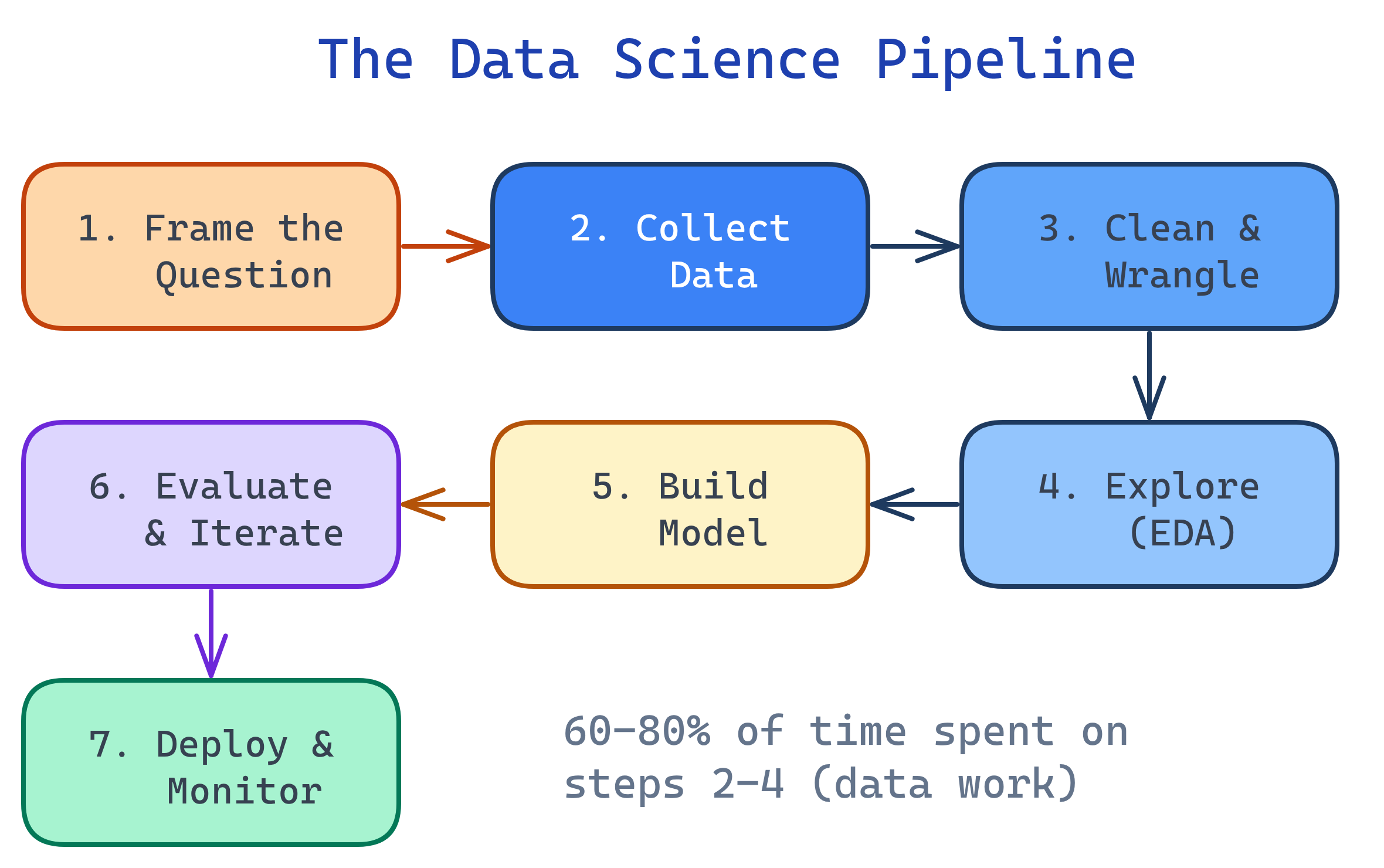
Data Science combines statistics, programming, and domain knowledge to extract actionable insights from data. The workflow goes: collect data → clean it → explore patterns → build models → deploy predictions. Python (with pandas, scikit-learn, and Jupyter) is the most common toolkit.
Data leakage is the most common way to build a model that looks accurate in training but fails in production. It happens when information from the future (or from the test set) sneaks into the training features. A classic example: imputing a missing feature value using the mean of the entire dataset, including test rows, before the train/test split. The model then "knows" something about the test distribution that it should not. The scikit-learn common pitfalls documentation covers this and other preprocessing errors in detail.
Scikit-learn Pipelines solve the leakage problem elegantly. By wrapping preprocessing steps and the model into a Pipeline object, you guarantee that fitting steps (like StandardScaler or imputers) are fit only on training data and transform test data using training statistics — even inside cross-validation folds. Teams that do not use Pipelines almost always have subtle leakage somewhere. The Pipeline and FeatureUnion documentation explains the pattern.
Data science skills are worth investing in deeply if you work with real-world datasets where the data is messy and the business question is ambiguous. If your work involves well-structured data and a clearly defined output, data engineering skills may be a higher-leverage investment than model building.
The Big Picture
Data Science is the practice of turning raw, messy data into decisions. It sits at the intersection of three skills: math/statistics (understanding probability, distributions, hypothesis testing), programming (writing code to automate analysis), and domain expertise (knowing what questions to ask in your industry). A data scientist follows a repeatable pipeline — from framing a question all the way to deploying a model in production.
Explain Like I'm 12
Imagine you're a detective, but instead of clues at a crime scene, your clues are numbers and data. Data Science is like being a detective for data. You collect evidence (data), clean it up (remove mistakes), look for patterns (who did it?), and then predict what will happen next (the model). Companies use it to recommend movies on Netflix, detect spam in your email, or predict which patients might get sick. The tools are basically Python (your magnifying glass) and math (your brain).
What Exactly is Data Science?
Data Science is an interdisciplinary field that uses scientific methods, algorithms, and systems to extract knowledge from structured and unstructured data. Unlike traditional analytics (which mostly looks backward at what happened), data science also builds predictive models that look forward.
| Aspect | Traditional Analytics | Data Science |
|---|---|---|
| Focus | What happened? (descriptive) | What will happen? (predictive) |
| Tools | Excel, SQL, BI dashboards | Python, R, Jupyter, scikit-learn |
| Skills | Reporting, visualization | Statistics, ML, programming |
| Output | Charts and reports | Models, APIs, automated decisions |
Who is Data Science For?
Analysts who want to go beyond dashboards and start building predictive models. Developers who want to add ML capabilities to their applications. Business professionals who need to understand what their data team is doing. Students exploring a career in one of the most in-demand fields in tech.
What Can Data Science Do?
- Predict outcomes — Will this customer churn? Will this loan default?
- Classify things — Is this email spam? Is this tumor malignant?
- Find patterns — Which customers behave similarly? What products sell together?
- Recommend items — Netflix movie suggestions, Spotify playlists, Amazon products
- Detect anomalies — Fraud detection, system failures, quality defects
- Automate decisions — Dynamic pricing, A/B testing, content personalization
What You'll Learn
Test Yourself
What are the three pillars of data science?
How does data science differ from traditional analytics?
Name 3 real-world applications of data science.
What is the typical data science workflow?

