What is AWS?
Amazon Web Services (AWS) is the world's largest cloud platform, offering 200+ services for computing, storage, databases, networking, machine learning, and more. Instead of buying physical servers, you rent capacity on-demand and pay only for what you use.
The most expensive AWS mistake we see repeatedly is treating IAM permissions as an afterthought. On a data platform migration, an early dev account had AdministratorAccess attached to every Lambda role "to get things working." When that code pattern was copied to staging and then to production, a misconfigured function could write to any S3 bucket in the account. The AWS Well-Architected Framework dedicates an entire pillar to Security for this reason: least-privilege IAM is not optional.
S3 pricing also surprises people who are new to AWS. Storage costs are low, but egress — transferring data out of AWS — is expensive. Architects who build reporting dashboards that pull raw data directly from S3 to a user's browser can generate hundreds of dollars in monthly egress fees from a relatively small dataset. The solution is to aggregate at query time using Athena or to serve from CloudFront. The S3 documentation on data transfer has the full pricing model.
Use the Well-Architected Tool directly in the AWS console when you are evaluating an architecture. It walks through all five pillars (Operational Excellence, Security, Reliability, Performance Efficiency, Cost Optimization) and produces a remediation backlog. This is the same checklist AWS Solution Architects use in customer reviews.
The Big Picture
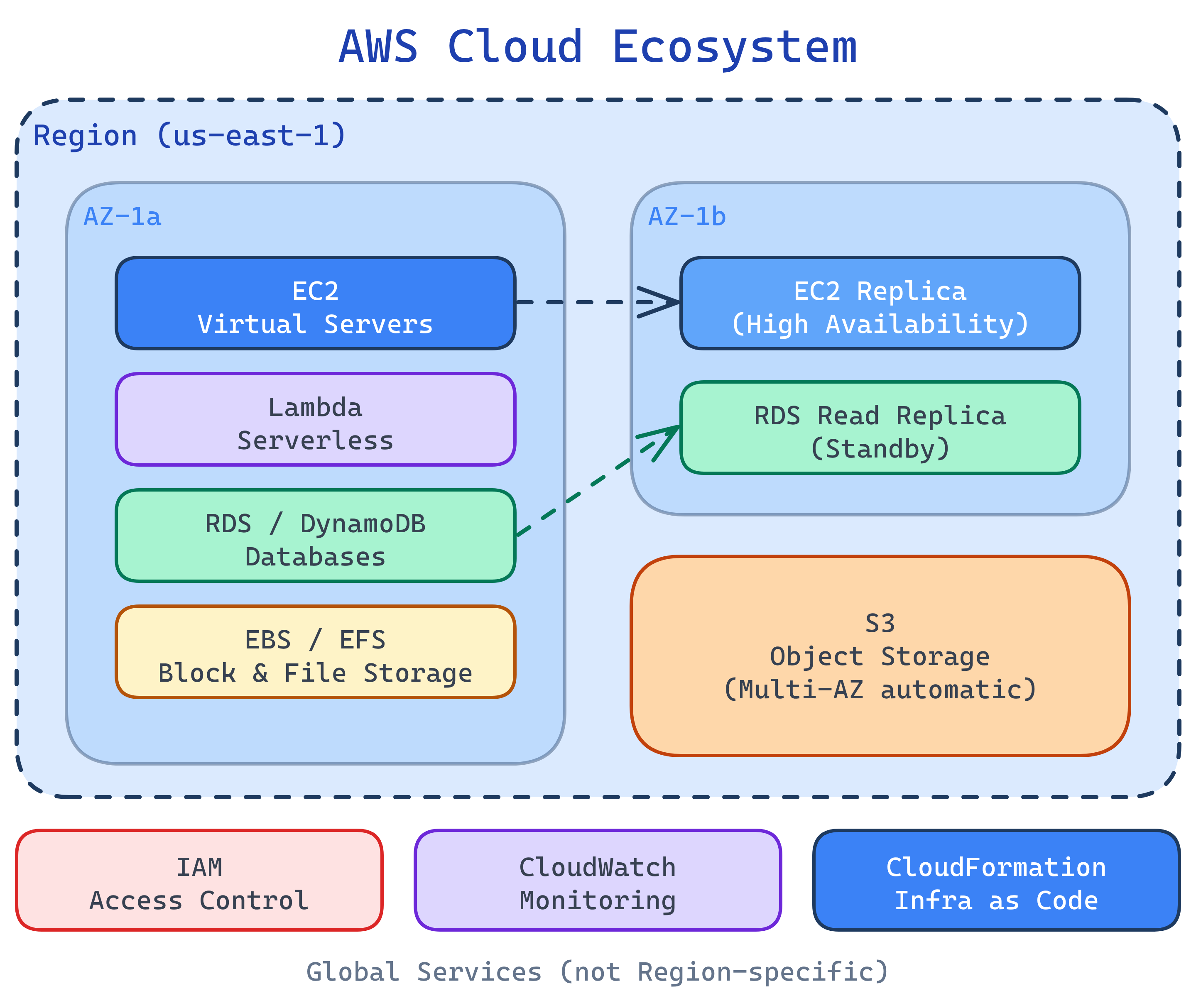
AWS provides the building blocks to run virtually anything in the cloud — from a simple static website to a globally distributed real-time application serving millions of users. Think of it as a massive toolkit: you pick the services you need, connect them together, and only pay while they're running.
Explain Like I'm 12
Imagine you want to open a lemonade stand, but instead of buying a table, cups, and a sign, you could rent them by the hour from a huge warehouse that has every supply imaginable. Need a bigger table on hot days? Just swap it out — no need to buy a new one. That's AWS. Amazon built massive data centers around the world, and you can rent their computers, storage, and tools for your app instead of buying your own hardware. When you're done, you stop paying.
Why AWS?
AWS launched in 2006 and holds roughly 31% of the global cloud market — more than Azure and GCP combined. It's used by Netflix, Airbnb, NASA, and millions of startups. Three reasons it dominates:
- Breadth — 200+ services covering compute, storage, AI/ML, IoT, databases, analytics, security, and more
- Global reach — 30+ geographic regions with 100+ Availability Zones, so you can deploy close to your users
- Pay-as-you-go — No upfront cost. Run a server for 5 minutes? Pay for 5 minutes. Scale to thousands and back in seconds
Who Is It For?
- Developers — Deploy apps without managing physical infrastructure
- Data engineers — Build scalable data pipelines with S3, Glue, Redshift, and EMR
- DevOps teams — Automate infrastructure with CloudFormation, CodePipeline, and ECS
- Startups — Launch fast with free tier, scale without re-architecting
- Enterprise — Migrate on-prem workloads, meet compliance requirements, reduce CapEx
What You'll Learn
Test Yourself
What is the difference between a Region and an Availability Zone in AWS?
Why would you choose AWS over running your own servers?
Name 3 core AWS services and what category each belongs to.
What does "pay-as-you-go" mean in the context of AWS?
Related Topics

