What are AI Agents?
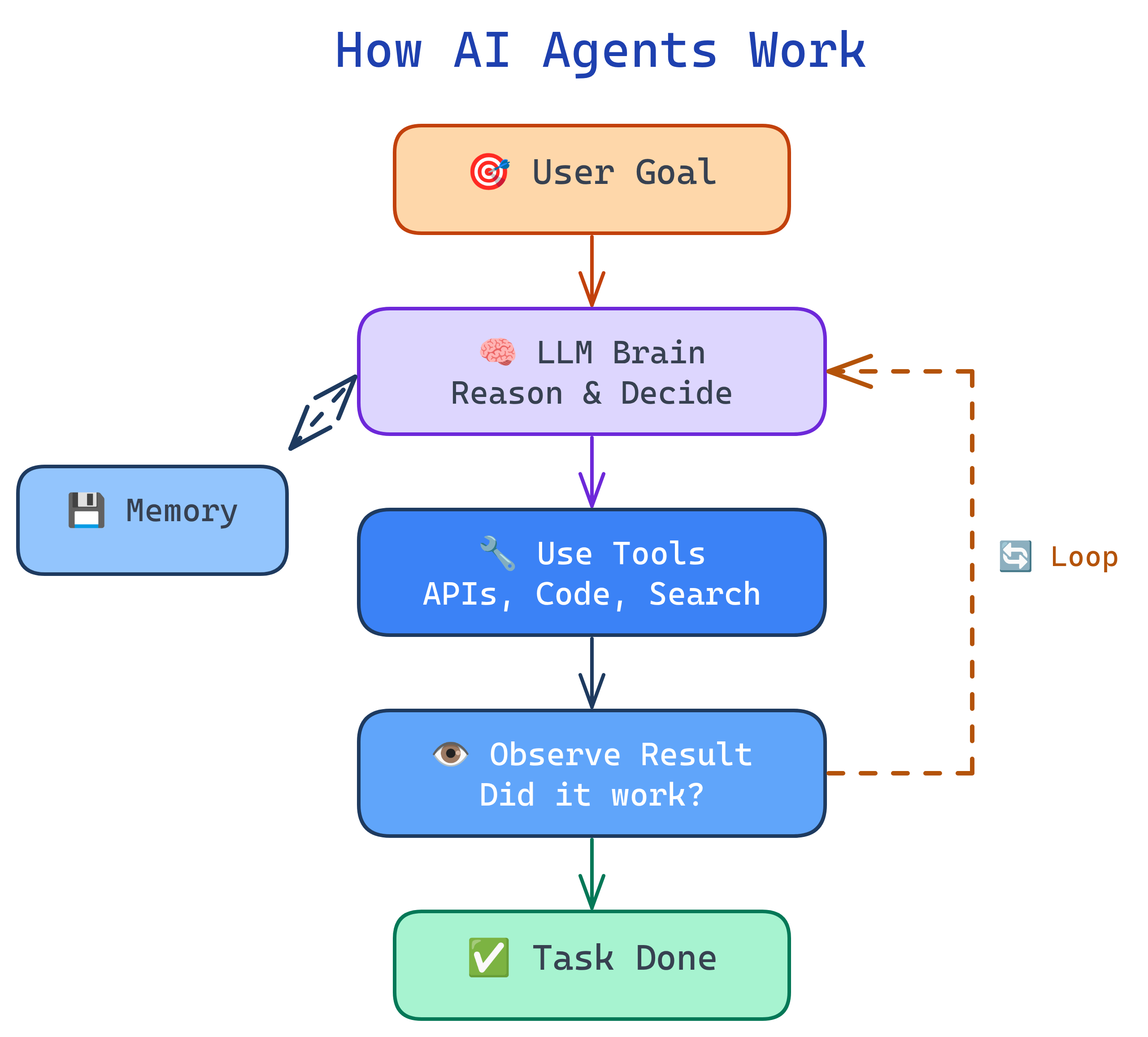
AI agents are autonomous systems that use LLMs to reason, plan, and take actions with tools — going beyond simple chatbots to accomplish complex, multi-step tasks. They observe their environment, decide what to do, execute actions, and learn from the results in a continuous loop.
The Big Picture
A chatbot answers questions. An AI agent does things. Think of the difference between asking someone for directions versus hiring a driver who navigates, avoids traffic, refuels, and gets you to your destination. AI agents combine the reasoning power of large language models with the ability to take real-world actions — browsing the web, writing code, querying databases, sending emails, and more.
Explain Like I'm 12
Imagine you have a super-smart robot assistant. A regular chatbot is like a robot that can only talk — you ask it a question, it gives you an answer, and that's it. An AI agent is like a robot that can talk AND do stuff. You can say "book me a flight to New York next Friday" and it will actually search for flights, compare prices, pick the best one, and book it for you. It thinks about what steps it needs to take, uses different tools (like a search engine, a calendar, a booking website), and keeps going until the job is done. If something goes wrong — like the flight is sold out — it figures out a backup plan on its own.
Why AI Agents Matter
Traditional software follows rigid rules: if this, then that. AI agents break this mold by making decisions dynamically based on context. Here's why they're transforming software engineering:
| Traditional Automation | AI Agents |
|---|---|
| Fixed scripts with predefined paths | Dynamic reasoning about novel situations |
| Breaks when inputs change | Adapts to unexpected scenarios |
| One task at a time | Orchestrates multiple tools and steps |
| Requires explicit programming | Learns from natural language instructions |
| No error recovery | Self-corrects and retries with different approaches |
Agent vs Chatbot vs Copilot
These terms get mixed up constantly. Here's the real difference:
| Type | Autonomy | Example |
|---|---|---|
| Chatbot | Zero — responds to prompts, no actions | ChatGPT answering "what is recursion?" |
| Copilot | Low — suggests actions, human decides | GitHub Copilot suggesting code completions |
| Agent | High — plans and executes autonomously | Claude Code refactoring an entire module |
Real-World AI Agents
AI agents aren't theoretical — they're shipping in production today:
- Claude Code — reads your codebase, edits files, runs tests, and commits changes directly in your terminal
- Devin — an autonomous software engineer that plans, writes code, debugs, and deploys
- AutoGPT / BabyAGI — early open-source agents that chain LLM calls with tool use
- Cursor Agent Mode — an IDE agent that understands your project and makes multi-file edits
- Customer support agents — handle refunds, look up orders, escalate to humans when needed
- Data analysis agents — connect to databases, write SQL, generate charts, and explain findings
What You'll Learn
Test Yourself
What's the key difference between a chatbot and an AI agent?
Name the core loop that most AI agents follow.
Why can't you just use a single LLM prompt instead of an agent?
Give two real-world examples of AI agents in production today.

